Note
QST, Jun 1982, inside back cover.
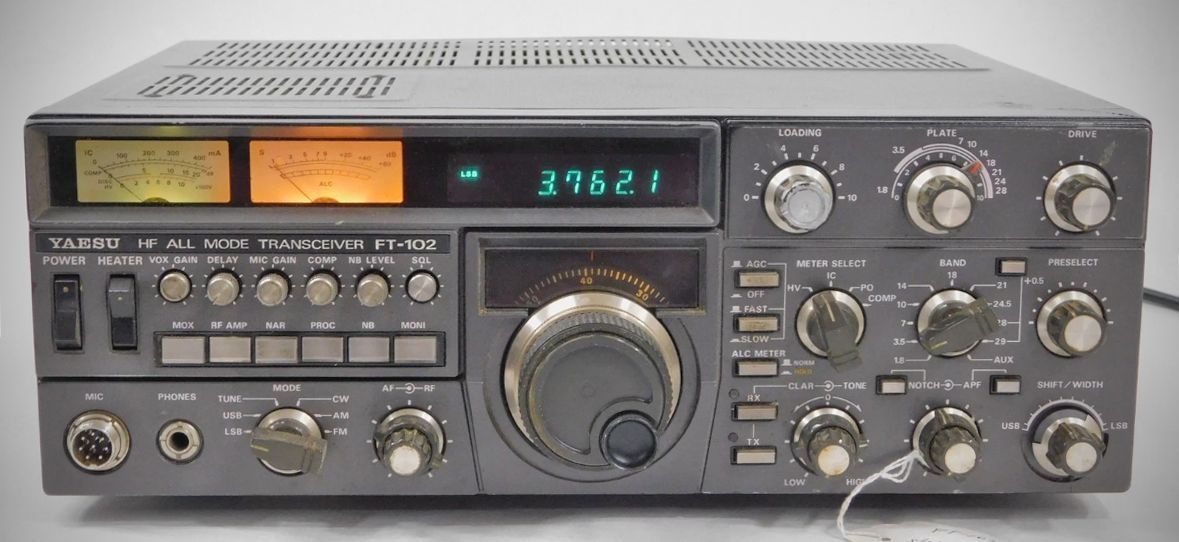
The FT-102 is an HF all-mode transceiver. It utilizes a unique 24 VDC receiver front end and an advanced final amplifier design. The transceiver provides all-band coverage for CW, SSB, and SSTV, with AM and FM capabilities available via an optional unit.
Introduced in 1982, the Yaesu FT-102 was developed as a high-performance successor to the popular FT-101ZD and FT-901/902DM series transceivers. At the time of its release, it served as a milestone in Yaesu's HF lineup alongside the company's flagship model, the FT-ONE.
In the European market, the exact same transceiver was sold under the name "Sommerkamp".
Key Features
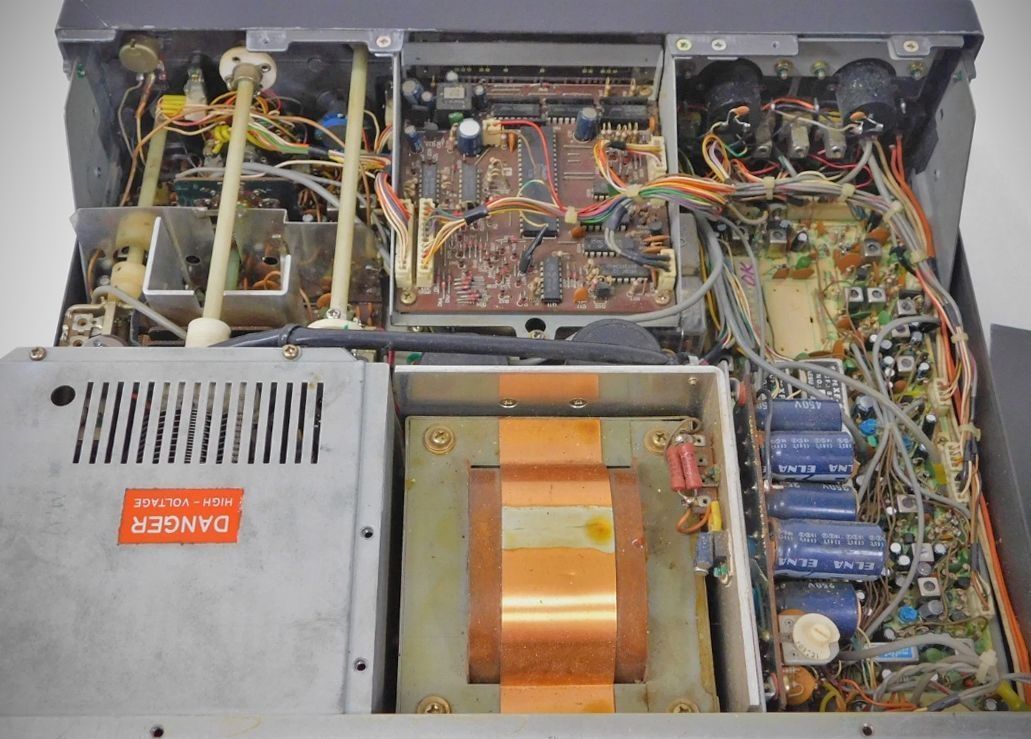
– High-Purity Transmitter: Features a final amplifier with three 6146B tubes and RF feedback, achieving nearly ten times better third-order IMD suppression than typical two-tube or solid-state designs.
– Advanced Receiver Front End: Employs four JFETs in the RF amplifier and mixer for a wide dynamic range, with the ability to switch the RF amplifier out of the circuit for extremely strong signal environments.
– Advanced Frequency Control: Uses PLL frequency synthesis with six VCOs for clean local and BFO signals, alongside a stable and simple VFO design.
– Customizable IF Passband: Features an IF shift/width system controlled by a single friction-coupled knob, allowing the operator to tailor the passband for optimal reception.
– Interference Rejection: Includes an adjustable-width noise blanker, an independent IF notch filter, and an audio peak filter (APF).
– Precise Monitoring: Equipped with dual front-panel meters, an ALC peak-hold system, and a transmitter IF monitor (product detector) for accurate signal adjustment.
– Operational Flexibility: Includes a clarifier (RIT/XIT) for shifting receive or transmit frequencies by ±2.5 kHz and a "+0.5" button for extended range on the 10-meter band.
Specifications
General
– Frequency Coverage: Covers all amateur bands from 1.8 MHz to 29.9 MHz (1.8, 3.5, 7, 10, 14, 18, 21, 24.5, and 28-29.9 MHz).
– Operating Modes: LSB, USB (A3J/J3E), CW (A1/A1A), and (with optional unit) AM (A3/A3E) and FM (F3/F3E).
– Frequency Stability: Less than 300 Hz drift during the first 30 minutes (after warm-up); less than 100 Hz every 30 minutes thereafter.
Transmitter
– Power Input: 240W DC for SSB/CW; 80W DC for AM; 120W DC for SSTV/FM.
– Third-Order IMD: Better than -40 dB (at 14 MHz, 100W PEP).
– Spurious Radiation: Better than -40 dB.
– Carrier Suppression: Better than -40 dB at 14 MHz.
Receiver
– Sensitivity: 0.25 µV for SSB (RF Amp ON) for 10 dB (S+N)/N.
– Selectivity (-6 dB/-60 dB): 2.7/4.8 kHz standard; adjustable down to 500 Hz width.
– Image Rejection: Better than 70 dB (1.8-21.5 MHz) or 50 dB (24.5-29.9 MHz).
– Dynamic Range: 90 dB minimum (standard) up to 102 dB (with optional narrow filters and RF Amp OFF).
– AF Output: 1.5W minimum into 8 ohms.
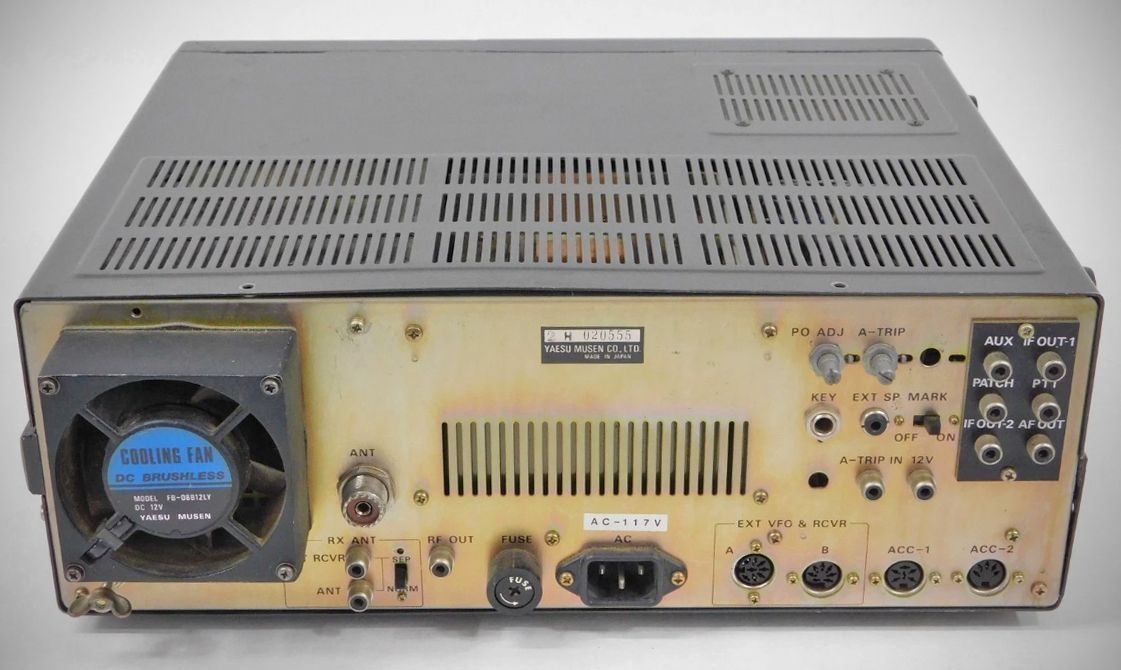
Power Requirements: 100, 117, 200, or 234 VAC, 50/60 Hz.