Note
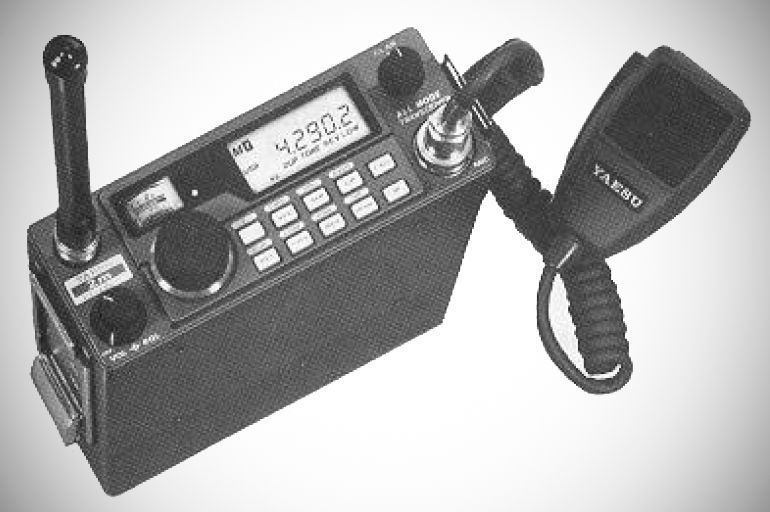
Introduced in 1986—several years after the original early-1980s "Mark I"—the Yaesu FT-290RII (Mark II) was a comprehensive redesign of the popular 2-meter multi-mode portable transceiver. While it retained the core "lunchbox" concept (covering 144–148 MHz in SSB, CW, and FM with 2.5W internal battery output), it modernized the radio's mechanics, tuning resolution, and accessory ecosystem.
1. Tuning Steps & Resolution
– Original FT-290R: Offered fixed steps of 100 Hz and 1 kHz for SSB/CW, and 5/10 kHz for FM.
– FT-290RII: Expanded and refined the synthesizer steps. SSB/CW gained finer 25 Hz and 2.5 kHz steps alongside the standard 100 Hz, and FM steps became more configurable (5, 10, or 20 kHz depending on the regional model), making it much easier to zero-in on weak signals or navigate band allocations.
2. High-Power Amplifier Ecosystem
– Original FT-290R: Typically paired with the optional FL-2010 linear amplifier, which boosted output power to around 10 watts.
– FT-290RII: Designed to dock seamlessly with the more potent FL-2025 clip-on linear amplifier, which cleanly ramped the output up to 25 watts for mobile or base station use.
3. Microphone & Connector Upgrades
– Original FT-290R: Utilized a 7-pin microphone connector layout with fixed audio/PTT lines.
– FT-290RII: Switched to a modern 8-pin metal locking microphone connector (compatible with Yaesu’s updated mic lineup like the MH-10 and MH-15 series), allowing more advanced remote scanning and function controls directly from the handheld mic.
4. CTCSS and Repeater Access
– Original FT-290R: CTCSS not available.
– FT-290RII: Designed with an internal subpanel to accommodate the optional plug-in FTS-7 CTCSS tone encoder/decoder unit, making repeater access vastly cleaner to configure.
### 5. Internal Layout and Styling
– FT-290RII: It updated the internal microprocessor and PLL architecture for improved frequency stability and replaced the front-mounted whip with a top-mounted BNC connection for flexible rubber duck antennas or external lines.
⚠️ Portable operation requires the optional FBA-8 battery pack.
Specifications
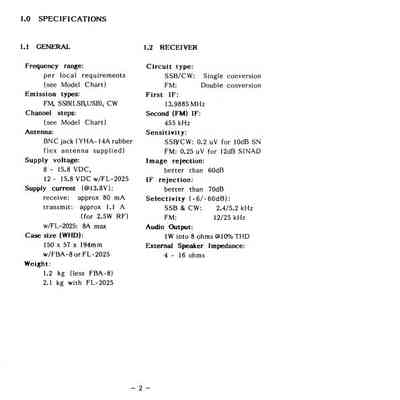
– Frequency Range: See Model Chart.
– Emission Types: FM, SSB (LSB, USB), CW.
– Channel Steps: See Model Chart.
– Antenna: BNC jack (YHA-14A rubber flex antenna supplied).
– Circuit Type: SSB/CW: Single conversion; FM: Double conversion.
– First IF: 13.9885 MHz.
– Second (FM) IF: 455 kHz.
– Sensitivity: SSB/CW: 0.2 µV for 10 dB S/N; FM: 0.25 µV for 12 dB SINAD.
– Image Rejection: Better than 60 dB.
– IF Rejection: Better than 70 dB.
– Selectivity (-6/-60 dB): SSB & CW: 2.4/5.2 kHz; FM: 12/25 kHz.
– Audio Output: 1W into 8 ohms @ 10% THD.
– External Speaker Impedance: 4 – 16 ohms (with FBA-8 or FL-2025).
– Input Power: 6W @ 13.8V (2.5W output).
– Modulation Type: SSB: Balanced, filtered; FM: Variable reactance.
– Deviation (FM): ± 5{ kHz.
– Carrier Suppression: Better than 40 dB.
– Unwanted Sideband Suppression: Better than 40 dB.
– Spurious Response: -60 dB.
– Microphone: 400 ohms, dynamic.
– Frequency Stability: First 30 min.: 300 Hz; After 30 min.: 50 Hz.
Power requirements: 8 – 15.8 VDC; 12 – 15.8 VDC with FL-2025.
– Current (@13.8V): Receive: approx. 80 mA; Transmit: approx. 1.1 A (for 2.5W RF); With FL-2025: 8A max.
---
### 1.3 FT-290R II Model Chart
– Ver. A1: Frequency range: 144–148 MHz | FM Steps: 5/10/20 kHz | Burst Tone: n/a.
– Ver. B: Frequency range: 144–146 MHz | FM Steps: 12.5/25/50 kHz | Burst Tone: 1750 Hz.
– Ver. C1: Frequency range: 144–148 MHz | FM Steps: 12.5/25/50 kHz | Burst Tone: 1750 Hz.
– Ver. D: Frequency range: 144–146 MHz | FM Steps: 5/10/20 kHz | Burst Tone: 1750 Hz.
– Ver. E1: Frequency range: 144–148 MHz | FM Steps: 5/10/20 kHz | Burst Tone: 1750 Hz.
Note: All versions feature 25/100/2500 Hz tuning steps for SSB & CW.