Note
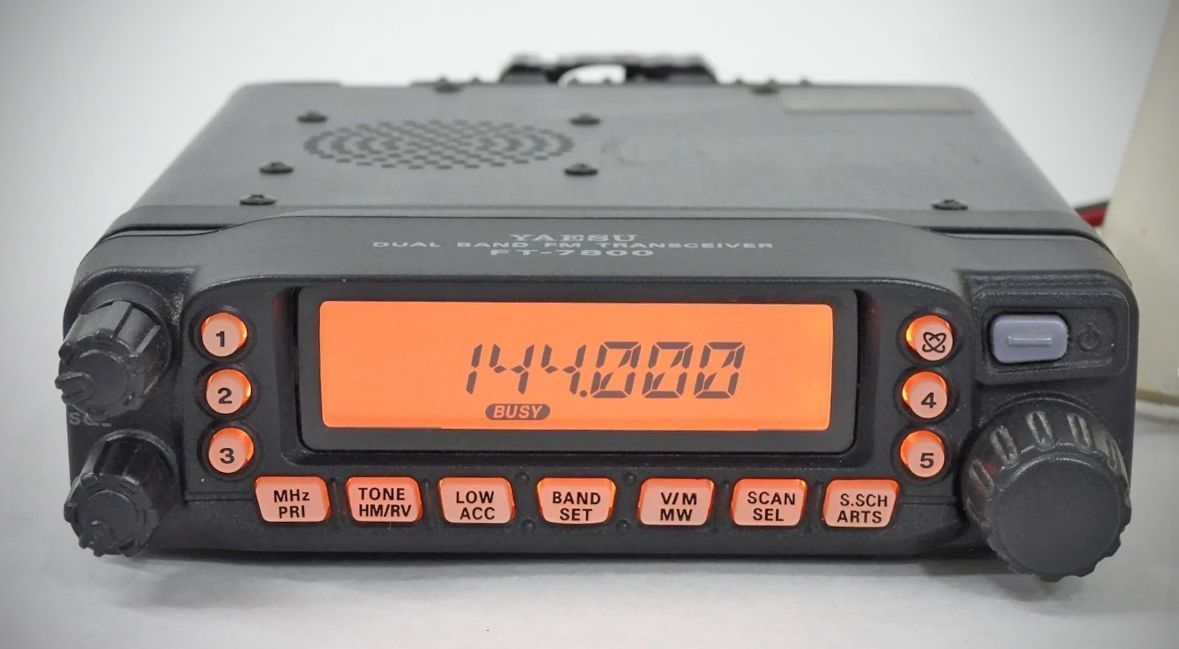
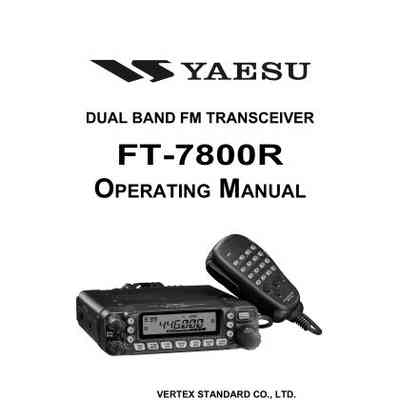
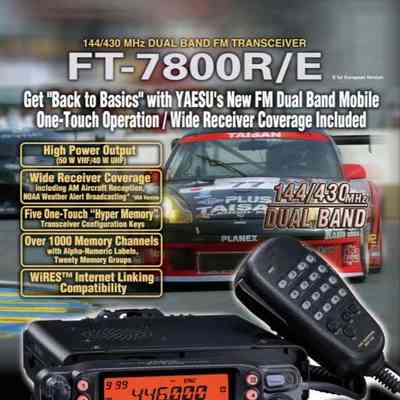
The Yaesu FT-7800 (specifically the FT-7800R for the US version) is a rugged, dual-band FM mobile amateur radio transceiver designed to offer straightforward, "back to basics" functionality paired with versatile multi-band reception.
Features
Transmit Power: The transceiver delivers up to 50 Watts of RF output on the 2-meter (144 MHz) VHF amateur band and 40 Watts on the 70-centimeter (430 MHz) UHF amateur band.
Adjustable Levels: To conserve energy and prevent overheating, users can select from four total transmit power settings: High (50W/40W), Mid 1 (20W), Mid 2 (10W), and Low (5W).
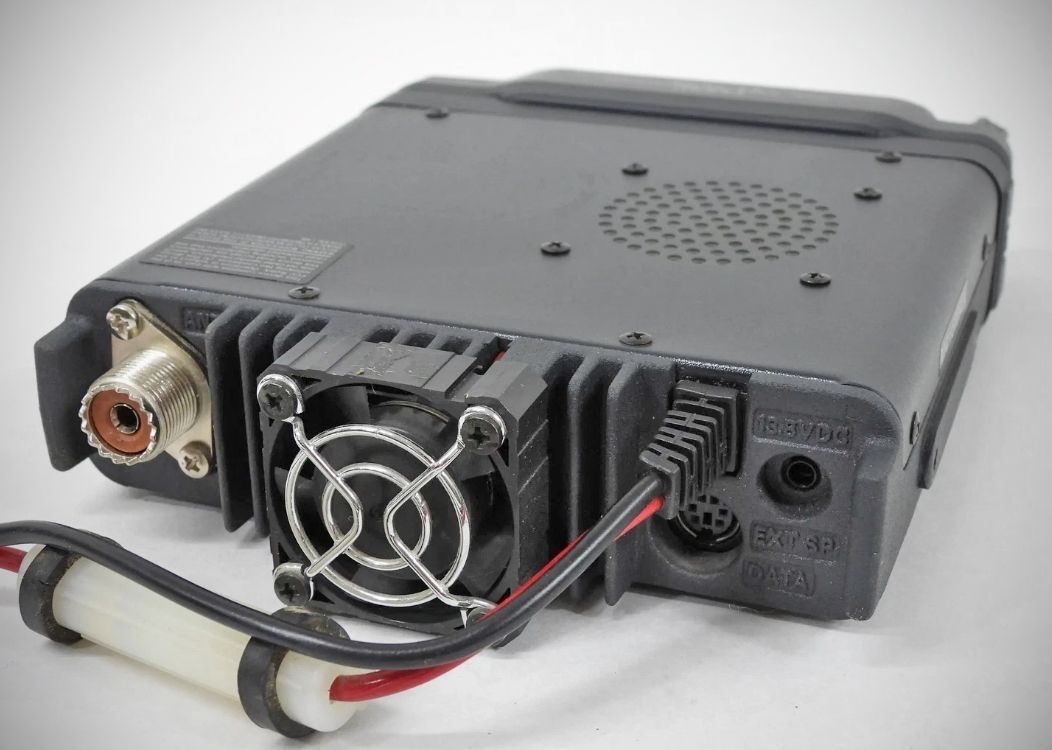
Cooling: High power stability is maintained using an RD70HVF1 Power MOS FET amplifier backed by a direct-flow heat sink and a thermostatically-controlled cooling fan.
Remote Faceplate Mounting: The front control head can be fully separated from the main radio body using the optional YSK-7800 Separation Kit, resolving spacing constraints in tight vehicle cabins.
Microphone Control: Supplied with the MH-48A6J DTMF backlit microphone, allowing direct frequency entry and control over various menu functions directly from the keypad.
Transmit Frequency Range:
VHF: 144.000 - 148.000 MHz
UHF: 430.000 - 450.000 MHz
Receiver (RX): It features wideband reception across two primary slots, supporting AM and FM modes with auto-selected synthesizer channel steps:
108.000 - 520.000 MHz (including AM Aircraft reception, Public Safety, Government, and Marine bands)
700.000 - 999.990 MHz (Cellular frequency bands are blocked)
Memory Capabilities
The FT-7800 boasts a highly comprehensive memory architecture with 1,055 total channels, organized as follows:
– 1,000 Standard Channels: Numbered 000 through 999, which support alphanumeric labeling ("tags") up to 6 characters for quick identification.
– 5 Home Channels: One dedicated prime frequency register for each primary operating band.
– 50 Sets of Band-Edge Memories: Used for Programmable Memory Scanning (PMS) to restrict scanning limits (labeled L1/U1 through L50/U50).
– 20 Memory Banks: Standard channels can be assigned into distinct banks for grouping regional repeaters or specific services.
– 5 One-Touch "Hyper Memories": Five dedicated front-panel keys store the complete configuration status of the transceiver (including frequencies, power levels, and scanning modes) for instant recall.
– 10 Weather Broadcast Channels: Pre-programmed from the factory for quick access to NOAA weather alerts.
Signaling and Data Features
– Tone Systems: Built-in 50-tone CTCSS and 104-code DCS encoder/decoder circuits facilitate reliable access to split-tone or tone-squelched repeater systems.
– ARTS™ (Auto-Range Transponder System): A Yaesu-exclusive feature that utilizes DCS signaling to automatically "beep" the user when they wander out of communication range with another ARTS-equipped station.
– Packet Radio Jack: A dedicated 6-pin mini-DIN data connector is located on the rear panel for a clean plug-and-play interface with external Terminal Node Controllers (TNCs) at speeds of either 1200 bps or 9600 bps.
– WIRES Compatibility: Includes a front-panel shortcut button for direct DTMF linking via Vertex Standard's Wide-coverage Internet Repeater Enhancement System.
Specifications
– Frequency Range:
RX: 108.000 - 520.000 MHz, 700.000 - 999.990 MHz (Cellular Blocked)
TX: 144.000 - 148.000 MHz, 430.000 - 450.000 MHz
– Channel Steps: 5/10/12.5/15/20/25/50/100 kHz
– Modes of Emission: F3E, F2D, F2A
– Antenna Impedance: 50 Ohms, unbalanced (Antenna Duplexer built-in)
– Frequency Stability: ±5 ppm @ –4F to +140F
– Operating Temp Range: –4F to +140F
– Output Power:
50/20/10/5 W (144 MHz)
40/20/10/5 W (430 MHz)
– Modulation Type: Variable Reactance
– Maximum Deviation: ±5 kHz, ±2.5 kHz
– Spurious Radiation: At least -60 dB below
– Microphone Impedance: 2 kΩ
– DATA Jack Impedance: 10 kΩ
– Receiver Circuit Type: Double-conversion superheterodyne
– Intermediate Frequencies: 45.05 MHz / 450 kHz
– Sensitivity:
0.8 µV (TYP) for 10 dB SN (108 - 137 MHz, AM)
0.2 µV for 12 dB SINAD (137 - 150 MHz, FM)
0.25 µV for 12 dB SINAD (150 - 174 MHz, FM)
0.3 µV (TYP) for 12 dB SINAD (174 - 222 MHz, FM)
0.25 µV (TYP) for 12 dB SINAD (222 - 300 MHz, FM)
0.8 µV (TYP) for 10 dB SN (300 - 336 MHz, AM)
0.25 µV for 12 dB SINAD (336 - 420 MHz, FM)
0.2 µV for 12 dB SINAD (420 - 520 MHz, FM)
0.4 µV (TYP) for 12 dB SINAD (800 - 900 MHz, FM)
0.8 µV (TYP) for 12 dB SINAD (900 - 999.99 MHz, FM)
– Squelch Sensitivity: Better than 0.16 µV
– Selectivity (-6dB / -60dB): 12 kHz / 30 kHz
– Maximum AF Output: 2 W @ 8Ω for 10% THD
– AF Output Impedance: 4 - 16Ω
Power requirements
13.8 VDC ±15%, negative ground
Current Consumption (Approx.):
RX: 0.5 A (Squelched)
TX: 8.5 A