Note
73, Mar 1983, inside back cover.
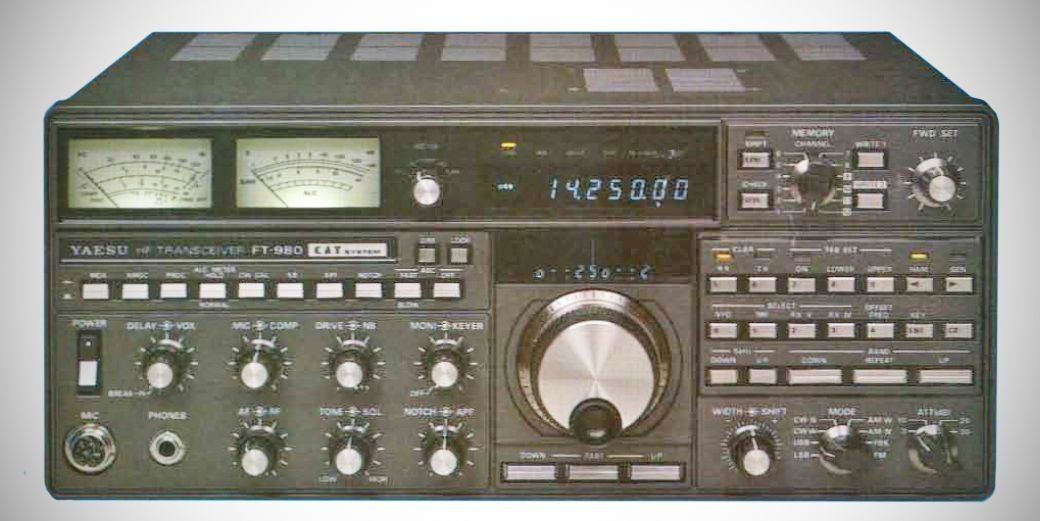
The Yaesu FT-980 is an all-solid-state HF transceiver featuring an 8-bit microprocessor for Computer Aided Transceiver (CAT) remote control and flexible operation. It was designed as a comprehensive, computer-ready base station for serious amateur radio operators.
The FT-980 offers continuous general coverage reception from 150 kHz to 30 MHz via a triple-conversion superheterodyne receiver, paired with 100-watt PEP transmission across all amateur bands from 160 through 10 meters (including the WARC bands).
Built-in operating modes include SSB, CW, AM, FSK, and FM, supported by 10 Hz synthesizer tuning steps, 12 independent VFO/memory registers, dual metering, and an array of interference-fighting features such as variable IF bandwidth and shift, a 455 kHz IF notch filter, an audio peak filter, and an RF speech processor.
Features
– Microprocessor & Computer Control:
– 8-Bit microprocessor for greater operating flexibility.
– Built-in SSB, CW, AM, FSK, and FM operation.
– CW and AM Wide/Narrow selection using optional filters.
– Three built-in FSK shifts.
– High-voltage, all solid-state transmitter PA for excellent linearity.
– RF Speech Processor.
– IF Monitor with front panel volume control.
– Full CW break-in with quiet solid-state switching.
– Front panel CW Spot switch.
– Optional Electronic Keyer Module.
– Variable IF Bandwidth and IF Shift using cascaded filters.
– IF Notch filter at 455 kHz for interference rejection.
– Audio Peak Filter for narrow band CW signal enhancement.
– RX Audio Tone Control for signal laundering in the AF line.
– Optional computer interface module (available mid-1983) for remote transceiver control from a personal computer terminal.
– Dual metering of Vcc, Ic, ALC, Compression, Discriminator Center, Relative PO, and SWR (Calibrated).
– Wide dynamic range and noise floor maintenance provided by a husky front end design and IF filter gain balancing.
– Optimization of audio passband for the mode in use to preserve noise figure with changing bandwidth.
– Variable Pulse Width Noise Blanker.
– Selectable AGC: Slow, Fast, or Off.
– Separate RX-only antenna jack.
Specifications
– Frequency range:
160 m: 1.5 to 1.99999 MHz
80 m: 3.5 to 3.99999 MHz
40 m: 7.0 to 7.49999 MHz
30 m: 10.0 to 10.49999 MHz
20 m: 14.0 to 14.49999 MHz
17 m: 18.0 to 18.49999 MHz
15 m: 21.0 to 21.49999 MHz
12 m : 24.5 to 24.99999 MHz
10 m: 28.0 to 29.99999 MHz
– Tuning steps: 10 Hz, 5 kHz and 500 kHz (band step)
– Emission types: LSB, USB, CW, AM, AFSK, FM
– Power output (all bands):
SSB, CW: 100 W (PEP)
AM: 25 W
FM, FSK: 50 W
– Carrier suppression: better than 40 dB below peak output
– Unwanted side band suppression: better than 50 dB below peak output (1 kHz tone)
– Spurious radiation: better than 50 dB below peak output
– Audio response: better than 6 dB from 250 Hz to 2750 Hz
– 3rd order intermodulation distortion: better than 40 dB below peak output (14 MHz, 100 W)
– Frequency accuracy: better than ± 3 ppm from 0-40C
– Modulation type:
– A3J, AFSK: Balanced Modulator
– A3: Low Level Modulation
– F3: Variable Reactance
– Maximum FM deviation: ± 5 kHz
– AFSK shift frequencies: 170, 425, 850 Hz
– Output impedance: 50 ohms (nominal), unbalanced
– Microphone impedance: Low (500 to 600 ohms)
– Receiver Circuit type: Triple conversion superheterodyne
– Clarifier range: ± 10 kHz
– Sensitivity: (CW, SSB, and AM figures measured for 10 dB S+N/N; 2 to 30 MHz, 150 kHz to 2 MHz)
– SSB/FSK/CW(W; w/out options): better than 0.25 uV, better than 4.0 uV
– CW(N) (with optional XF-455.8MCN 300 Hz filter installed): better than 0.1 uV, better than 1.6 uV
– CW(W) (with optional XF-8.9HC filter installed): better than 0.1 uV, better than 2.6 uV
– AM(W): better than 1.4 uV, better than 22 uV
– AM(W) (with optional XF-8.9GA filter installed): better than 1.25 uV, better than 20 uV
– AM(N): better than 1.0 uV, better than 16 uV
– FM: better than 0.6 uV for 12 dB SINAD
– Intermediate frequencies:
1st IF: 47.055 MHz
2nd IF: 8.9875 MHz
3rd IF: 455 kHz
FM IF: 455 kHz
– Image rejection: better than 70 dB
– IF rejection: better than 70 dB for all frequencies
– Selectivity (adjusted for maximum IF width):
SSB, CW (W/N), FSK
-6 dB, 2.5 kHz
-60 dB, 4.2 kHz
CW(N)*
-6 dB, 300 Hz
-60 dB, 600 Hz
CW(W)*
-6 dB, 600 Hz
-60 dB, 1.2 kHz
AM(W)*
-6 dB, 6 kHz
-60 dB, 17 kHz
AM(W)
-6 dB, 5 kHz
-60 dB, 12 kHz
AM(N)
-6 dB, 3 kHz
-60 dB, 9 kHz
FM*
-6 dB, 12 kHz
-60 dB,, 24 kHz
* with optional filter installed
– Dynamic range (at maximum sensitivity): better than 95 dB with optional 300 Hz CW(N) filter
– Audio peak filter range: 350–1400 Hz
– IF notch filter range (demodulated): 500–2700 Hz
– Audio output power: 3-watts minimum (into 4 ohms, with less than 10% THD)
– Audio output impedance: 4 to 16 ohms
Power requirements:
– Voltage: AC: 100 to 120 V, or 200 to 234 V; 50 to 60 Hz
– Power consumption (AC):
– Receiver: 72 VA
– Transmit (100 W output): 530 VA