Note
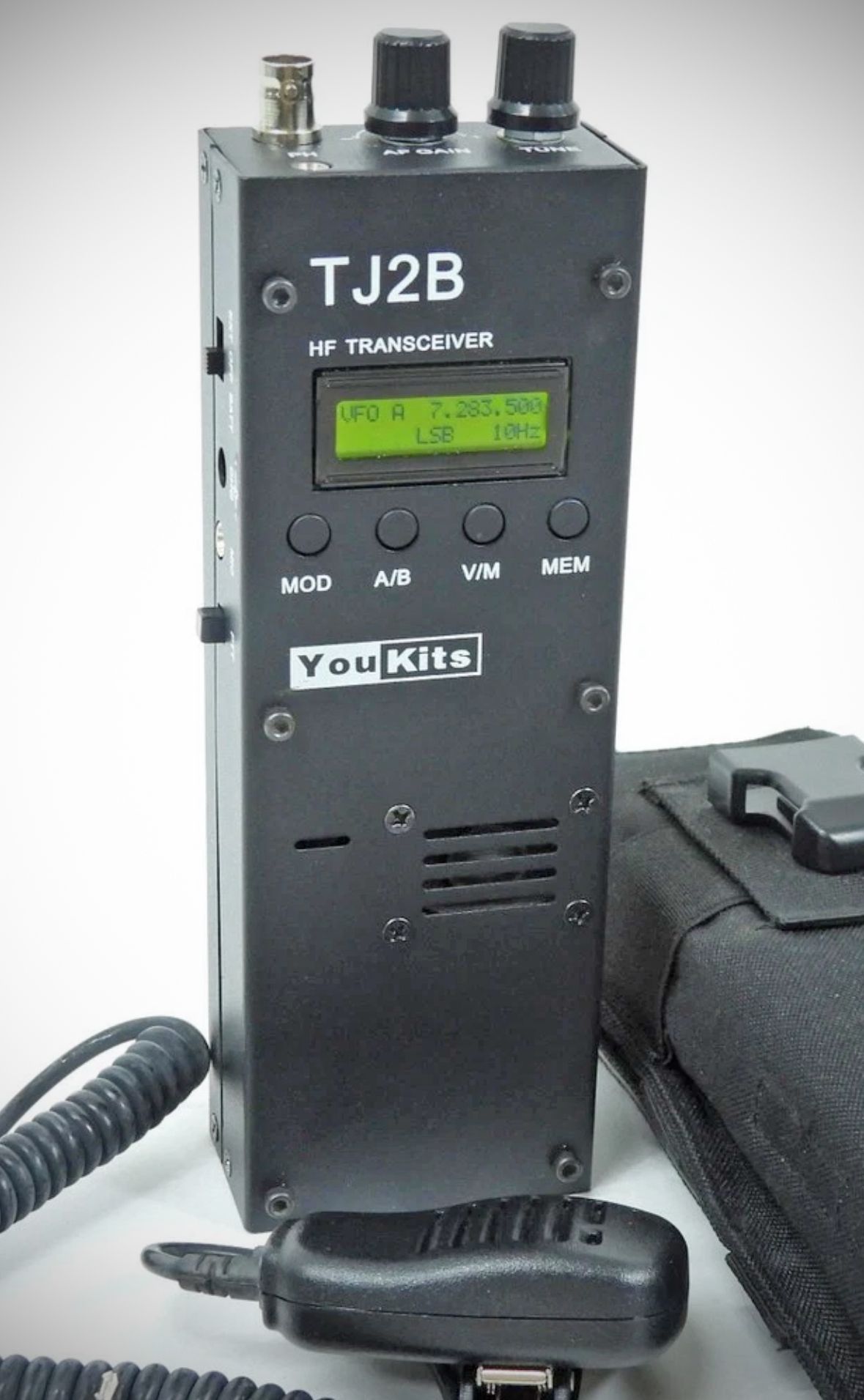
The Youkits TJ2B is a portable QRP multi-band HF SSB transceiver, notable for its compact, handheld design and up to 5W power output. It operates using Direct Digital Synthesis (DDS) and has specific frequency coverage depending on whether it is Kit A or Kit B.
The unit is supplied mostly pre-assembled and requires only the soldering of buttons, pots, switches, can transformers, toroids, etc.
Frequency Coverage
Kit A
TX: 5-15 MHz, covering 60m, 40m, 30m, 20m amateur bands.
RX: 3-18 MHz.
Kit B
TX: 18-30 MHz, covering 17m, 15m, 12m, 10m amateur bands.
RX: 14-30 MHz.
General Specifications
Modes: LSB, USB, CW (receive only)
Operating Power: DC 10.5 – 12.6V (later versions specified 10-13.6V).
Output Power: Up to 5W (power varies by band).
Receiver Sensitivity: 0.3uV.
Current Drain: Approximately 250mA (RX); 1100mA (TX).
Memory Channels: 40.
Key Features
DDS controlled: Provides stable frequency generation.
Tuning Rates: Selectable from 1Hz up to 1MHz.
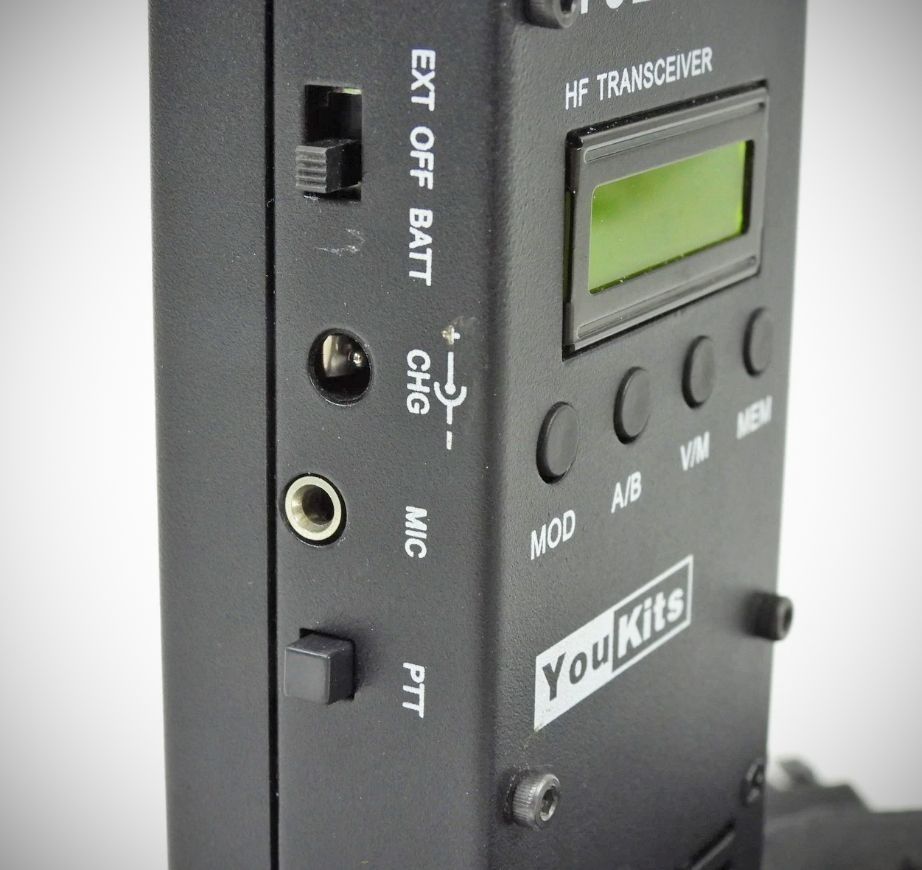
Built-in components: Includes an internal speaker, condenser microphone, and PTT button.
Portability: Designed as a handheld unit with space for an internal rechargeable lithium battery pack (1600mAh)
In real-world use, the Youkits TJ2B is valued for its extreme portability but is often described by operators as a "minimalist" rig with specific performance quirks.
Receiver Performance
Audio Quality: The internal speaker is widely criticized for poor sound quality; many users recommend replacing it with a small PC-style speaker or using external headphones for better clarity.
Sensitivity: While adequate for hearing moderate to strong stations, the receiver can be easily overloaded if connected to a large fixed-station antenna. It lacks a robust Automatic Gain Control (AGC), meaning users must manually manage volume on strong signals.
Stationary Monitoring: It is highly effective as a "spotting" radio, capable of running quietly on a band until it opens up with a strong signal.
Transmitter Performance
Power Stability: Actual output often falls slightly short of the 5W spec. Testing has shown varied results across bands (e.g., ~1.5W on 20m vs ~4.5W on 15m), and it may require an external microphone to reach full modulation on some units.
Signal Quality: Technical reviews indicate higher-than-average intermodulation distortion (IMD) compared to desktop rigs, though on-air reports typically describe the audio as clear and readable.
Field Usability
Antenna Requirements: While it can make contacts using a whip antenna on 20m, it generally requires a full-size antenna or a counterpoise to be effective on 40m.
Portability vs. Ruggedness: Its steel case provides a quality feel, but it is not weatherproof. The open vents and exposed jacks mean it must be protected from rain and condensation during field operations.
Battery Life: The internal 1600mAh battery is sufficient for casual QRP sessions, but the 250mA receive drain means it will deplete over a few hours of continuous monitoring.