Name/Title
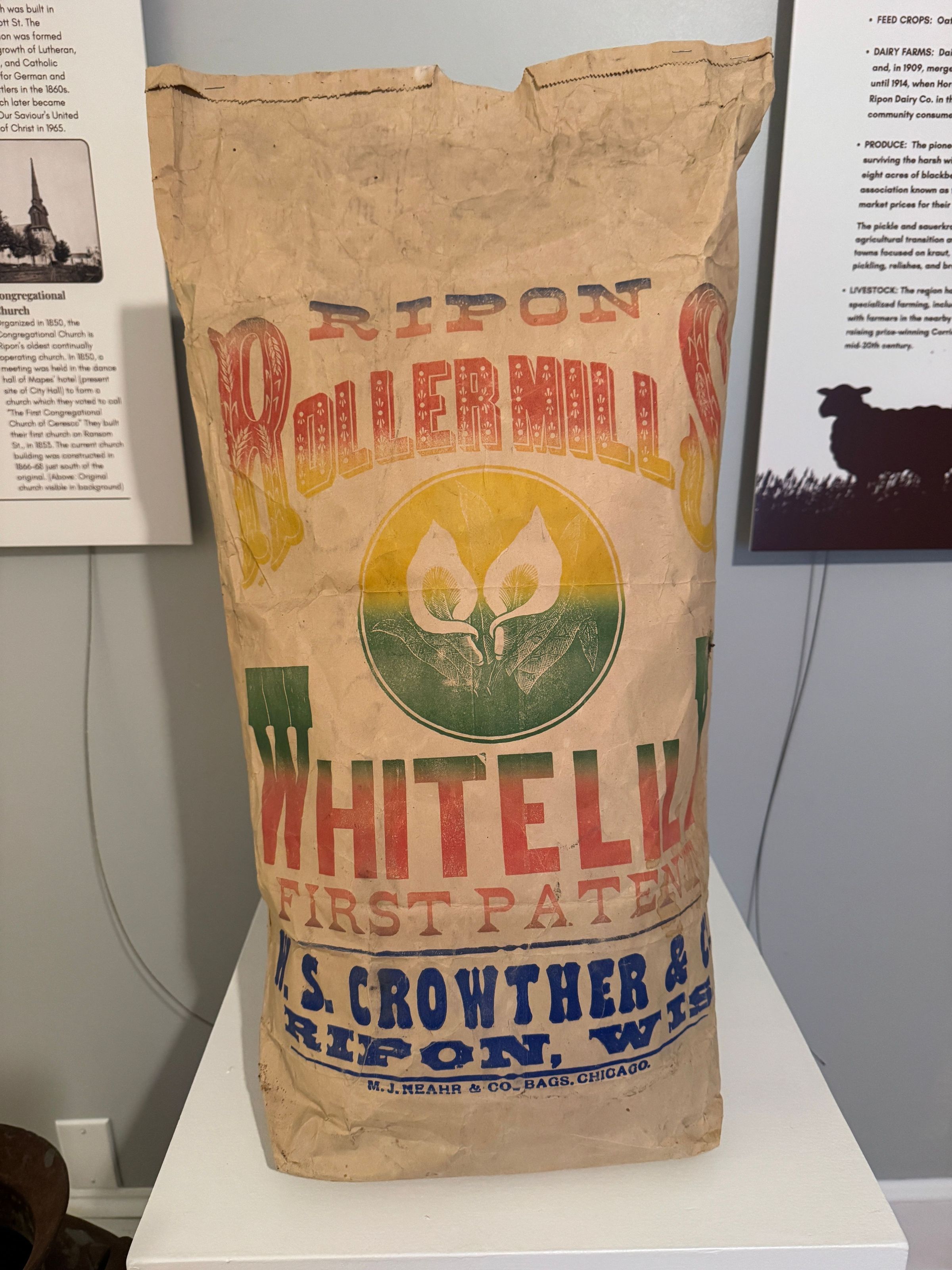
Ripon Roller Mills Flour BagEntry/Object ID
2026.348.1Description
Ripon Roller Mills flour bag, paper. Once contained White Lilly brand flour. Dates 1900-1920.Context
Between 1851 and 1925, ownership of Ripon’s mills changed several times before they became the center of the city’s flour industry. After purchasing the Ceresco Mill in 1851, Dellinger eventually sold it to William S. Crowther, who also acquired the Rippin City Mills and Gothic Dam in 1890. When the Ceresco Mill burned down in 1891, Crowther expanded the Rippin City Mills instead, installing new steel roller technology that produced finer white flour more efficiently. Renamed the Rippin Roller Mills, the five-story mill became the only flour mill remaining on Silver Creek and produced the well-known White Lily flour, which was sold throughout the United States and England.
In 1909, Thomas B. Genge purchased the mill and modernized its waterpower system by replacing the wooden flume with a steel pipeline. During World War I, demand for flour soared, and in 1914 Genge sold the business to Henry O. Nash. Under Nash’s family ownership, the mill prospered during the war, shipping flour across the Midwest and eastern United States. After the war, however, falling farm prices and increased competition from larger, more efficient mills led to declining business. By 1925, the Nash family ended flour production and focused instead on feed and grain operations.Acquisition
Accession
2026.348Acquisition Method
Found in CollectionLexicon
Nomenclature 4.0
Nomenclature Tertiary Object Term
Mill, FlourNomenclature Secondary Object Term
Mill, GrainNomenclature Primary Object Term
Tool, Grain ProcessingNomenclature Sub-Class
Food Processing EquipmentNomenclature Class
Food Processing & Preparation T&ENomenclature Category
Category 04: Tools & Equipment for Materials