Name/Title
DressEntry/Object ID
1979.13.0Description
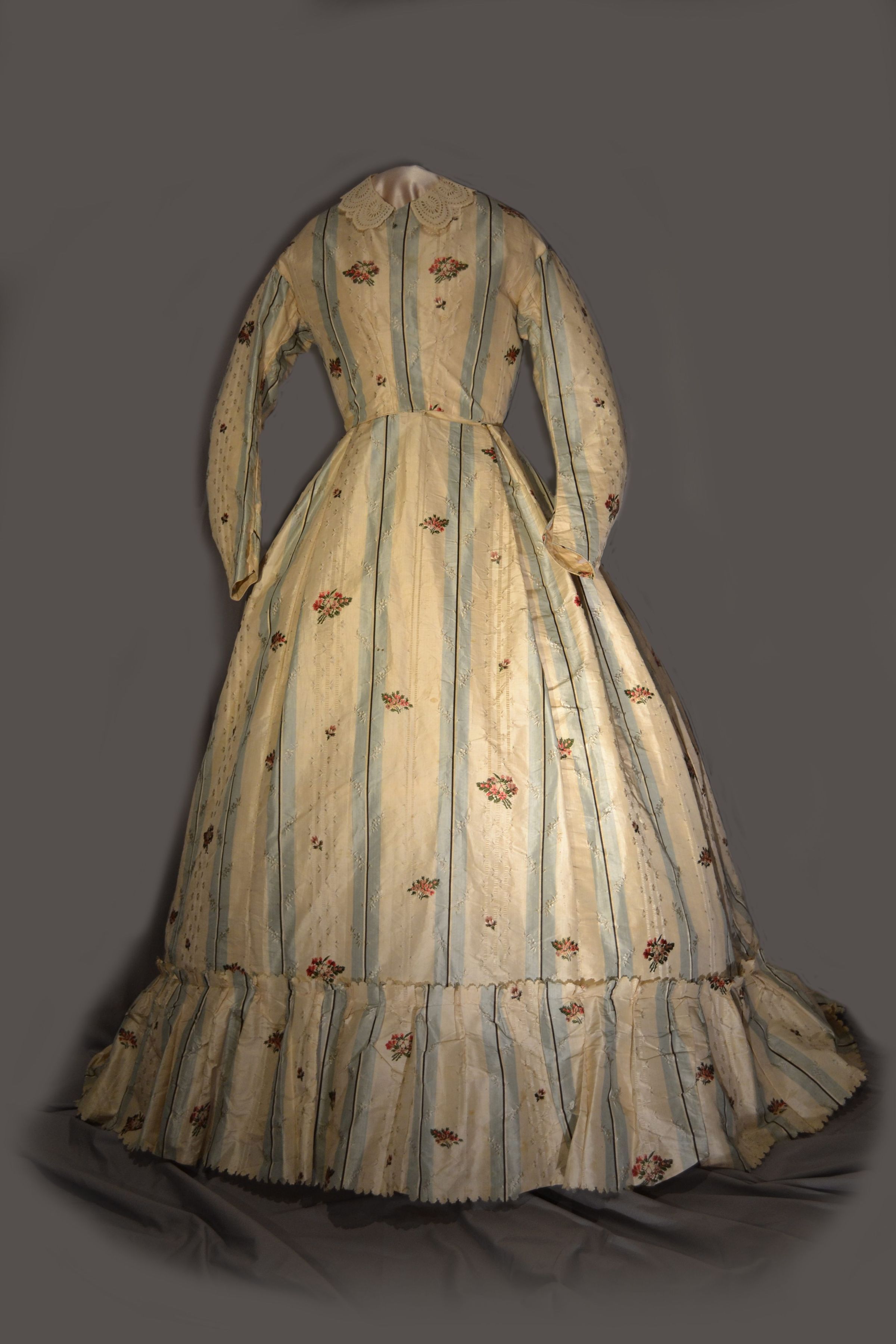
Silk brocade dress, blue and white stripes with brocaded polychrome flowers scattered across the ground. The bodice closes up the front with hooks and eyes. Two-piece coat sleeves, which are pieced out of several smaller sections of cloth (especially under the arms). Full skirt with a 10.5" wide ruffle sewn around the bottom of the skirt; top and bottom of the ruffle have their edges pinked in a small scalloped pattern.
Bodice has been extensively reworked. It closes up the front with hooks and thread eyes. On the left side of the bodice one of the large floral motifs has been appliqued to match the woven motif on the other side. Two small darts on the front on each side of the front opening. The back is constructed of three pieces. There is evidence of two wider spaced darts were removed on each side of the front near the side seam. Also two darts from the back appear to have been removed near the current side seams. Lined with a cotton fabric printed with a pink meandering vine. At the neckline, the fashion fabric is not sewn to the lining. Sleeves have been extensively pieced. They are lined with the same cotton fabric in some sections, and in others with a glazed cotton fabric.
Skirt is flat in the front with a pleat to each side; back is gathered. Large slit on the left side of the skirt. Large section of loose fabric at the waist next to the slit; the balance of one width of fabric has been left loose rather than being cut. Also on the right hand side where there is a small pocket on the right side lined with glazed cotton. The skirt consists of 6 panels of fabric, 19' wide. Most of the original hem has been picked out. A wide band of natural colored glazed cotton has been sewn on above the original silk hem (at various lengths) and the ruffle sewn back on above the skirt hem.Context
While the fabric dates to the 1760s-1770s, the dress in its current configuration was probably made up in the 1860s. This gown was made from an 18th century gown; separate fabric scrap shows that the original side slit was sewn shut. It was probably remade at least one more time before the bodice reached its current configuration, as there appear to be signs that the bodice had darts in the front that would not have been part of an 18th century garment. It probably underwent additional changes after the mid-late 19th century, as the ruffle on the bottom of the skirt was removed at some point.Dimensions
Length
67 inDimension Notes
20" dropped shoulder
20" sleeves 14" wide at elbows and 8" at wrist with 2" slit at bottom
30" waist
43" skirt
19 3/4" fabric panel width
Separate fabric panel 19 3/4" wide by 36" long, probably originally a skirt panelMaterial
silk brocade, printed cotton liningInterpretative Labels
Label Type
Cultural/Historical ContextLabel
Although this dress was made in the mid-1860s, the silk fabric dates to a much earlier time. The expensive brocaded material was probably woven in either England or France in the 1770s. Crisp 18th-century silks were perfect for the fitted bodices and full-skirted styles that became popular in the mid-19th century, and many 18th-century gowns were picked apart and remade in newer styles. The only element of the original garment which remains is the skirt flounce with its scalloped edges, cut by striking a steel pinking iron with a mallet. When worn in the 1860s, the full skirt of this dress would have been supported by a spring-steel cage crinoline. The light-weight crinoline, or hoop skirt, made it unnecessary to wear multiple layers of heavy stiffened petticoats under the voluminous skirts of the era.