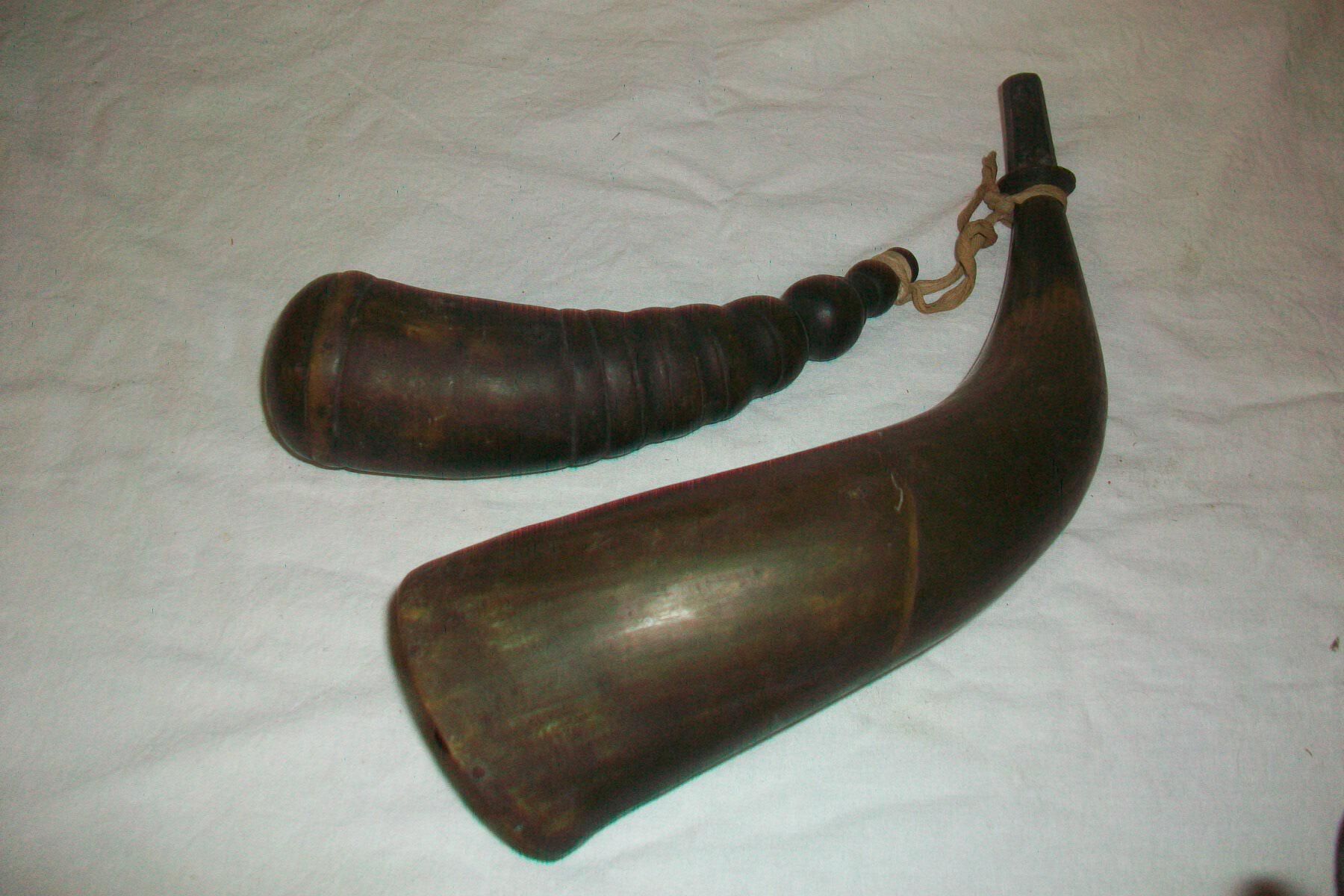
Powder horn

Object/Artifact

-

Saco Museum

2003.0053.0001

2003.0053.0001

Name/Title

Powder horn

Entry/Object ID

2003.53.1

Description

Horn with faceted spout above a carved ring which is flattened on the top and angled below. A pine plug in the butt end rises slightly in the center where an old screw is inserted. The plug is held in place by eight small round wooden pins around the circumference at evenly spaced intervals. A uniform dark brown colors the spout and extends unevenly in length to an area below the ring another 2-3 inches. The surface of the horn is undecorated although there is a faint incised line which appears to be deliberate running about three-quarters of the way around the perimeter almost at the midpoint between the spout and the plug. There is a small round hole 1 1/4" below the ring. There is also a tiny hole in the plug 5/8" from the screw in the middle. There is a 1/4 inch hole in the spout. The horn is tied to 2003.54.1with a 1/2" cotton twill tape which is now an even tan color and appears to post-date Caleb D. Jordan's donation of the horns and other materials from the Benjamin Simpson house to the York Institute in 1873.

Context

Simpson records making two powder horns in diary entries for February 1 and March 31, 1785, however he did not describe specific details which would definitively link this horn and 2003.54.1 to his diary entries. These two horns are the most likely ones believed to have been donated to the York Institute in 1873 by Caleb D. Jordan along with a number of other items from the Benjamin Simpson House, including diaries, books and papers, and household and agricultural artifacts.

Made/Created

Artist Information

Attribution

Attributed to Benjamin Simpson

Date made

circa 1785 - 1830

Dimensions

Length

13 in

Diameter

3-1/8 in

Circumference

10 in

Materials

Material

pine, animal horn, iron or steel

Material Notes

Horn is translucent in sunlight.

Interpretative Labels

Label Type

Cultural/Historical Context

Label

In 1773, Benjamin Simpson was a 19-year-old mason’s apprentice in Boston. In December of that year, he participated in the Boston Tea Party. George Folsom published Simpson’s account of the events in his 1830 History of Saco and Biddeford in 1830. Between 1775 and 1777, Simpson enlisted several times for short periods, serving in coastal Maine, New York, and Rhode Island. In 1778, he enlisted once again, this time for nine months. Simpson departed York in May bound for Valley Forge, in charge of driving wagons filled with clothing and other supplies for the army. Upon arrival, he was inoculated for smallpox, but he apparently contracted the disease anyway. Simpson remained with the baggage train until after the Battle of Monmouth, when he was so ill that the doctors despaired of his life. He eventually recovered enough to rejoin the army in New York and served out the remainder of his enlistment, which ended in March 1779. After the war, Benjamin Simpson moved to North Saco near the Buxton line. He continued his trade as a mason and was also a prosperous farmer. In the early 19th century, Simpson served as a tax collector and surveyor of the highways for many years. Caleb Jordan donated these items owned by Simpson to the York Institute (now Saco Museum) in 1873. At the same time, he gave a banner that had been presented to Simpson during a parade that read: “Benj Simpson, the last survivor of the Boston Tea Party, Dec. 15, 1773.” Unfortunately, the banner no longer survives.