Name/Title
Richard Foxwell vs. John Jackson, March-June 1671Entry/Object ID
2026.19.1Scope and Content
17th Century laid paper document, single sheet.
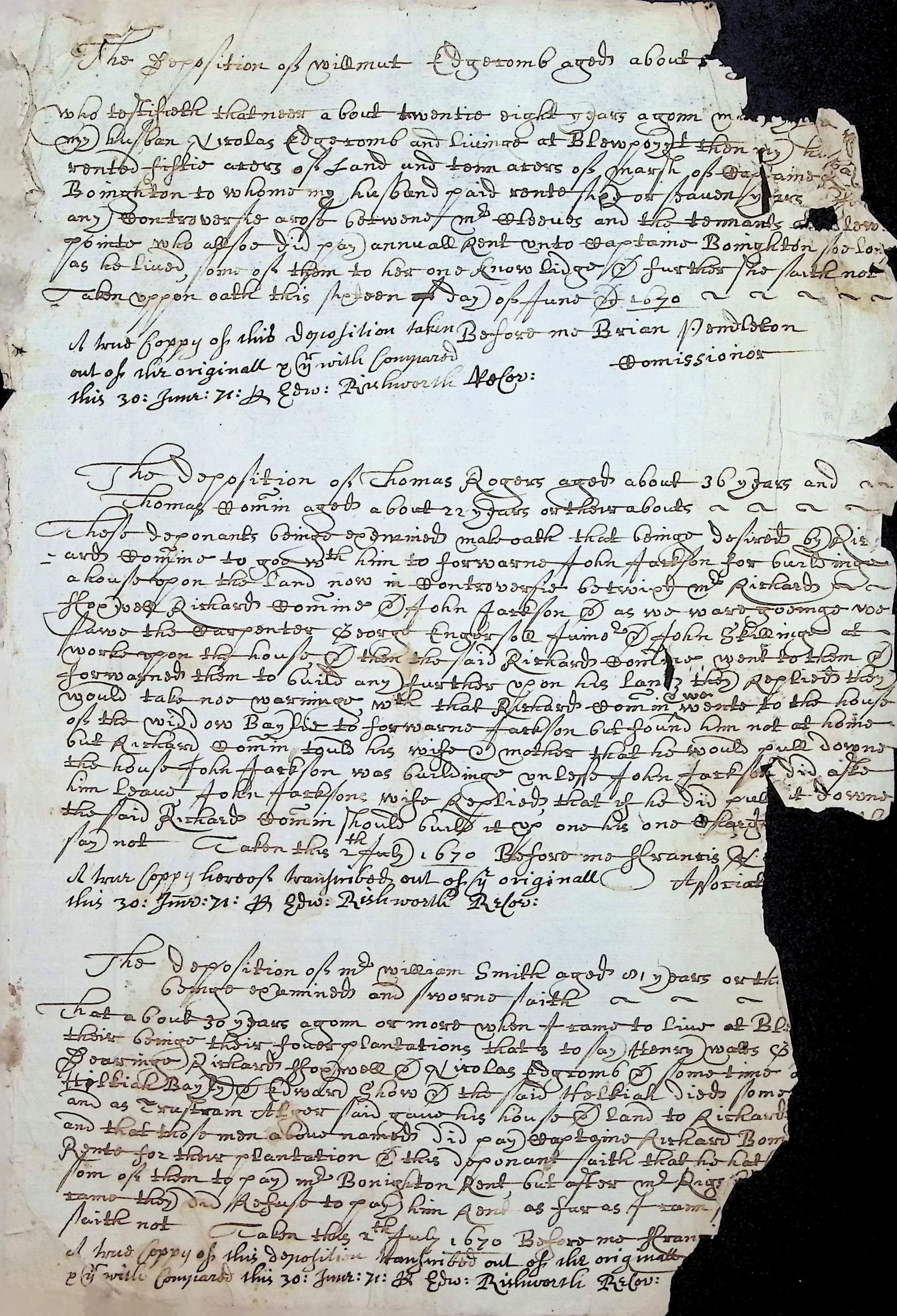
A 1671 copy made by Edward Rishworth, Recorder for the Province of Maine, of depositions taken in 1670, for a lawsuit made by Richard Foxwell, son-in-law of Captain Richard Bonython, against John Jackson, a planter supposedly squatting on Bonython lands, somewhere in the area between Blue Point/Pine Point and Old Orchard.
Transcribed as follows:
The Deposition of Willmut Edgecomb aged about ___
who testifieth that shee about twentie eight years agone married
my husban(d) Nicolas Edgecomb and lived at Blewpoynt then my husband
rented fiftie acres of land and ten acres of marsh of Captain
Bonighton to whom my husband paid rent ___ of ___ years
[without] any controversie as of between Mr. Cleeves and tho [demands?] a ___
__ into who also did pay annual rent onto Captain Bonighton as long
as he lived, some of them to her own knowledge & further she saith not
taken upon oath this [nine]teen Day of June 1670
Before M. Bryan Pendleton Commissioner
A true copy of this deposition taken
out of the original and y’with compared
This 30 June ‘71 per Edw. Rishworth Recor.
The Deposition of Thomas Rogers aged about 36 years and
Thomas Cummin [Cummings] aged about 22 years or thereabouts.
These deponents being [examined and sworn] make oath that being desired by Ri_
-chard Cummin to go with him to forewarn John Jackson for building
A house upon the land now in controversie betwixt [the said Richard]
The said Richard Cummin & John Jackson as we was going we
saw the carpenters George Engersoll [Ingersoll] & John Skillings at
work upon the house & then the said Richard Cummin went to them &
forewarned them to build any further upon his land. They replied they
would take no warning, with that Richard Cummin went to the house
of the widow Baylie to forewarn Jackson but found him not at home
But Richard Cummin told his wife & mother that he would pull down
the house John Jackson was building unless John Jackson did offer
him board, John Jackson’s wife replied, that if he did pull it down
the said Richard Cummin should build it up on his own charge & further said not.
5th July, 1670, Before M. Francis H. [Hooke]
A true copy hereof transcribed out of y’ original
This 30 June ‘71, per Edw. Rishworth Recor.
The Deposition of Mr. William Smith aged about 51[?] years and
Being examined and sworn saith
That about 30 years agone or more when I came to live at Blue Poynt
There being there four plantations that is to say Henry Watts &
Richard Foxwell & Nicholas Edgecomb & some time
Hebidiah Bayley & Edward Shaw & the said Hebidiah Bayley some time
And as Tristram Alger said gave his house & land to Richard ____
And that the fore above named did pay Captain Richard Bonighton
Rent for those plantation & this deponent saith that he hath
Seen of them to pay Bonighton rent but also Mr. [Alexander] Rigsby
And they did refuse to pay him rent as far as he knows [and further]
Saith not
Taken this 7th July 1670
Before M. Francis [Hooke]
True copy of this deposition transcribed out of the original
& y’with compared this 30 June ‘71, per Ed. Rishworth, Recor.
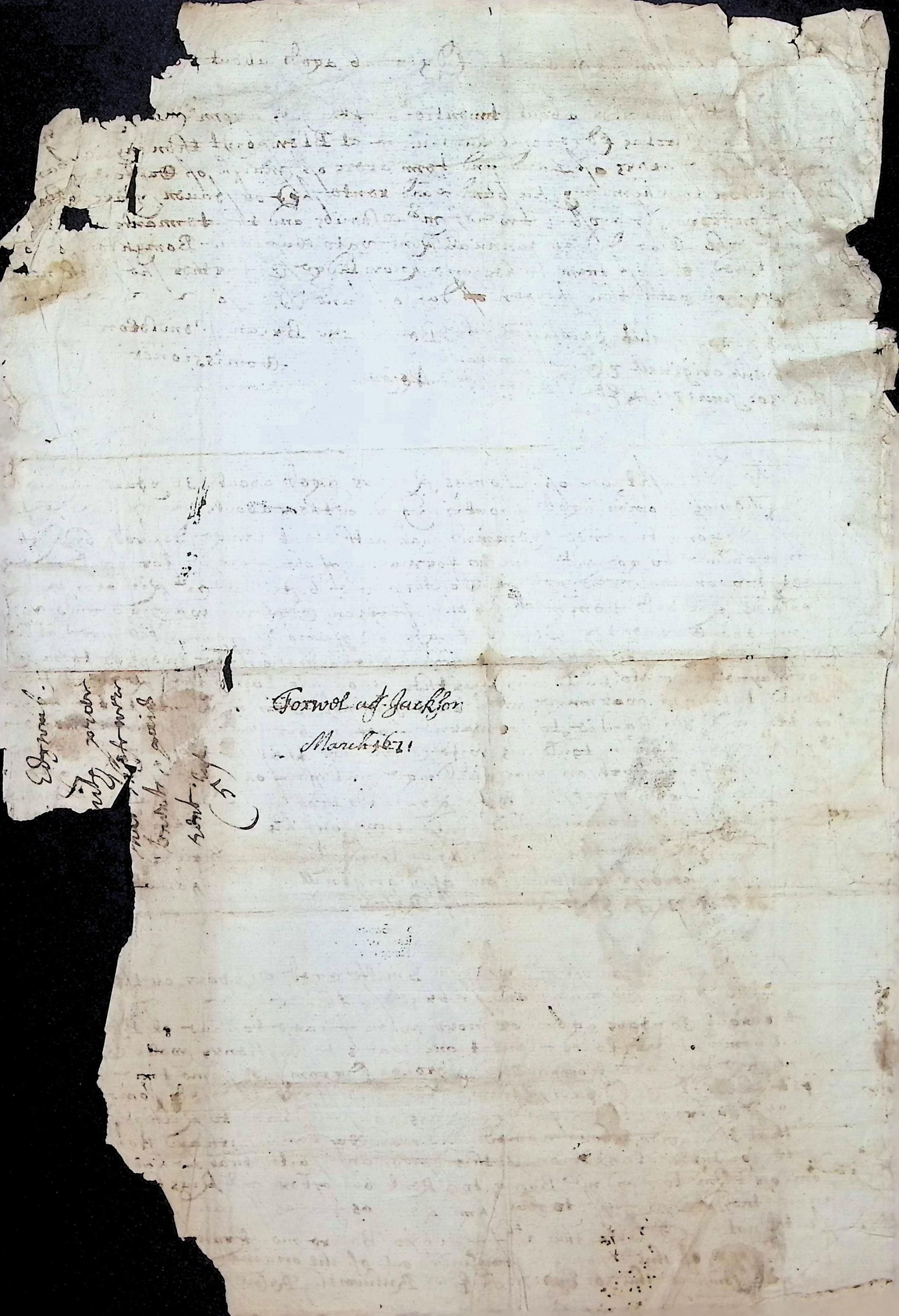
*Backside
Foxwell agt. [against] Jackson
[Richard Foxwell, son-in-law of Captain Richard Bonython, vs. John Jackson, squatter]
[Note about Edgecomb rent]Context
This is a rare 17th-century document that gives insight into the squabbles that early settlers held during the contentious Lygonia patent period of the Saco Bay region. Several known historical figures appear in this lawsuit, including Captain Richard Bonython, an original patent holder of the Saco region, and Thomas Rogers, the earliest known settler at Old Orchard (see list of individuals below). Richard Foxwell centered his case around establishing his father-in-law's uncontested dominion over the Bonython patent. The deponents (witnesses) were mostly old planters who testified on behalf of the Bonython family, stating that they paid rent to Captain Bonython for the entire period that they lived on his land. The deponents made special note that they did not pay rent to Parliamentarian Alexander Rigby and his enforcer George Cleeves, who contested the Bonython patent. Witnesses also described how Richard Cummings, another son-in-law of Captain Bonython, aggressively threatened to tear down the house of John Jackson, who was being accused of squatting on Bonython lands.
A point of note is the complete absence of John Bonython, the primary male heir of Richard Bonython's lands. By this point in 1670, John Bonython was declared an "outlaw" by the Massachusetts Bay Colony and was also deemed "incapable" to conduct any business "respectably" by his own father's court. Here we see the sons-in-law taking Bonython estate affairs into their own hands. (Captain Bonython died sometime around 1650.)
Individuals named in the depositions:
Patent Holders/Enforcers
Captain Richard Bonython (1580 - c. 1650): The original co-patentee of Saco (1630) with Thomas Lewis. He is the central figure the document revolves around, as the depositions are explicitly proving that early settlers paid him rent. He is the father-in-law to both Richard Foxwell and Richard Cummin(gs).
Mr. Rigsby (Alexander Rigby) (1594-1650): Wealthy English Parliamentarian and proprietor of the rival Lygonia Patent. George Cleaves was his enforcer on the ground. William Smith testifies that the Saco planters "did refuse to pay him rent".
Mr. Cleeves (George Cleaves/Cleeves) (? - c. 1667): Rigby's deputy and enforcer. Notorious among the early colonists, often associated with Thomas Morton (of Merrymount). Wilmot Edgecomb's deposition likely references a controversy or demands made by him.
The Bonython Heirs (Plaintiffs)
Mr. Richard Foxwell (c. 1604 - 1676): An early planter at Blue Point and son-in-law to Capt. Bonython (married Susannah Bonython). The docketing on the back reveals he is the primary plaintiff bringing the 1671 lawsuit against John Jackson.
Richard Cummin (Cummings) (c.1581 - 1676): Son-in-law to Capt. Bonython (married Elizabeth Bonython). He aggressively confronts the carpenters and John Jackson's family to stop them from building on the contested land.
The Deponents (Witnesses)
Willmutt Edgecomb (Wilmot Randall Edgecomb): Wife of Nicholas Edgecomb (c.1593 - c. 1681, married 1642). She testifies that they lived at Blue Point 28 years prior and paid rent to Capt. Bonython.
“Wilmott Randall, a former servant of [John] Winter [at Richmond Island].” - The Pioneers of Maine & New Hampshire - Charles Henry Poper.
William Smith (aged 51) (1619 - ?): Testifies that he arrived at Blue Point 30 years prior and witnessed the original planters paying rent to Bonython while refusing to pay Mr. Rigby.
“Andrew Brown and William Smith, both of Black Point village, were granted by George Cleeve, agent of Alexander Rigby, proprietor of the province of Lygonia, five hundred acres in that village on September 29, 1651.” - Mass. & Maine Families, by Walter Goodwin Davis.
"The first to settle near them were: George Deering and Nicholas Edgecomb, who came in 1639, and were joined the next year by William Smith. Smith, in a deposition affirms that when he came to live at Blue Point in 1640, there were four plantations there; those of Richard Foxwell, Henry Watts, George Deering, and Nicholas Edgecomb; and that some time after came Hilkiah Bailey, Edward Shaw, and Tristram Alger.” - The Scarboro Register 1905, Ch. 2 “Early Settlement”
Thomas Rogers (aged 36) (c. 1632 - 1675): Testifies as a witness to Richard Cummin's confrontation with the carpenters and Jackson's family.1659 - he received a town grant next to Richard Cummings. Thomas Rogers’ famous “Garden” or “Orchard” is said to be the origin of the name “Old Orchard.”
Thomas Cummin(gs) (aged 22) (c. 1648 - ): Testifies alongside Thomas Rogers. Given his age and name, he is almost certainly the son of Richard Cummin (and thus the grandson of Capt. Bonython), brought along by his father as a witness.
Jackson Family (Defendants)
John Jackson: The man attempting to build a house on the contested land. The defendant.
“Other early settlers in town:....John Jackson” - The Scarboro Register 1905, Ch. 2 “Early Settlement”
John Jackson's Wife: Confronts Richard Cummin(gs) when he threatens to pull the house down, telling him that if he destroys it, he will have to rebuild it at his own charge.
John Jackson's Mother (or Mother-in-Law): Present at the Widow Bayley's house (likely her) during Richard Cummin's confrontation with Jackson's wife. Likely a relation of Hebidiah.
The Carpenters & Blue Point Neighbors
George Ingersoll (? - 1685): A carpenter hired by John Jackson, who ignored Richard Cummin's warning to stop building.
“George Ingersoll…bought 55 acres of land adjoining that of Thomas Skilling March 25, 1658. He deposed 24 June 1685, ae. about 67 years” - Pioneers of Maine & New Hampshire - Charles Henry Poper.
John Skillings: Another carpenter working alongside Ingersoll on Jackson's house. Likely a relation of Thomas Skilling(s), Ingersoll’s neighbor.
Nicholas Edgecomb (c.1593 - c. 1681): Wilmot's husband; an early Blue Point planter who paid rent to Bonython.
“Nicholas Edgecomb, planter, one of Winter's fishermen from 1638 to 1641. He m. in 1642 Wilmot Randall, a servant in the family of Winter, and paid for the unexpired time of her (year's) contract. [Trelawny] Took oath of allegiance to Mass. govt, at Spurwink July 13, 1658. Settled at Saco. He and his wife sold land formerly occupied by them at Scarborough 3 Oct. 1660. He d. before 28 March, 1681, when the widow presented the inventory of his estate. Testimony was given that he left all to his son Robert, who was to maintain the mother; "the rest of the children" are referred to. [York De. V.]” - Pioneers of Maine & New Hampshire - Charles Henry Poper.
Henry Watts (1602 - ?): Named by William Smith as one of the four original plantation owners at Blue Point. Granted patent in London via Thomas Lewis, 1629/30. Watts is extensively covered in Walter Goodwin Davis, "Watts, of Cockfield, Co. Durham, and Scarborough, Massachusetts and Maine Families, Vol. III”
Hebidiah [Hilkiah] Bayley: An early planter at Blue Point. Also appears as “Hilkiah” in early records. Possible relation to “Widow Bayley” mentioned in the deposition.
Widow Bayley: Likely related to Hebidiah. John Jackson was either living at or visiting her house when Richard Cummin came looking for him.
Edward Shaw: An early planter mentioned by William Smith.
“...the court ordered that ‘Jane Shaw, wife of Edward Shaw, shall be whipped at the next quarter court holden at Saco, for abusing Capt. Bonython in slanderous and unreverent speeches.’ Edward recognized in the sum of £50 ‘to bring his wife to abide the censure of the court.” - Folsom p. 114.
Tristram Alger: An early planter and landowner mentioned in relation to property given to a "Richard".
“Trustrum Algers, Casco, 1637 ‘a quiett man,’ sent money home to his wife in England through his employer. Winter. [Trelawny]” - Pioneers of Maine & New Hampshire - Charles Henry Poper. Likely a relation of the infamous brothers Arthur and Andrew Algers, from Saco who purchased Owascoag and vicinity from Jane Uphannum, 1659.
The Court Officials
Edward Rishworth (1617 - 1689): The Recorder for the Province of Maine/York County, 1651 until death. Thomas Gorges agent. He transcribed and certified these depositions as "true copies" on June 30, 1671.
Major Bryan Pendleton (1599 - 1680): The Commissioner who swore in Wilmutt Edgecomb in June 1670. Winter Harbor selectman 1666, 1667. Saco Town Clerk 1672, Saco Tax Assessor 1676.
Major Francis Hooke (c. 1630 - 1694): The Magistrate/Justice of the Peace who swore in Thomas Rogers, Thomas Cummin, and William Smith in July 1670.
“... said Hooke doth act by his authority, granting warrants, summonses, taking depositions, and hearing causes” - Folsom pg. 93.