Note
Expanded Wall Label:
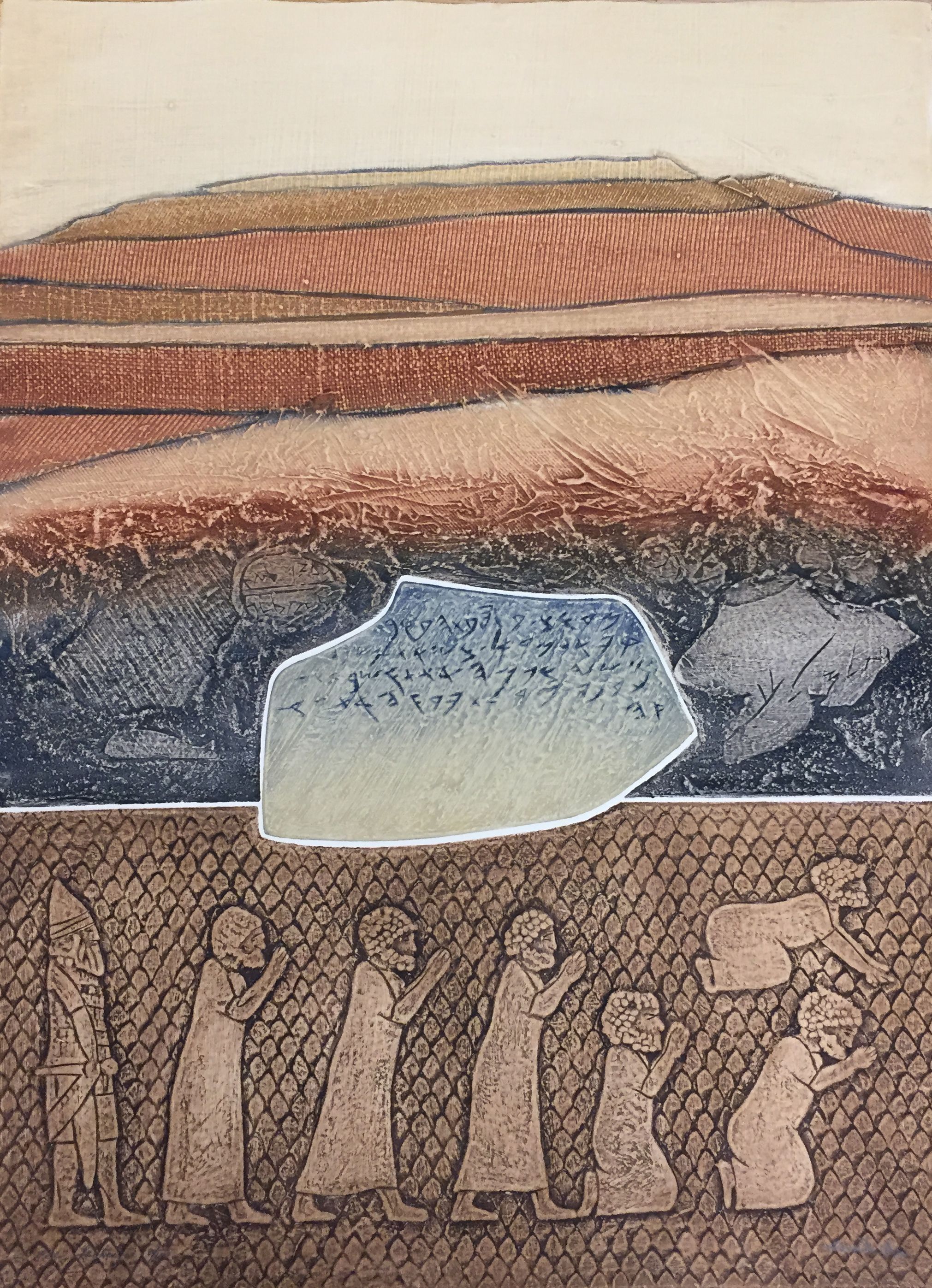
This print is part of the Israelite Tel Suite series. The Israelite Tel suite is a collection of four intaglio collagraphs, depicting important archaeological sites relating to Biblical Israel. A tel is a mound covering the site of some ancient settlement, generally consisting of many layers of rubble and artifacts left by succeeding civilizations. Strata accentuated by horizontal lines divide the picture into three levels, forming a cross section of archaeological time. In the Israelite Tel Suite, Bowden brings together earth and time, incorporating the present landscape of each site, some finds embedded in a strata, and centered in each piece, a significant specific object relating to the tels history.
Tel Lachish was a prominent Israelite city southwest of Jerusalem.
Its significant finds include ostraca of great interest for linguistic
research of ancient Hebrew. This one is written in a cursive script,
the most developed form of Paleo-Hebrew. The lower section of
the print is a portion of a. mural found at Ninevah depicting the
Israelites being marched into captivity by King Sennacherib.
A collagraph is an intaglio printing process, which used a built-up collaged plate made from a great variety of materials (strips of fabric, thread, aluminum foils, plants, marble dust, acrylic modeling paste) that are glued onto the surface of the masonite or cardboard. The surface is then painted or inked and run through an etching press at several thousand pounds of pressure, thereby transferring the paint and the texture to the surface of the paper. The process is completely repeated to create another print in the edition.