Name/Title
Boatbuilding and transporation by Kit LaneEntry/Object ID
2024.41.264Scope and Content
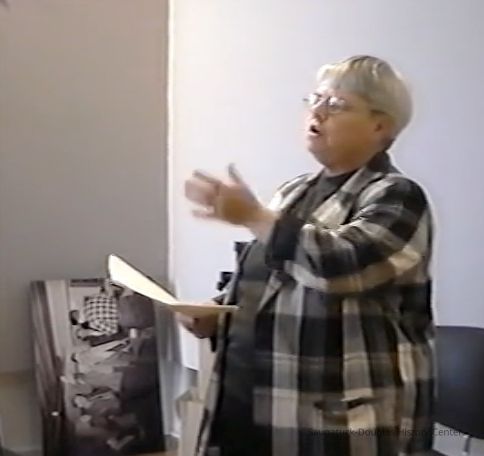
Presentation about area boats by Kit Lane, author of "Built on the Banks of the Kalamazoo," at the Saugatuck-Douglas History Museum (Pump House).
Presentation opens with a questions-and-answers session including When did the Big Pavilion Burn? How may steps to the top of Mount Baldhead? How did Saugatuck get its name? (The "Belle Haven" mystery a side note.) How did Douglas get its name? How did Allegan get its name? (minute 11) The history of the Pump House and how the water system worked. Why was Saugatuck so slow to get municipal electric service in 1912 (not including the Interurban electric train and Big Pavilion generators) when Fennville had it in 1896?
The nautical portion of the presentation begins at minute 15 with information about Indian canoes, fur traders on the Kalamazoo, William Butler arriving on the schooner Madison in May and building a raft to get to the Flats, about rafting wood and flour grown in the Kalamazoo Oak Openings and how early rafts were disposable, how in 1838 the C.C. Trowbridge was built at Singapore, about the O.R. Johnson sailboat with its pointy keel, how most local boats were scow schooners with a hull described as "a sardine can with sails," the difficulty of navigating the Ox-Bow bend, how the railroad put an end to most river traffic, how after 1871 Saugatuck was known for building towing and fishing tugs, statistics about how many boats and what kinds were built often of the favored local white oak wood, and how boatbuilder Martell moved to South Haven for its better harbor.
Next, the presentation turns to more recent boat-building activity including Hoffman's Princess, the Starring family's Queen of Saugatuck and Star of Saugatuck built by Shashaguay shop, the River Queen plant that was active about 10 years, Broward Marine's luxury yachts, Douglas Marine, home-built rowboats, experimental boats, and the Gotham.
Kit shows the audience a large print of the E.G. Crosby excursion photo (minute 38) and then talked about how in the 1890s piers were added to river mouth for unloading ships that could not navigate the river shallows. This development spurred the first telephone system so fruit farmers could figure out if they should ship out via Saugatuck or Pier Cove (preferred) or by rail.
Next comes statistics about amount of lumber, shingles, cords of wood, railroad ties, pickets, lathes, hair, fish, hemlock bark, fruit, hides, grocery, grain, barrels of lime, barrels of flour, sugar, stoves, barrels of oil, iron, dry goods, farm products, sturgeon caviar and passengers.
Kit tells about how commodity shipping was replaced by passenger service. She recounts the bonfires and torches once used to wish the weekend-visiting fathers a bon voyage on the Sunday overnight boat back to Chicago, about the Crawford Transportation line, the Indiana Transportation Company. Chicago's Eastland disaster put an end to the booming passenger market. Saugatuckian Captain Reid certified the Eastland. Other passenger services came and went including the Graham and Morton route via Interurban and Goodrich.
Steamships North American and South American of the Georgian Bay Line wintered here until the Ottawa Beach Inn fire raised concerns about docking next to the wooden Big Pavilion. The ships moved to Holland and one burned there. Kit brings the presentation to a close with mentions of cruise director Jeanne Edgcomb, the fate of North American and South America, Carl Bird, fishing boats, and how gill nets were outlawed in 1967 because they killed too many fish.
Video ends as Kit is talking about alewife fishing.Collection
Nautical, 0001 Anishinabek/Ojibwe/Odawa/Bodéwadmi, Utilities and public infrastructure, 1840 Shipbuilding, 1870 Fruit growing, farming, agricultureCataloged By
Winthers, SallyAcquisition
Accession
2024.41Acquisition Method
Found in CollectionCredit Line
To view this recording, scroll down to the bottom of this entry and click the blue web link.
This video was created by Saugatuck-Douglas History Center volunteers or was donated to the Center in a good faith effort to preserve local history. If you feel this content should not be available to the public — or have additional information that will add context to this interview — please contact the SDHC Archives at [email protected].Oral History Details
Interviewee
Lane, Kit 1939-2024Interview Date
Apr 20, 2002Length of Interview
63Dimensions
Dimension Description
DVD versionWidth
5 inDepth
5 inLocation
Box
AWS/VidArch SSD/DVD originalsRelationships
Related Person or Organization
Person or Organization
735 Park/S-D History Museum/Shorey Cottage/Pump House, Shorey, William, Robinson, Rix, Butler, William Gay 1799-1857, C.C. Trowbridge (ship), E.G. Crosby (ship) 1903-1935, Crawford Transportation Company, Indiana Transportation Company, Reid, Robert Sr. 1827-1906, Graham & Morton Transportation Co. 1874-1950, Goodrich Transporation Company, Edgcomb, Jeanne, North American (ship), South American (ship), Sewers, Reuben W. "Rube" Jr. 1894-1978, Fisher Boy (sailboat)Create Date
April 2, 2025Update Date
May 24, 2026