Name/Title
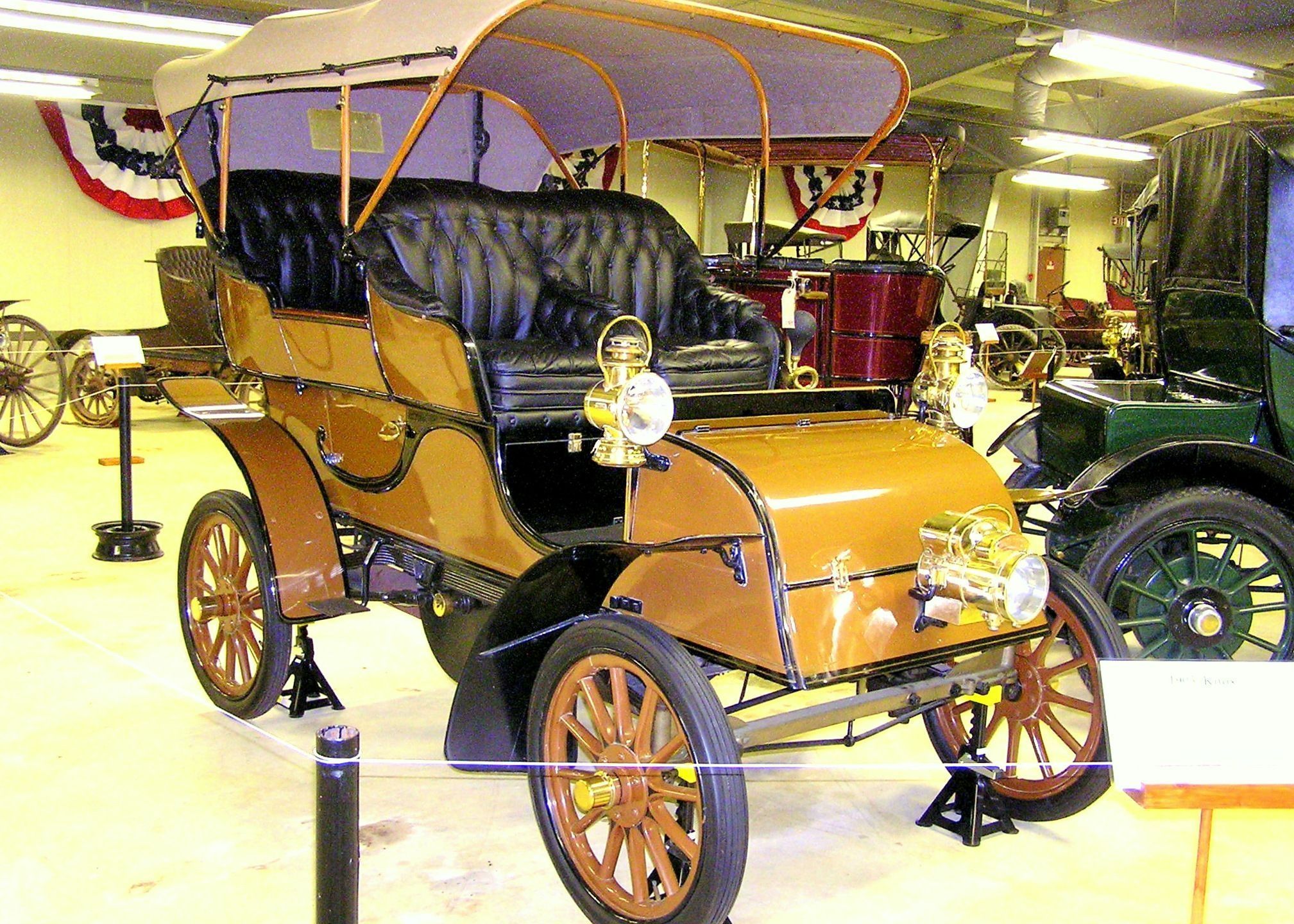
Knox 1904Description
The Knox Automobile Company was a pioneer in the automobile business in New England. The company's founder, Harry Austin Knox, was born in 1875 in the outskirts of Westfield and went to school at the Springfield Industrial Institute. His practical work was done at the Elektron Company, manufacturers of electric motors and elevators, conveniently located next to the school building. He graduated at the top of his class of twelve in 1894 and gave the graduation address. A few years later, Knox built his first three cars, with the help of his former classmate Herman Farr. The two men returned to Springfield and talked Elisha Cutler into forming the Knox Automobile Company. The business started in 1899 with the manufacture of a three-wheeled vehicle with a six-horsepower, air-cooled engine. There was no reverse on the transmission, as the vehicle could turn a nine-foot circle. The three-wheelers were sold for cash right from the factory door. Though Knox had only a trade school education, he was an engineering genius. The company built everything from three-wheelers to tractors, buses, and the ultimate six-cylinder closed car with a 65-horsepower, water-cooled engine. The powerful six-cylinder cars won many hill climbs and races. Beginning in 1906, Knox built fire engines that made Springfield the first motorized fire department in the country. The company went out of business in 1927, after building thousands of machines.
The Knox car, built in Springfield, MA, by Harry R. Knox was a bit different that most right from the start. The firm started out with a one-cylinder air-cooled engine which was in a very distinctive three-wheeled-tiller-steered chassis in 1900-1901. Knox soon moved to four wheels in 1902, along with a two-cylinder engine which was horizontal as the earlier one-cylinder was.
The Knox cars were tiller driven until 1904, in 1905 they adopted a steering column and wheel, but it appears that they used the tiller column visible in front of the drivers arm, for other control functions. This car uses the style of hood which is seen in a 1907 catalog illustration, but could have possibly also have been used in 1906. The model F was offered in three different wheelbases during 1906 that ranged between 81" to 90" and in 1907 only as a 91" version. During both years the engines are listed as being rated at 14/16 h.p.
Most makers of air-cooled engines utilized cooling fins which were usually cast integral with the cylinder block. At the time it was found this would only work for light duty engines, as it could not carry off heat fast enough under heavy loads. Harry Knox took it one step further and came up with the clever invention called pin-cooling. The illustration below shows his solution, where hundreds of specially made pins with a spiral-knurled surface which increased the surface area a reported 100%. The pins were threaded into holes which were drilled and tapped into the casting. According to the 1911 edition of Self-Propelled Vehicles, these pins which were machined out of brass round stock. The combination of the pins and a small mechanically-driven fan, kept the Knox engine running at normal engine temperatures. This pin-cooling lead to the air-cooled Knox engine acquiring the nickname, "The Porcupine engine".
This is a tonneau touring car with a brown body trimmed in black, a surrey top, a black tufted leather interior, and brown wood spoked wheels. The top can be raised or lowered in thirty seconds and then acts as a very good dust shield when folded back; it also has detachable side curtains. There is a large carrying space under the back of the rear seat with rear access to same. Rear side doors may be 'prototype' as more common rear entry single door was not only popular but typical.
The cooling system, with dozens of two inch metal pins screwed into cylinder jackets was used to conduct heat from the cylinder rather than the more usual fins. This led to the nickname of "Old Porcupine." The "Waterless Knox" became a popular designation in 1903. The slogan was "The Car That Never Drinks."