Name/Title
American Underslung, 1910Description
The vehicle has had four owners from new including Larz Anderson, Isabel Anderson,
Briggs Cunningham, the Collier Family prior to donation to the Richard C Paine Charitable Trust.
Serial number is 2465, Engine no., 2051.
There are approximately 30 Americans that still exist of all types that were produced.
American Engines were built by the Light Inspection Car Company (LICC). LICC later became Teetor Hartley. When Teetor Hartley got out of the engine building business in the mid 19teens it was renamed Perfect Circle. Unfortunately none of the engine records have survived.
A list of existing cars was put together by Walter Seeley in 1971 and it was published in the Antique Automobile magazine. His list has since been updated to show cars that have been located since 1971. The list had some of the serial numbers for the existing cars but it is not complete. Based on the serial number of the Anderson/Cunningham American it would have been a 1911 Model Year car. A couple of other characteristics of the car help to confirm this dating. The 1911 cars were the first to have an enclosed cowl with a front passenger door. The 1910 cars had no front doors.
It is not a 1912 Model year car because electric cowl lamps integrated into the body were introduced in 1912. The fact that the car originally had gas headlights indicates it is not a 1913 Model Year car. By 1913 American had adopted electric headlights on its cars.
In 1911 American was offering cars with underslung and non-underslung chassis. The company literature would have listed the car as an American. The buyer would have had to option to purchase a car with or without the underslung chassis. In early 1911 the company was reorganized and the name of the company changed from the American Motor Car Company to American Motors Company. Shortly after the organizational change they dropped the non-underslung cars and starting referring to the cars as American Underslung. Technically the Anderson/Cunningham car would be an "American", however, only one non-underslung chassis car still exists (was in the Paine collection, sold in 2008 auction) and, since the Trust's car is a 1911 "American," it is perfectly correct to refer to it as an American Underslung.
The reference to the reorganization of the company came from Walter Seeley's 1972 magazine article. He states as follows: "Official notice of reorganization was made in a letter dated February 2, 1911 from the factory to their dealers, simply stating that the entire business of the American Motor Car Company had passed into the hands of the American Motors Company, a corporation, which would materially add to the facilities of the old company." Seeley's article appeared in the July-August 1972 Antique Automobile Magazine. Seeley was able to obtain a great deal of original American literature and photos from F. F. Tone who was the son of the designer of the American Underslung. He also restored four of the existing Americans that were originally purchased by the same family. A copy of the article resides in the Seal Cove Museum's archive.
The Anderson/Cunningham car is a definitely a Traveler. The Tourist designation was used for the non-Underslung cars up until 1911. After discontinuing non-Underslung cars the name Tourist was used to designate the smaller lower priced American Underslung touring car introduced in 1911. Seeley notes that the cars were named Traveler after General Robert E. Lee's famous horse... RMR October 26, 2013.
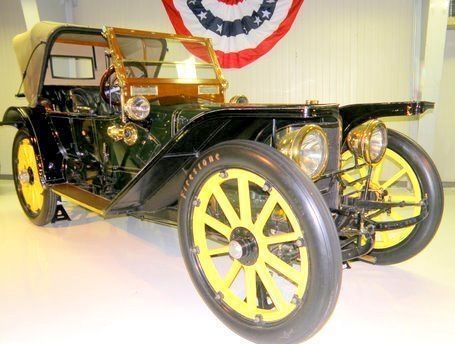
This is a large open vehicle with a black "Victoria" soft-top over the rear seats, a green over black body, yellow wood spoked wheels, brass lighting, horn, and accessories, a varnished wood/brass windscreen, and a black tufted leather interior.
American Traveler "Underslung" model. Referred to as "Underslung" because the frame hung below the axles giving the car a low appearance and more stability without sacrificing ground clearance. Able to make a 55 degree turn. (Average car could only turn 43 degrees.)
It is powered by a four cylinder, 50 horsepower gas engine. The wheelbase is 124 inches, which was the longest offered this year. The wheels are very large, 41inches, offering superior ground clearance.
The 1910 American models sold for over $4,000, hence the company's advertisements which stated, "A Car for the Discriminating Few."
The odometer reads 4,200 miles, perhaps showing that this car was used sparingly.