Name/Title
CrucifixEntry/Object ID
2025.9.1Description
Title [assigned by archives]: Crucifix
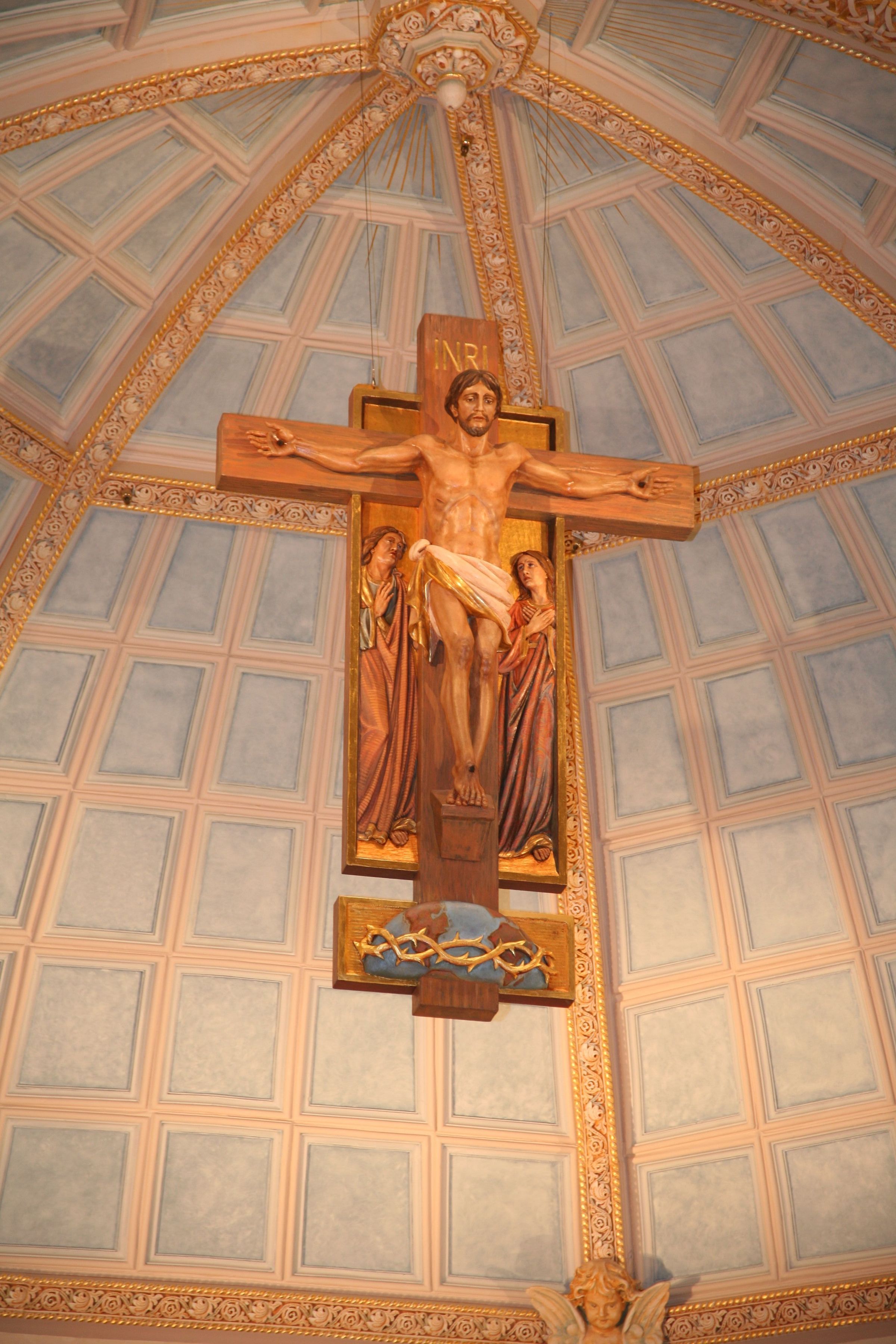
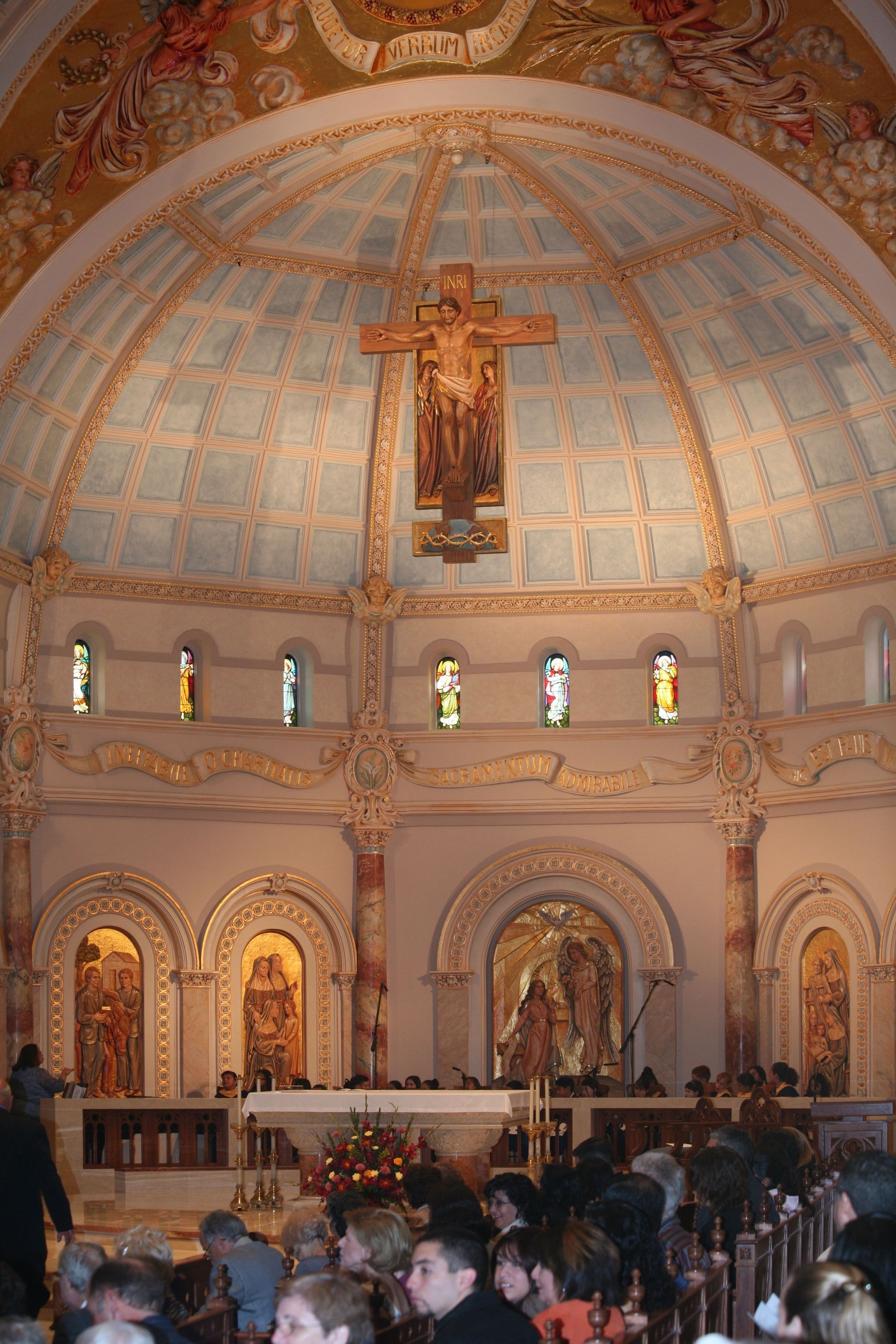
This 10-foot linden wood Crucifix hangs above the altar in the apse of the Chapel of the Incarnate Word. It was commissioned by the Sisters of Charity of the Incarnate Word during the chapel renovation of 2006-2007, which corresponded with the 100th anniversary of the completion of the Chapel. Woodcrafter Edmund Rabanser carved the statue in his studio in Ortisei, Italy using drawings by artist Renate Rohn.
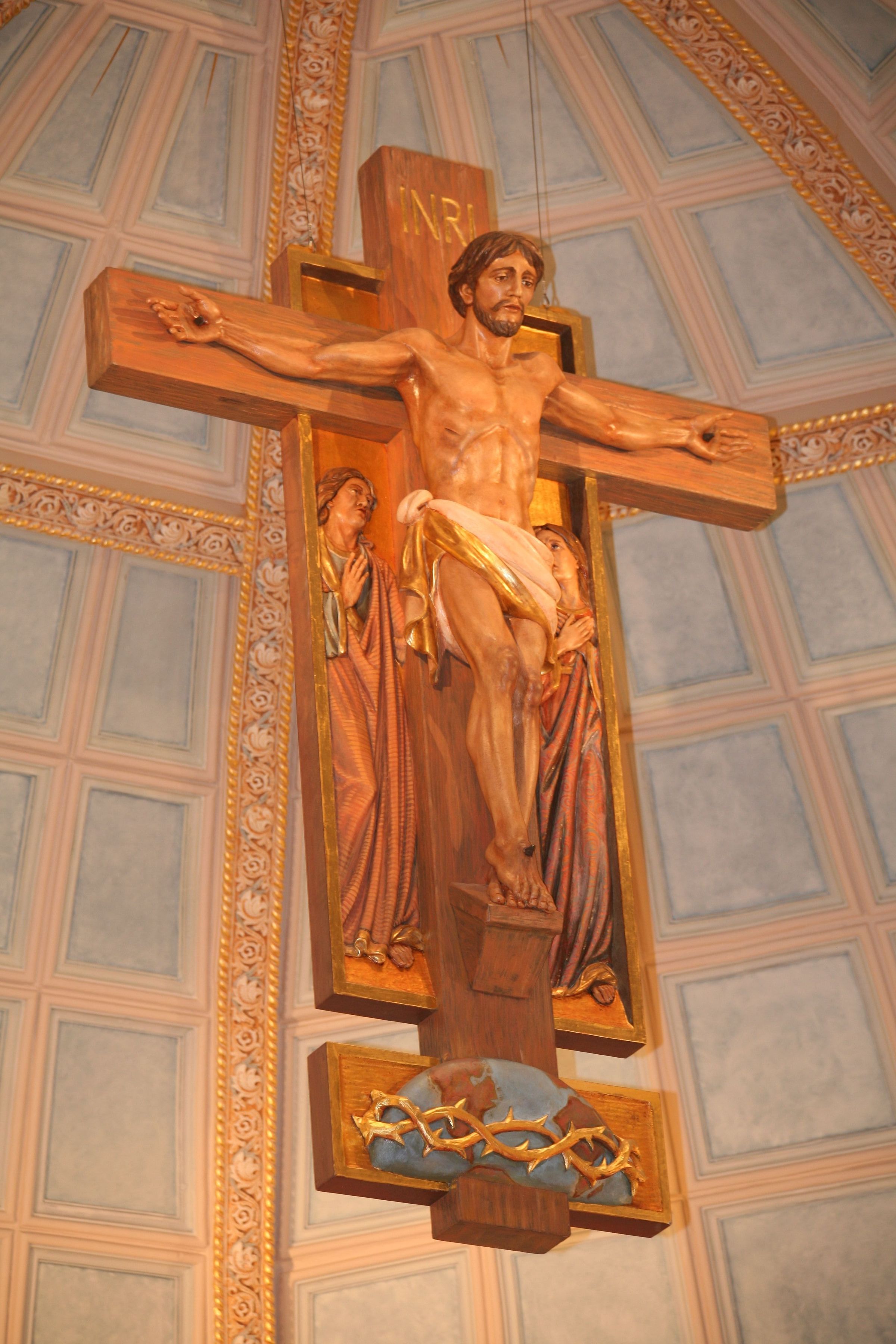
Jesus hangs on the cross, his gaze cast downward. The Virgin Mary and Mary Magdalene stand at either side of him. An inscription above his head reads “INRI,” a Latin acronym that stands for "Iesus Nazarenus, Rex Iudaeorum," which translates to "Jesus of Nazareth, King of the Jews." A globe circled by a Crown of Thorns sits at the base of the Crucifix. Sister Eilish Ryan, CCVI wrote the following description of the Crucifix’s imagery:
“The Cross is inserted into the whole Earth, rather than just the rocky hill of Calvary, to emphasize Jesus’ relationship with all of humanity and even the earth itself. The merciful love of God extends to all peoples of the earth in the daily realities of their lives, in many cultures and conditions, mainly through the self-giving concern and solidarity of people of good will and generous heart.
Second, the life-size figure of Jesus is portrayed as a non-Caucasian man, [specifically a Hispanic.] [The face of Jesus was modeled after a Panamanian-born Dominican priest, Fr. Wilmo Candanedo, former pastor of St. Ann Church here in San Antonio, and now stationed at the Dominican priory in Irving, Texas.] The choice of a non-white Jesus is intended to highlight some of the deeper issues that people often do not think about when they view traditional representations of Jesus: questions about systemic economic injustice which leaves millions of people without even basic human necessities such as housing, access to education, adequate food and health care.
Third, the Crown of Thorns encircles the Earth rather than the head of Jesus. This focuses our attention on the suffering of the global human family and the environment through wars, genocide, oppression, natural disasters, pollution and human perversity and greed. While in faith we believe that the suffering which occurs on earth is transformed in the risen Christ, human beings have the responsibility to work toward the alleviation of human suffering and the protection of the natural environment.”
///////////////////////////////////
Título [asignado por los archivos]: Crucifijo
Este crucifijo de madera de tilo de 3 metros de altura cuelga sobre el altar en el ábside de la Capilla del Verbo Encarnado. Fue encargado por las Hermanas de la Caridad del Verbo Encarnado durante la renovación de la capilla en 2006-2007, que coincidió con el centenario de la finalización de la capilla. El artesano Edmund Rabanser talló la estatua en su taller de Ortisei, Italia, utilizando dibujos de la artista Renate Rohn.
Jesús cuelga de la cruz con la mirada dirigida hacia abajo. La Virgen María y María Magdalena están a ambos lados de él. Sobre su cabeza hay una inscripción que dice «INRI», acrónimo latino que significa «Iesus Nazarenus, Rex Iudaeorum», que se traduce como «Jesús de Nazaret, Rey de los Judíos». Un globo terráqueo rodeado por una corona de espinas se encuentra en la base del crucifijo. La hermana Eilish Ryan, CCVI, escribió la siguiente descripción de la singular imaginería del crucifijo:
«La cruz está insertada en toda la Tierra, y no solo en la colina rocosa del Calvario, para enfatizar la relación de Jesús con toda la humanidad e incluso con la propia Tierra. El amor misericordioso de Dios se extiende a todos los pueblos de la tierra en la realidad cotidiana de sus vidas, en muchas culturas y condiciones, principalmente a través de la preocupación desinteresada y la solidaridad de las personas de buena voluntad y corazón generoso.
En segundo lugar, la figura de Jesús a tamaño real se representa como un hombre no caucásico, [concretamente, hispano]. [El rostro de Jesús se inspiró en el de un sacerdote dominicano nacido en Panamá, el padre Wilmo Candanedo, antiguo párroco de la iglesia de Santa Ana aquí en San Antonio, y ahora destinado en el convento dominicano de Irving, Texas]. La elección de un Jesús no blanco tiene por objeto poner de relieve algunas de las cuestiones más profundas en las que la gente no suele pensar cuando ve las representaciones tradicionales de Jesús: cuestiones relacionadas con la injusticia económica sistémica que deja a millones de personas sin siquiera las necesidades humanas básicas, como la vivienda, el acceso a la educación, una alimentación adecuada y la atención sanitaria.
En tercer lugar, la corona de espinas rodea la Tierra en lugar de la cabeza de Jesús. Esto centra nuestra atención en el sufrimiento de la familia humana global y del medio ambiente a causa de las guerras, el genocidio, la opresión, los desastres naturales, la contaminación y la perversidad y codicia humanas. Si bien en la fe creemos que el sufrimiento que se produce en la tierra se transforma en Cristo resucitado, los seres humanos tenemos la responsabilidad de trabajar para aliviar el sufrimiento humano y proteger el medio ambiente natural».Type of Sculpture
Free StandingCollection
HIM-US-Communities-MotherhouseMade/Created
Date made
2006Time Period
21st CenturyPlace
City
Ortisei, ItalyRegion
Central EuropeContinent
EuropeLexicon
Nomenclature 4.0
Nomenclature Tertiary Object Term
CrucifixNomenclature Secondary Object Term
CrossNomenclature Primary Object Term
Symbol, ReligiousNomenclature Sub-Class
Religious ObjectsNomenclature Class
Ceremonial ObjectsNomenclature Category
Category 08: Communication ObjectsLOC Thesaurus for Graphic Materials
Crucifixes, Religious art objects, Wood carvingResearch Notes
Research Type
CuratorNotes
"Through a lifetime of professional art experience, Renate Rohn has brought her artistic skills to thousands of churches and historic art restoration projects. Her expertise includes custom murals, paintings and icons; statue and painting restoration; and artistic visions for paintings, statuary, mosaics and art glass."Research Type
CuratorNotes
"Nearly half a century ago, Rudolph Rohn discovered a brilliant young artisan whose God-given talent allowed him to carve masterpieces from wood. So strong was Rudolph’s faith in this gifted woodcarver that he entrusted him with his first major commission. That young artisan was Edmund Rabanser—who would go on to become one of the world’s preeminent master woodcarvers.
Today [05/28/2016], with heartfelt sympathy, Rolf Rohn shares the news of Edmund’s passing. A trusted collaborator and dear friend, Edmund was a true artist—devoted to creating one-of-a-kind sacred works through simple Old World craftsmanship in his treasured Ortisei studio, nestled in his home overlooking the Italian Alps."