Name/Title
Our Lady of Guadalupe NichoEntry/Object ID
2025.8.6Tags
EnedinaVasquezDescription
Title [assigned by archives]: Our Lady of Guadalupe Nicho
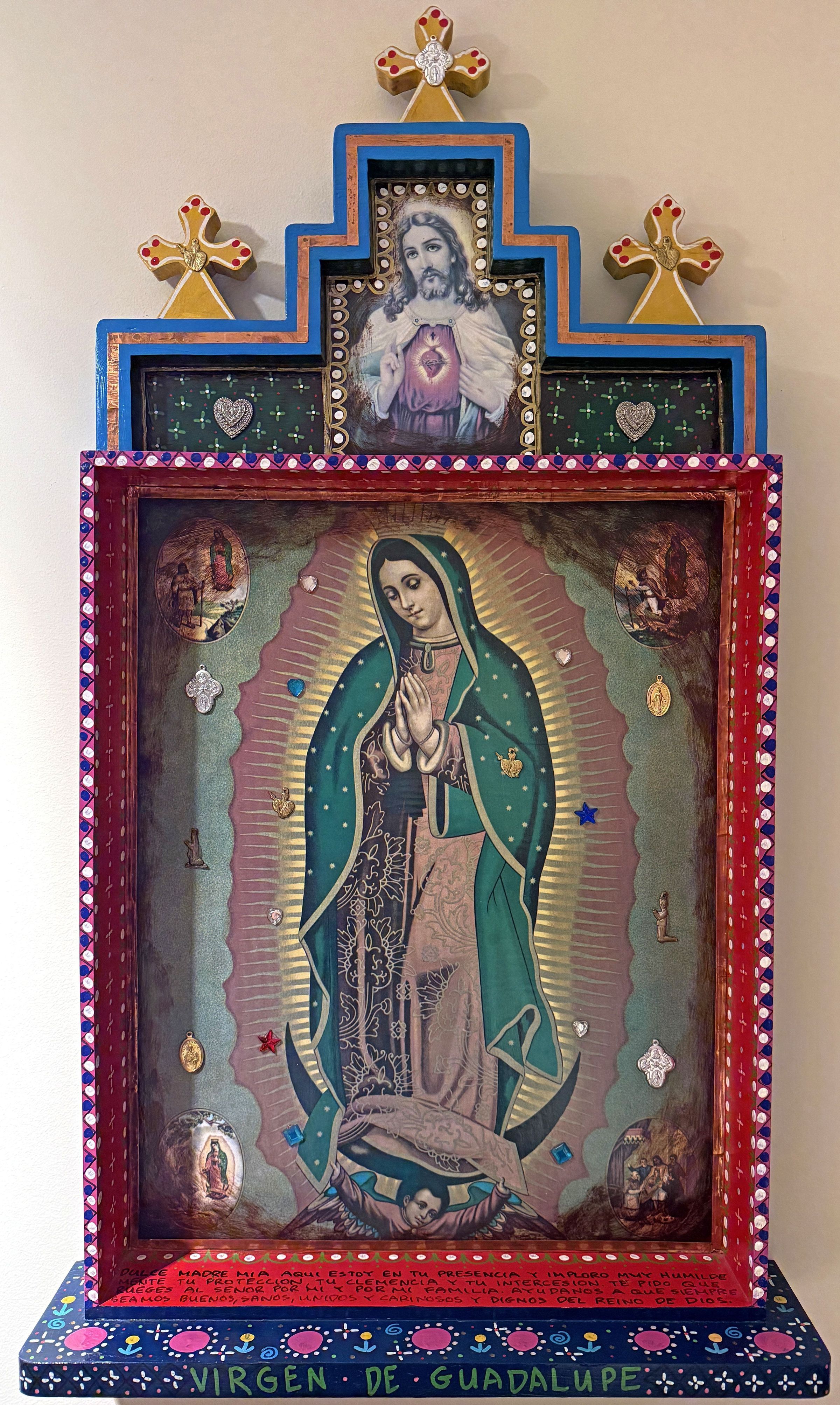
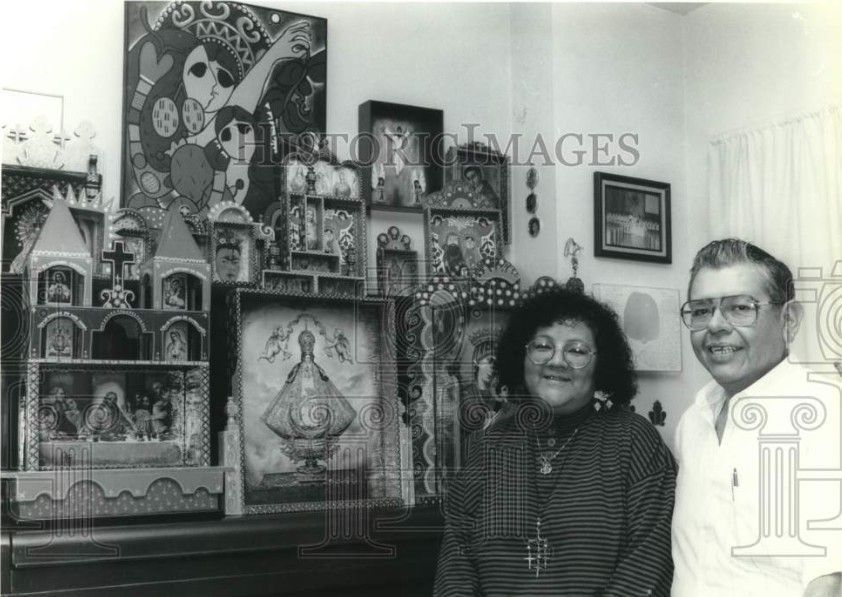
San Antonio artists Enedina Cásarez Vásquez (1945 – 2021) and Arturo Cantu Vásquez (1945 – 2004), known together as “Ene-Art,” created this Mexican-style “nicho,” or niche, for Visitation House Ministries in 1994. Enedina and Arturo collaborated on Ene-Art and made countless nichos from 1987 until Arturo’s passing in 2004. According to the Ene-Art website (eneart.com), “Arturo cut and sanded each of the pieces while Enedina added color and fanciful designs. Many of her design ideas drew their inspiration from Mexico’s Huichol Indians. Enedina also incorporated antique holy cards and iconic images from Mexico into the folk art pieces and occasionally added tin milagritos (miracles).”
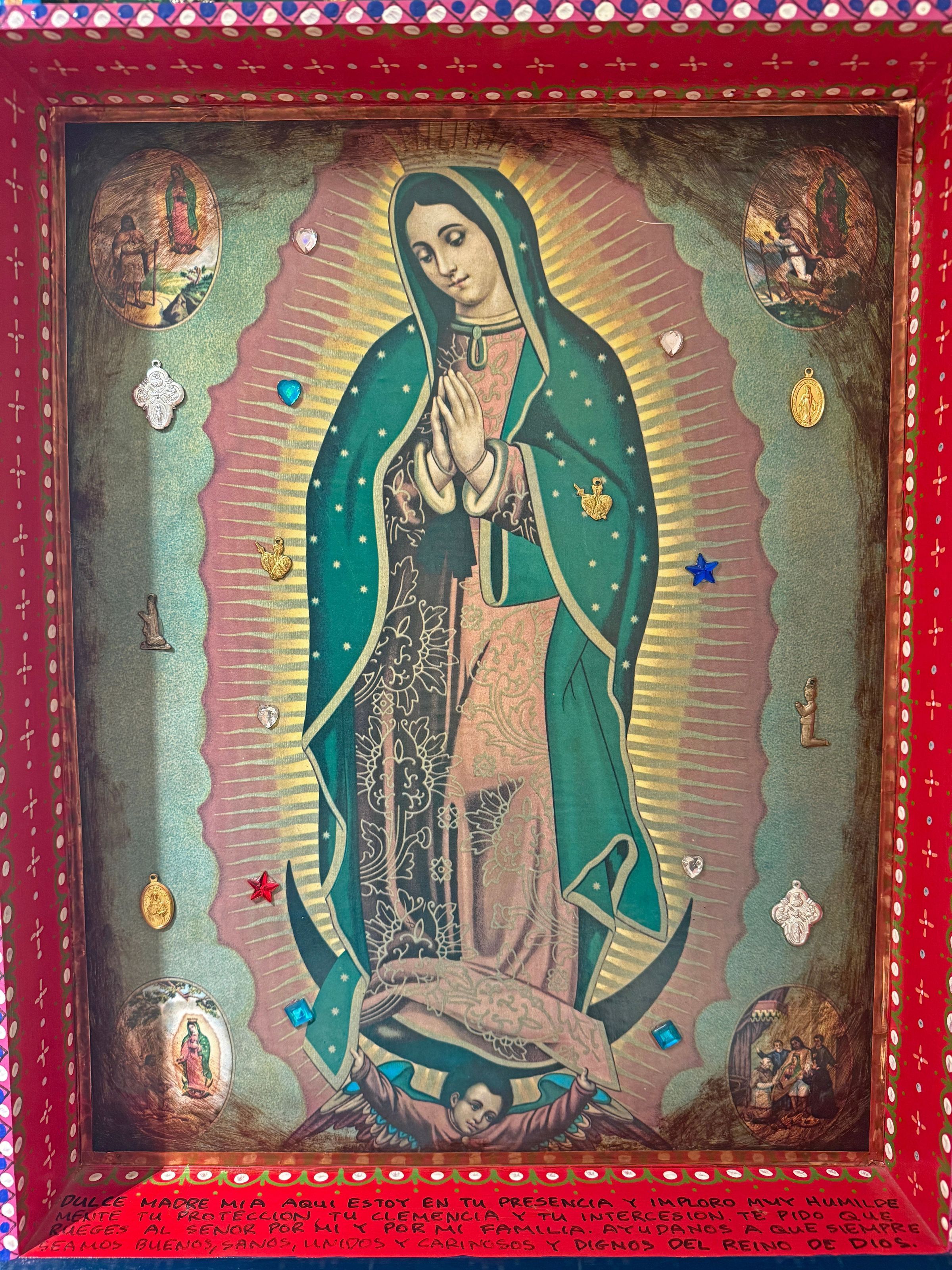
This nicho prominently features the image of the Our Lady of Guadalupe from the tilma of Saint Juan Diego. In 1531, she appeared three times to Juan Diego Cuauhtlatoatzin (1474–1548), an Indigenous Aztec convert, on Tepeyac Hill. After the final apparition, her image was miraculously imprinted on his cactus-fiber cloak (tilma). The original tilma is preserved today in the Basilica of Our Lady of Guadalupe, though the image has been widely reproduced.
The image of the Virgen is set back into the recessed central panel of the nicho. In each of the four corners surrounding Our Lady is an oval vignette: three depict her revealing herself as an apparition, and one depicts Juan Diego presenting his tilma to Bishop Zumárraga of Mexico. Vásquez affixed several faux gemstones and small milagritos, tin miraculous medals, around the Virgen.
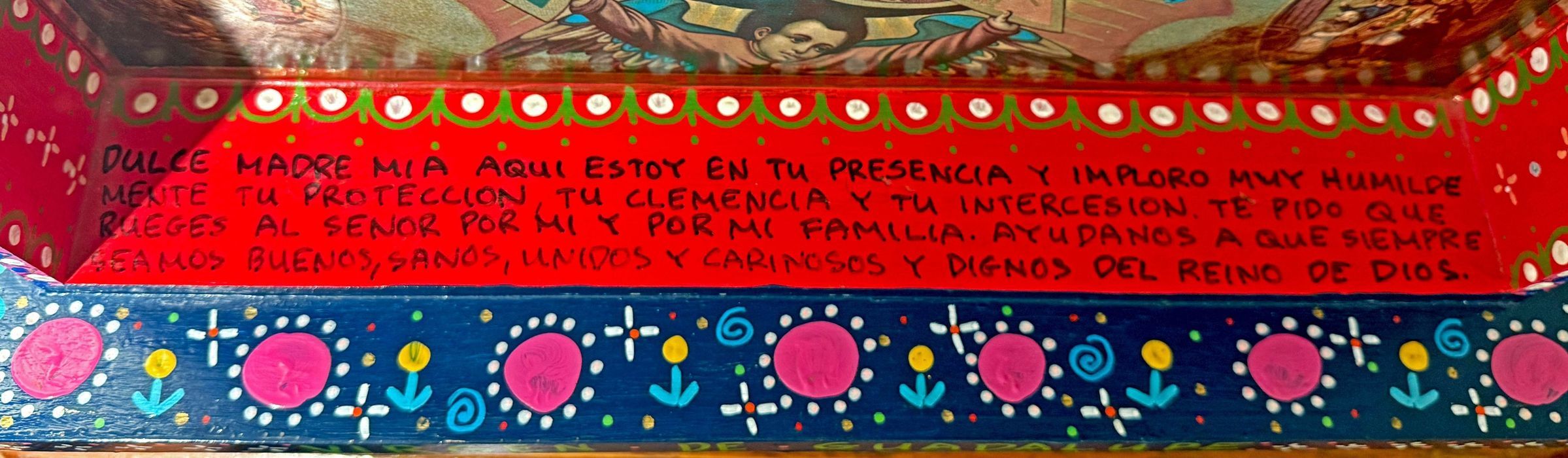
Beneath the Virgin, a handwritten inscription in Spanish reads: “Sweet Mother Mary, here I am in your presence, humbly imploring your protection, your mercy, and your intercession. I ask you to pray to the Lord for me and my family. Help us to always be good, healthy, united, loving, and worthy of the kingdom of God.” Along the base, Vásquez painted the words “Virgen de Guadalupe” in bold green letters. The nicho is topped by a smaller, stepped recess containing an image of Jesus displaying his Sacred Heart. This upper section is crowned with three small golden crosses.
/////////////////
Título [asignado por los archivos]: Nuestro Señor de Guadalupe Nicho
Los artistas de San Antonio Enedina Cásarez Vásquez (1945-2021) y Arturo Cantu Vásquez (1945-2004), conocidos juntos como «Ene-Art», crearon este «nicho» de estilo mexicano para Visitation House Ministries en 1994. Enedina y Arturo colaboraron en Ene-Art y crearon innumerables nichos desde 1987 hasta el fallecimiento de Arturo en 2004. Según el sitio web de Ene-Art (eneart.com), «Arturo cortaba y lijaba cada una de las piezas, mientras que Enedina añadía color y diseños fantasiosos. Muchas de sus ideas de diseño se inspiraban en los indios huicholes de México. Enedina también incorporaba antiguas estampas religiosas e imágenes icónicas de México en las piezas de arte popular y, en ocasiones, añadía milagritos de hojalata».
Este nicho destaca la imagen de Nuestra Señora de Guadalupe de la tilma de San Juan Diego. En 1531, se le apareció tres veces a Juan Diego Cuauhtlatoatzin (1474-1548), un indígena azteca convertido al cristianismo, en el cerro del Tepeyac. Tras la última aparición, su imagen quedó milagrosamente impresa en su manto de fibra de cactus (tilma). La tilma original se conserva hoy en día en la Basílica de Nuestra Señora de Guadalupe, aunque la imagen ha sido ampliamente reproducida.
La imagen de la Virgen está colocada en el panel central empotrado del nicho. En cada una de las cuatro esquinas que rodean a Nuestra Señora hay una viñeta ovalada: tres representan su aparición y una representa a Juan Diego presentando su tilma al obispo Zumárraga de México. Vásquez colocó varias piedras preciosas falsas y pequeños milagritos, medallas milagrosas de hojalata, alrededor de la Virgen.
Debajo de la Virgen, una inscripción manuscrita en español dice: «Dulce Madre María, aquí estoy en tu presencia, implorando humildemente tu protección, tu misericordia y tu intercesión. Te pido que reces al Señor por mí y por mi familia. Ayúdanos a ser siempre buenos, sanos, unidos, amorosos y dignos del reino de Dios». A lo largo de la base, Vásquez pintó las palabras «Virgen de Guadalupe» en letras verdes en negrita. El nicho está coronado por un hueco escalonado más pequeño que contiene una imagen de Jesús mostrando su Sagrado Corazón. Esta sección superior está coronada por tres pequeñas cruces doradas.Collection
HIM-US-Ministries_Visitation HouseMade/Created
Artist
Ene-Art: Enedina Cásarez Vásquez and Arturo VásquezDate made
1994Time Period
20th CenturyInscription/Signature/Marks
Type
Signature, InscriptionLocation
Back of artworkTranscription
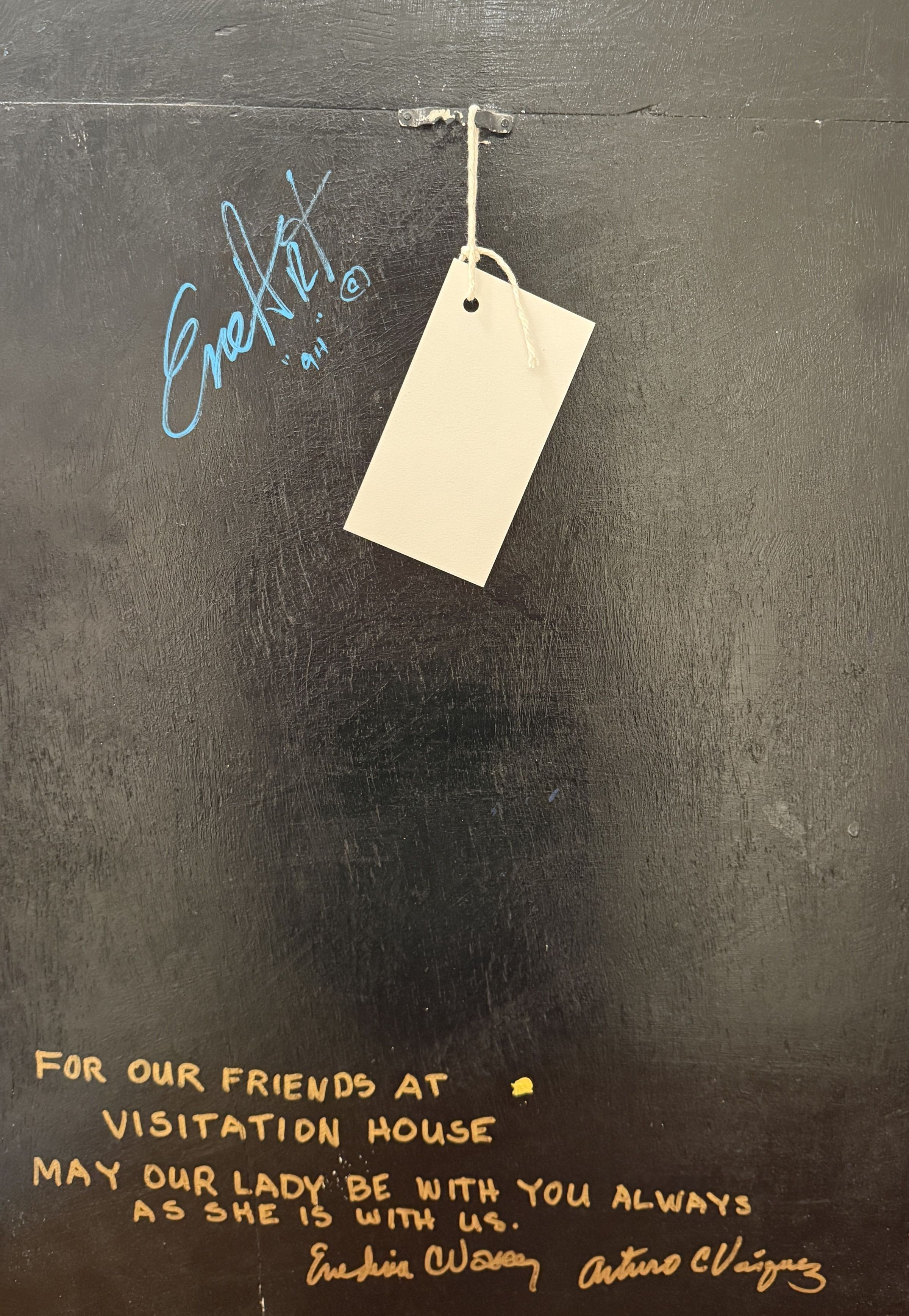
"Ene-Art © '94'" / "For our friends at Visitation House / May Our Lady be with you always as she is with us. - Enedina C. Vasquez, Arturo C. Vásquez"Language
EnglishTranslation
«Ene-Art © '94» / «Para nuestros amigos de Visitation House / Que Nuestra Señora esté siempre con vosotros como está con nosotros. - Enedina C. Vásquez, Arturo C. Vásquez»Material/Technique
In Artist's Hand, PenType
InscriptionLocation
Underneath image of Our LadyTranscription
Dulce Madre Mia aquí estoy en tu presencia y imploro muy humilmente tú protección, tu clemencia y tu intercesión. te pido que ruegues al Señor por mí y por mi familia. Ayúdanos a que siempre seamos buenos, sanos, unidos y cariñosos y dignos del reino de Dios.Language
SpanishTranslation
Sweet Mother Mary, here I am in your presence, humbly imploring your protection, your mercy, and your intercession. I ask you to pray to the Lord for me and my family. Help us to always be good, healthy, united, loving, and worthy of the kingdom of God.Material/Technique
Pen, In Artist's HandType
LabelLocation
Bottom of artworkTranscription
Virgen de GuadalupeLanguage
SpanishTranslation
Virgin of GuadalupeMaterial/Technique
In Artist's Hand, PenDimensions
Height
20 inWidth
16 inDepth
1 inResearch Notes
Research Type
CuratorNotes
A native of San Antonio, Texas, Enedina Cásarez Vásquez (1945 – 2021) was a poet, playwright, visual artist, and Lutheran pastor. She received a Fine Arts degree from Our Lady of the Lake University and taught art at St. Peter Prince of the Apostles and Holy Cross High School. From 1986 to 1991, Vásquez served on the first iteration of the Fine Arts Commission for the City of San Antonio.
From 1987 to 2004, Enedina and her husband, Arturo Vásquez, produced a popular array of folk-art pieces under the name of Ene-Art. Their products, inspired by the synthesis of the Catholic faith and Native American/Chicano culture, included wooden nichos (niches), jewelry, and furniture. Their work was displayed and sold in over 30 art galleries and museum gift shops throughout the United States. For several years, the couple also designed and constructed the annual Día de los Muertos exhibition at the Witte Museum. Enedina’s Día de los Muertos altar was later featured in Chicano Now: American Expressions, a traveling exhibition (2001–2008) sponsored by Cheech Marin and the Smithsonian Institution.
Vásquez was a friend of Visitation House founder and director Sister Yolanda Tarango, CCVI. Together, they were members of Las Hermanas, a national organization founded in 1971 to amplify the voices of Latina Sisters and laywomen within the U.S. Catholic Church. Throughout her career, Enedina generously donated artwork to Visitation House and other nonprofit organizations. In 1987, she wrote a poem that Visitation House adopted as its guiding philosophy:
“If you tire in the struggle of constant echoes of, ‘it’s not your place’… take the hand of the woman you love. And, let us take our flight.”
Enedina Vásquez passed away in San Antonio in 2021.Research Type
CuratorNotes
Nacida en San Antonio, Texas, Enedina Cásarez Vásquez (1945-2021) fue poeta, dramaturga, artista visual y pastor luterano. Se licenció en Bellas Artes por la Universidad Our Lady of the Lake y enseñó arte en el colegio St. Peter Prince of the Apostles y en el instituto Holy Cross High School. De 1986 a 1991, Vásquez formó parte de la primera Comisión de Bellas Artes de la ciudad de San Antonio.
Entre 1987 y 2004, Enedina y su marido, Arturo Vásquez, produjeron una popular serie de piezas de arte popular bajo el nombre de Ene-Art. Sus productos, inspirados en la síntesis de la fe católica y la cultura nativa americana/chicana, incluían nichos de madera, joyas y muebles. Su obra se expuso y vendió en más de 30 galerías de arte y tiendas de regalos de museos de todo Estados Unidos. Durante varios años, la pareja también diseñó y construyó la exposición anual del Día de los Muertos en el Museo Witte. El altar del Día de los Muertos de Enedina se presentó posteriormente en Chicano Now: American Expressions, una exposición itinerante (2001-2008) patrocinada por Cheech Marin y la Institución Smithsonian.
Vásquez era amiga de la fundadora y directora de Visitation House, la hermana Yolanda Tarango, CCVI. Juntas, eran miembros de Las Hermanas, una organización nacional fundada en 1971 para amplificar las voces de las hermanas y mujeres laicas latinas dentro de la Iglesia católica de los Estados Unidos. A lo largo de su carrera, Enedina donó generosamente obras de arte a Visitation House y otras organizaciones sin fines de lucro. En 1987, escribió un poema que Visitation House adoptó como su filosofía rectora:
«Si te cansas de la lucha constante de los ecos de «no es tu lugar»... toma la mano de la mujer que amas. Y emprendamos nuestro vuelo».
Enedina Vásquez falleció en San Antonio en 2021.