Research Type
CuratorNotes
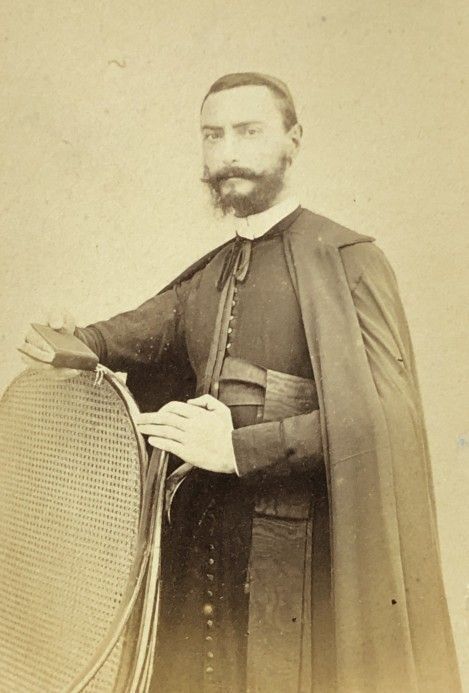
*Notes on the life of Monseigneur Felix Valarga [from the Latin Patriarchate of Jersusalem website]:
Born: 26.4.1838 Loano (Savona, Italy) nephew of SB Patriarch Giuseppe Valerga
Ordination: 2.3.1862
April 25, 1862: Joined the Latin Patriarchate of Jerusalem
Secretary General of the Latin Patriarchate under His Holiness Patriarch Vincenzo Bracco
1.1.1871: Invested as Canon of the Holy Sepulchre
October 6, 1882: Leaves the Latin Patriarchate
1908: Retired to his home in Loano (where P. Lahon saw him) at the age of 70
Died: January 5, 1924 in Loano, at the age of 86
Writings: 4 volumes of the life of Bishop Giuseppe Valerga, discovered by Father Pierre Medebielle at the procurator's office of the Fathers of Bétharram in Rome and brought back by him to Jerusalem. (bound, archives)
*Notes on Monseigneur Giuseppe Valerga from eBay listing of photo card of Don Felix Valerga:
Giuseppe Valerga, born in Loano, Liguria, on April 9, 1813, and died on December 2, 1872, in Jerusalem, was an Italian clergyman who served as the first Latin Patriarch of Jerusalem following the restoration of the patriarchate by Pius IX in 1847. He had been ordained a priest in 1836.
Giuseppe Valerga earned a doctorate in theology from the Sapienza University and became a professor at the College of the Propaganda Fide. Later, in 1841, he served as secretary to the Apostolic Delegate for Syria, Aleppo, and Mesopotamia. After serving as Vicar General for Mesopotamia, he was consecrated Latin Patriarch of Jerusalem on October 10, 1847, by Pius IX himself in the chapel of his palace on the Quirinal Hill (the popes did not reside in the Vatican during the time of the Papal States). Bishop Valerga was then a young clergyman of thirty-four years of age.
From the time of his consecration until his death, Bishop Valerga served as Grand Master of the Equestrian Order of the Holy Sepulchre of Jerusalem. From 1862 to 1872, he oversaw the construction of the Latin Co-Cathedral, the patriarch’s seat. It is called a “co-cathedral” because the true mother church is the Basilica of the Holy Sepulchre, which is shared among several denominations.
Bishop Valerga also built the seminary in Beit Jala, outside Jerusalem, for the training of future priests in the Holy Land. He played an active and significant role in the First Vatican Council.
He died of typhus in 1872, shortly after the consecration of his co-cathedral—to which many French people had contributed—and was buried beneath the altar of Saint Joseph in the co-cathedral.
Bishop Valerga spoke, of course, Italian and Latin, as well as Greek, French (France was still the guardian of the Holy Places at the time), Arabic, and Hebrew, and later learned Turkish, Chaldean, and Kurdish. His two brothers were priests; one, Charles-Hyacinthe (1818–1864), was a missionary and apostolic vicar in India, and one of his sisters was a nun.Research Type
CuratorNotes
*Notas sobre la vida de Monseñor Félix Valarga [extraídas de la página web del Patriarcado Latino de Jerusalén]:
Nacido el 26 de abril de 1838 en Loano (Savona, Italia), sobrino de Su Beatitud el Patriarca Giuseppe Valerga
Ordenación: 2 de marzo de 1862
25 de abril de 1862: Ingresó en el Patriarcado Latino de Jerusalén
Secretario general del Patriarcado Latino bajo Su Santidad el Patriarca Vincenzo Bracco
1 de enero de 1871: Nombrado canónigo del Santo Sepulcro
6 de octubre de 1882: Abandona el Patriarcado Latino
1908: Se retira a su casa en Loano (donde lo vio el P. Lahon) a la edad de 70 años
Fallecido: 5 de enero de 1924 en Loano, a la edad de 86 años
Escritos: 4 volúmenes sobre la vida del obispo Giuseppe Valerga, descubiertos por el padre Pierre Medebielle en la procuraduría de los Padres de Bétharram en Roma y traídos por él a Jerusalén. (encuadernados, archivos)
*Notas sobre monseñor Giuseppe Valerga extraídas de la ficha de eBay de una tarjeta fotográfica de don Félix Valerga:
Giuseppe Valerga, nacido en Loano, Liguria, el 9 de abril de 1813, y fallecido el 2 de diciembre de 1872 en Jerusalén, fue un clérigo italiano que ocupó el cargo de primer patriarca latino de Jerusalén tras la restauración del patriarcado por Pío IX en 1847. Había sido ordenado sacerdote en 1836.
Giuseppe Valerga obtuvo un doctorado en teología por la Universidad de La Sapienza y se convirtió en profesor del Colegio de la Propaganda Fide. Más tarde, en 1841, ocupó el cargo de secretario del Delegado Apostólico para Siria, Alepo y Mesopotamia. Tras ejercer como vicario general de Mesopotamia, fue consagrado patriarca latino de Jerusalén el 10 de octubre de 1847 por el propio Pío IX en la capilla de su palacio en la colina del Quirinal (los papas no residían en el Vaticano durante la época de los Estados Pontificios). El obispo Valerga era entonces un joven clérigo de treinta y cuatro años.
Desde el momento de su consagración hasta su muerte, el obispo Valerga ejerció como Gran Maestre de la Orden Ecuestre del Santo Sepulcro de Jerusalén. De 1862 a 1872, supervisó la construcción de la Concatedral Latina, sede del patriarca. Se denomina «concatedral» porque la verdadera iglesia madre es la Basílica del Santo Sepulcro, que es compartida por varias confesiones.
El obispo Valerga también construyó el seminario de Beit Jala, en las afueras de Jerusalén, para la formación de los futuros sacerdotes en Tierra Santa. Desempeñó un papel activo y destacado en el Concilio Vaticano I.
Falleció de tifus en 1872, poco después de la consagración de su concatedral —a la que habían contribuido muchos franceses— y fue enterrado bajo el altar de San José en la concatedral.
El obispo Valerga hablaba, por supuesto, italiano y latín, así como griego, francés (Francia seguía siendo la guardiana de los Lugares Santos en aquella época), árabe y hebreo, y más tarde aprendió turco, caldeo y kurdo. Sus dos hermanos eran sacerdotes; uno de ellos, Charles-Hyacinthe (1818-1864), fue misionero y vicario apostólico en la India, y una de sus hermanas era monja.