Research Type
CuratorNotes
Brother Cletus George Behlmann, SM was born on November 3, 1933 in Florissant, Missouri. The 11th of 12 children, he grew up on the family farm and attended a Marianist high school before professing his first vows as a Marianist brother in 1953. He earned a B.A. in English from St. Mary’s University in 1956 and took his final vows in 1958. Shortly thereafter, Brother Cletus began an 18-year teaching career that spanned primary and secondary schools in Texas and Missouri.
Brother Cletus began studying art in the late 1950s while teaching at a Marianist school in El Paso, Texas. As he honed his talents, the Society of Mary sponsored his artistic education at the Chicago Institute of Art and Washington University in St. Louis. In 1977, Brother Cletus moved to San Antonio, Texas and began to pursue artmaking as his full-time vocation. He founded the St. Mary’s University Art Center an served as artist-in-residence at the university for nearly 40 years.
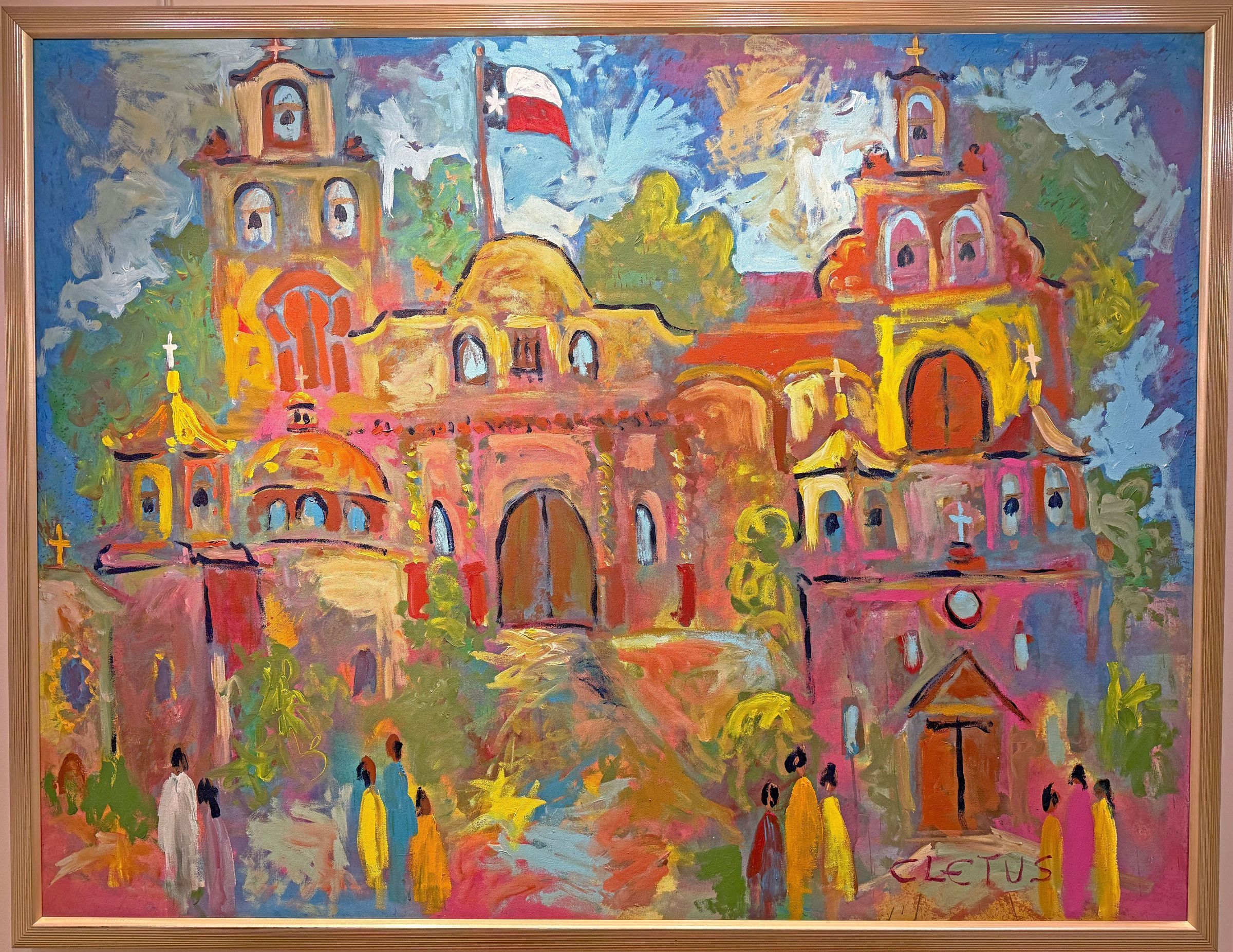
Brother Cletus is remembered for his prolific output of vibrant and colorful artwork. He was a true multi-media artist who produced works using metal, acrylics, watercolors, stained glass, ceramics, pastels, weaving, and more. The themes of his art range from biblical narratives to cityscapes, yet his artworks are all united as “celebrations of life.” In describing his practice, the Marianist brother stated, “My artwork and vocation are one and the same. Both have been a gift from God and a blessing for each day. My art is a way to touch people in a visual way rather than using the spoken word.”
In June 1994, ReBarn/Center for the Spirituality and the Arts, a CCVI ministry and interfaith spiritual arts center, hosted an exhibition of Brother Cletus’s recent works. Brother led a painting demonstration and slideshow of his other works at the Center later that month. He was a friend of Sister Alice Holden, CCVI, Director of ReBarn, who donated one of his watercolors to the CCVI Archives. Nearly 15 of Brother’s artworks, including block prints, a clay sculpture, watercolors, and canvas paintings, hang on the walls of the CCVI business offices as of March 2026. There is little documentation on the provenance of these works, though some could have been donated to the Congregation by Brother Cletus, who was known for his generosity and often gave his art to nonprofits.
Brother Cletus Behlmann passed away in San Antonio on July 12, 2016. His artworks continue to be cherished by private collectors and public institutions across the nation.Research Type
CuratorNotes
El hermano Cletus George Behlmann, SM, nació el 3 de noviembre de 1933 en Florissant, Misuri. Era el undécimo de doce hermanos, creció en la granja familiar y asistió a un instituto marianista antes de profesar sus primeros votos como hermano marianista en 1953. Obtuvo una licenciatura en inglés por la Universidad de St. Mary en 1956 y profesó sus votos perpetuos en 1958. Poco después, el hermano Cletus comenzó una carrera docente de 18 años que abarcó escuelas primarias y secundarias en Texas y Misuri.
El hermano Cletus comenzó a estudiar arte a finales de la década de 1950, mientras enseñaba en una escuela marianista en El Paso, Texas. A medida que perfeccionaba su talento, la Sociedad de María patrocinó su educación artística en el Instituto de Arte de Chicago y en la Universidad de Washington en St. Louis. En 1977, el hermano Cletus se trasladó a San Antonio, Texas, y comenzó a dedicarse al arte como vocación a tiempo completo. Fundó el Centro de Arte de la Universidad de St. Mary y fue artista residente en la universidad durante casi 40 años.
El hermano Cletus es recordado por su prolífica producción de obras de arte vibrantes y coloridas. Fue un auténtico artista multimedia que creó obras utilizando metal, acrílicos, acuarelas, vidrieras, cerámica, pasteles, tejidos y mucho más. Los temas de su arte abarcan desde narraciones bíblicas hasta paisajes urbanos, pero todas sus obras están unidas por el tema común de la «celebración de la vida». Al describir su práctica, el hermano marianista afirmó: «Mi obra artística y mi vocación son una misma cosa. Ambas han sido un regalo de Dios y una bendición para cada día. Mi arte es una forma de llegar a las personas de manera visual, en lugar de utilizar la palabra hablada».
En junio de 1994, ReBarn/Center for the Spirituality and the Arts, un ministerio de CCVI y centro de artes espirituales interreligioso, acogió una exposición de las obras recientes del hermano Cletus. Más tarde ese mismo mes, el hermano dirigió una demostración de pintura y una presentación de diapositivas de sus otras obras en el centro. Era amigo de la hermana Alice Holden, CCVI, directora de ReBarn, quien donó una de sus acuarelas a los archivos de CCVI. Cerca de 15 de las obras de arte del hermano, entre las que se incluyen grabados en bloque, una escultura de arcilla, acuarelas y pinturas sobre lienzo, cuelgan de las paredes de las oficinas comerciales de CCVI desde marzo de 2026. Hay poca documentación sobre la procedencia de estas obras, aunque algunas podrían haber sido donadas a la Congregación por el hermano Cletus, conocido por su generosidad y que a menudo regalaba sus obras de arte a organizaciones sin ánimo de lucro.
El hermano Cletus Behlmann falleció en San Antonio el 12 de julio de 2016. Sus obras de arte siguen siendo apreciadas por coleccionistas privados e instituciones públicas de todo el país.