Name/Title
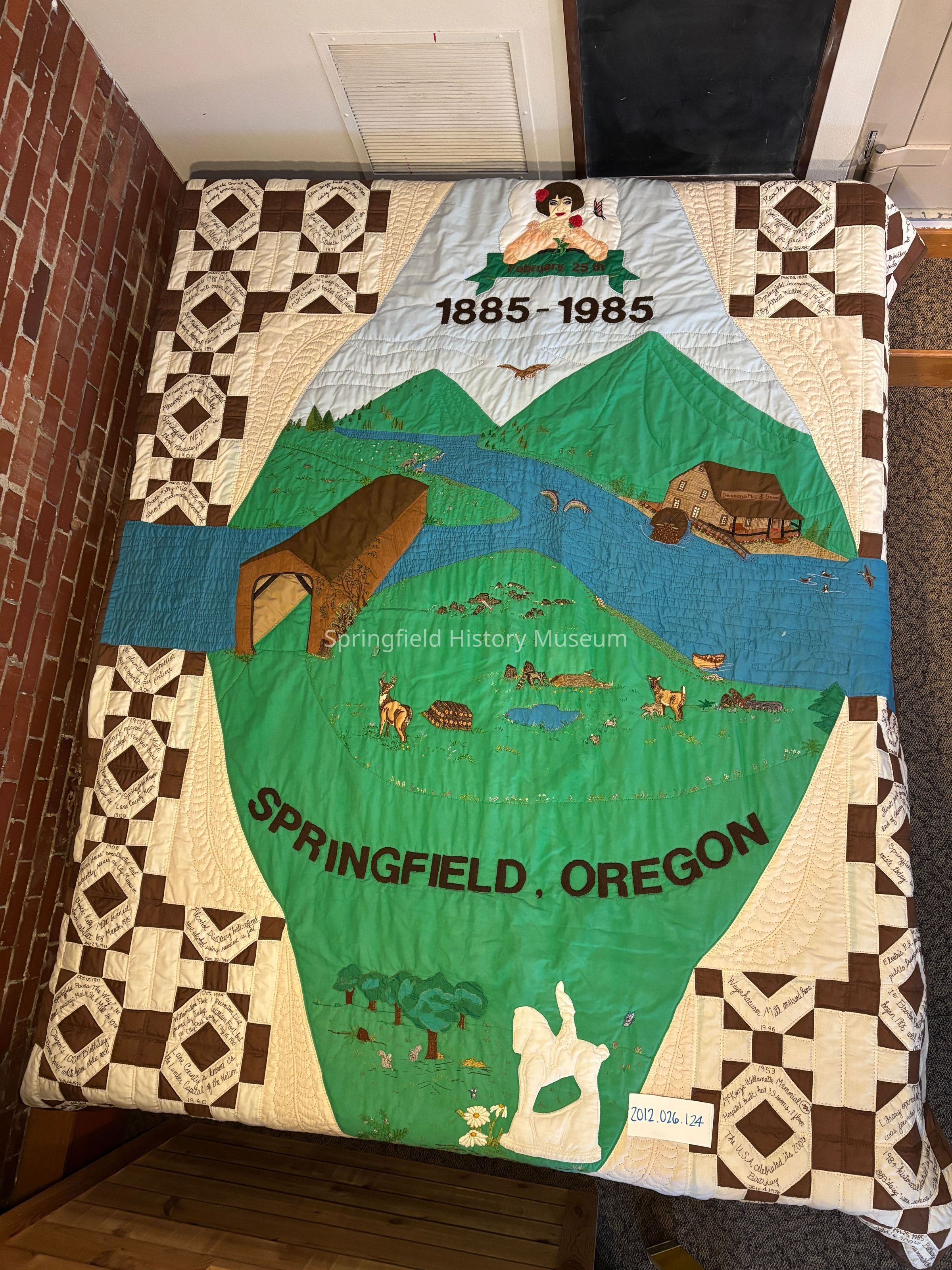
Quilt, "Centennial Springfield Quilt", circa 1985Entry/Object ID
2012.026.124Description
Poster: of CENTENNIAL QUILT:
Informatively About the Quilt::
Time to make --13 months (January 1984- February 1985)
Hours to make --3,000 volunteer hours
Cost to make --$115.00.
Materials used-- 20 yards of fabric and 1mile of thread.
Sewing Methods Used--10 different methods, including: Regular Appease, Padded Applique, Over-Lay Applique, Lap Siding, Bargello, Trapunto, Tubing Rolls, Quilting, Pieced Quilt Blocks, Finish Binding.
The Springfield, Oregon Centennial Quilt is a story Quilt and can be read just like a book. Begin with the outside border, then read from the top to the bottom.
Start: The State of Oregon Quilt block surrounds the center, and each Oregon block includes historic events of Springfield's past.
The official CENTENNIAL LOGO of the Flower Girl at the top symbolizes the first Mill, a flour mill, and represents the centennial celebration.
The Two Hills, two large pine trees, and winding rivers depict SPRINGFIELD'S CITY LOGO. Since history tells us that Springfield was located "at the mouth of the fork of two river, near a spring in a field, " the second river was added.
The mill is symbolic of the lumber mills built in the past 170 years which has been Springfield's economic strength.
The Rivers powered the mills, supported Agriculture and were a natural highway. Area wildlife deponed on the rivers for sustenance.
The Bridge is symbolic of the many bridges connecting Springfiield to the rest of Oregon.
The Tall Trees are the area's great natural resource, sustaining the lumber industry and providing wilderness recreation.
The Cut Trees represent basic buiding materials for the pioneers. The Crosscut Saw and Axe were the tools used to build the town and the lumber industry.
The Spring represents the origin of the city: a spring in a field, an natural place for the starting a new settlement.
The Filbert Trees represent the pioneering Doris Ranch Filbert orchards.
THE DAISIES are the official city flower.
THE PIONEER SPRITE white horse statue was given to the city in 1959, Oregon's 100th birthday.
The Flowers are all native to Springfield and can be found almost everywhere. They enhance the natural beauty of the city.Inscription/Signature/Marks
Location
Left Lower ConnerTranscription
Terry Maddox