2_05: Doris Fogel Drawing
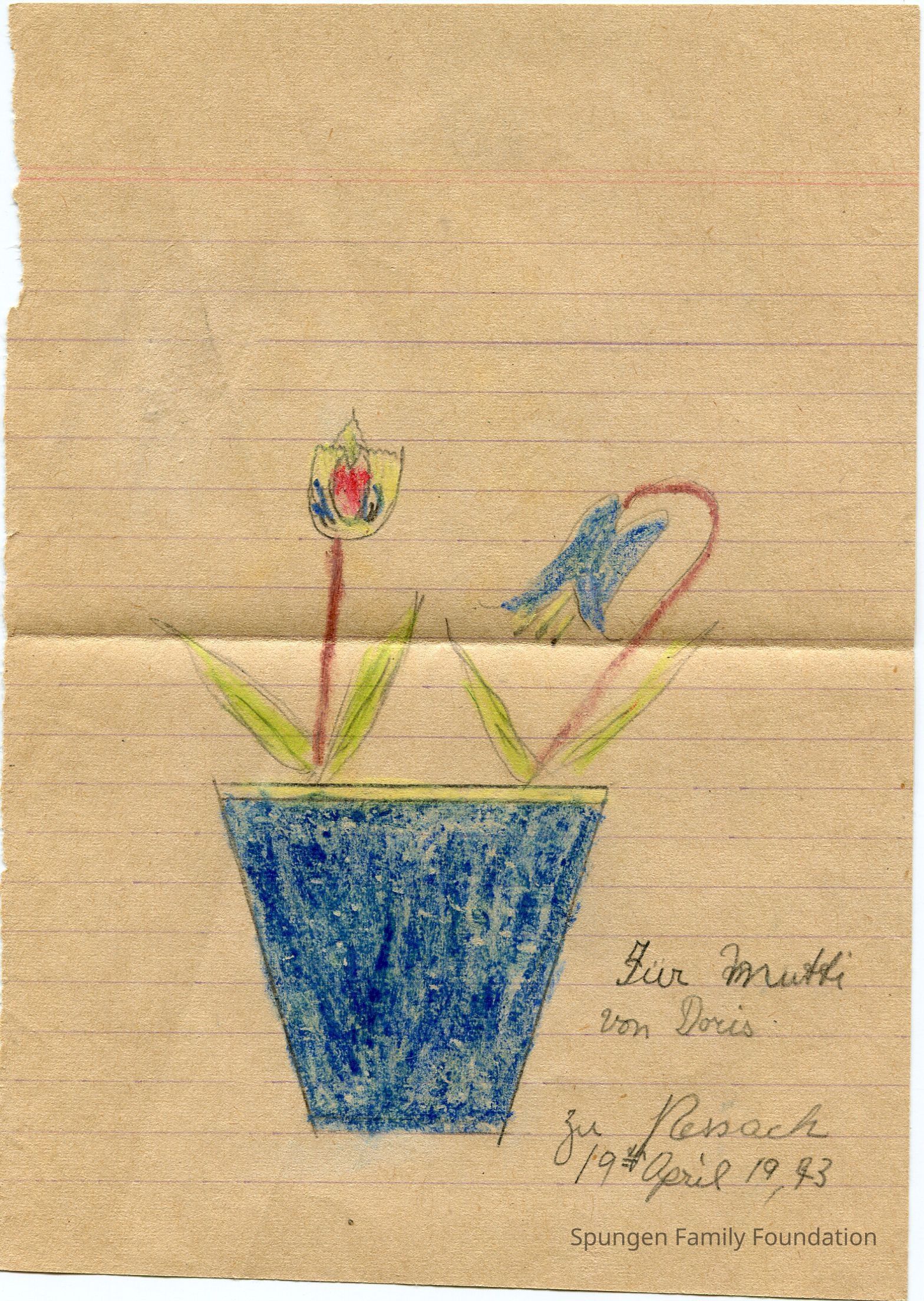
1943 April 19, Front side - Drawing from Doris Fogel in Shanghai, China.
Tan paper with drawing in pencil and colored crayon. A flower pot in blue with two flowers present. One flower has a brown stem, green leaves, and green pedals. The other has a brown stem, green leaves, and a blue pedal with green inner pistil. Cursive handwriting in German using pencil reads "Für Mutti von Doris / zu Renoch 19th April 1943" or "For mother from Doris / to Renoch 19th April 1943" in English.
Name/Title
2_05: Doris Fogel DrawingEntry/Object ID
2024.2.5Scope and Content
1943 April 19, drawing from Doris Fogel in Shanghai, China.Context
Partial excerpt taken from exhibit page 1.2 Children's Art During the Holocaust: During war and genocide, children often see and hear the same horror and violence to which adults are exposed. But with innate creativity and emotional sensitivity, children sometimes see more than adults can see. The misery, death, and suffering they experience becomes inseparable from the beauty, hope, and joy they also feel. The rich and complicated inner world of children is reflected in the pictures they paint, the doodles they draw, their personal letters, and even in routine school assignments. The artifacts from the minds and hands of children who witnessed the Holocaust appear to be completely ordinary: drawings of flowers, an arrangement of stamps, a Mother's Day post card. In another sense, they are extraordinary windows into the emotional experience of children as they were forced to adapt to the every-changing circumstances of the war. In genocides throughout history, the breakdown of humanity becomes complete when barbarism and destruction does not even spare the children in a society. The impact reaches far into the future. These drawings and writings speak to us of the capacity of human beings to remain hopeful, to find beauty, and to courageously carry on despite uncertainty and loss. Doris Warschawski (b. May 3, 1934, Berlin, Germany). After Kristallnacht in November 1938, Doris and her mother Edith found refuge in Shanghai from 1939 to 1947 before immigrating to the USA. Doris was fond of drawing while in Shanghai and many of her works survived.Collection
Doris FogelCategory
Illustration
Philatelic Material