Albert Speer
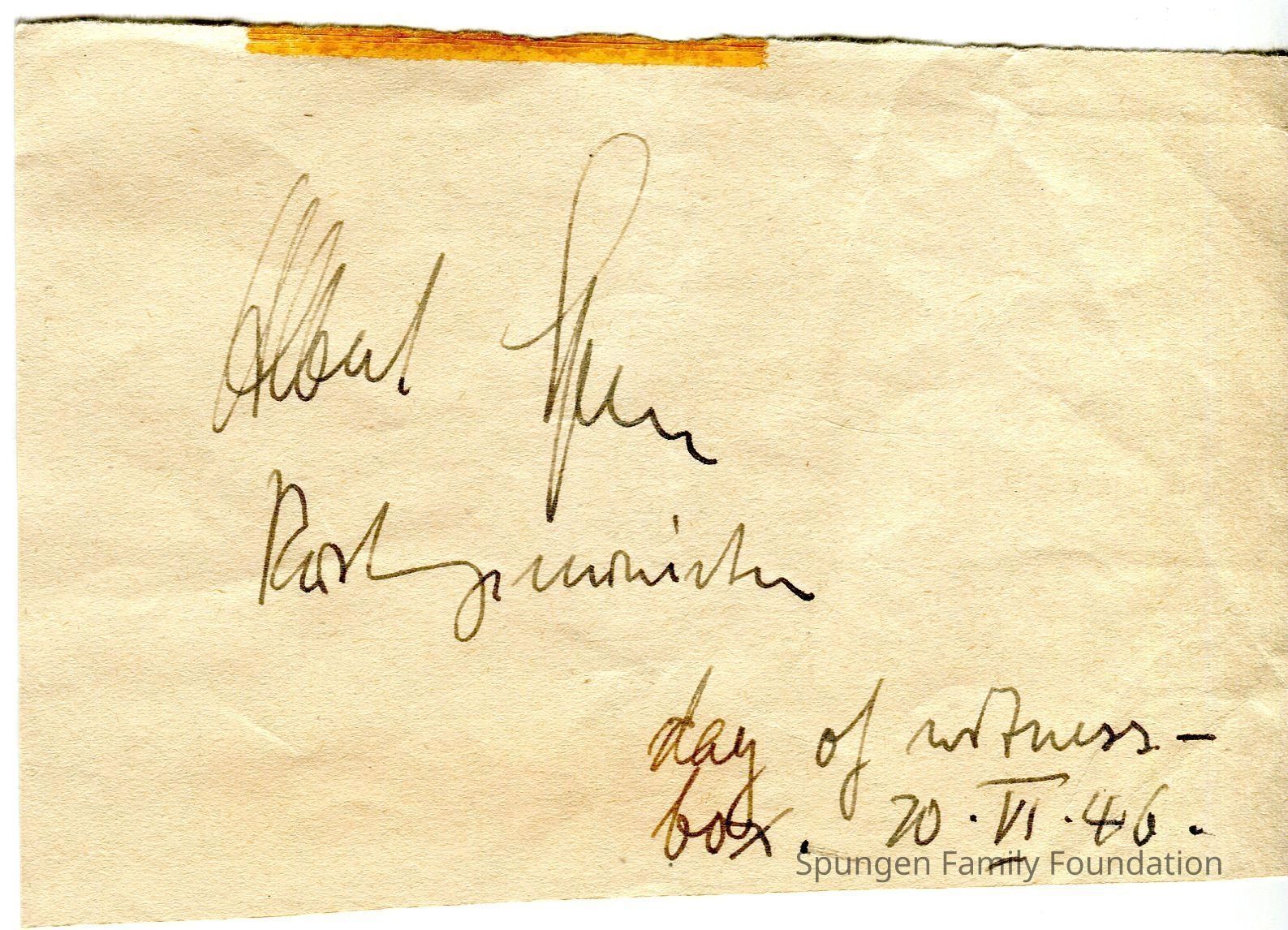
1946, Front side - Note card with Albert Speer signature from the Palace of Justice in Nuremberg, Germany.
Tan note card with cursive signature and printed handwriting in German using black ink.
Name/Title
Albert SpeerEntry/Object ID
2026.7.18Scope and Content
1946 June 20, note card with Albert Speer signature from the Palace of Justice in Nuremberg, Germany.Context
German architect Albert Speer was the Minister of Armaments and War Production for the Nazi Party during World War II. He was a close friend of Adolf Hitler and an early member of the then NSDAP. In 1924, Speer studied architecture in Munich where he received an architecture license. After moving to Mannheim, Speer failed to acquire a job in which he could provide for himself. Speer moved home to work part time for his father, when he joined the Nazi Party in 1931. Speer was introduced to Joseph Goebbels by a friend who recommended him to help renovate the Berlin headquarters. Speer completed the commission and returned to Mannheim. When Hitler took office in 1933, Speer was asked to submit designs for the Nuremberg Rally. Speer’s design work won over Hitler and the Nazi Party, and he was appointed Commissioner for the Artistic and Technical Presentation of Party Rallies and Demonstrations. Through his career, Speer became a close member of Hitler’s inner circle, much to his surprise. Speer replaced Paul Troost as the Chief Architect following his death. Furthermore, Hitler appointed Speer as the Chief Office for Construction. Speer had worked on prestigious projects such as the Zeppelinfeld stadium in Nuremberg and the Olympiastadion, the site for the 1936 Summer Olympics. During World War II, Speer created plans for the Reich Capital, overseeing the building’s management. Additionally, Speer oversaw the labor for construction of various concentration camps in Germany. Later on, Speer’s responsibilities spanned to the German military, designing submarines and aircrafts. Moreover, Speer facilitated the transportation of prisoners from concentration camps to work areas where construction and labor was required to fulfill his architecture concepts. In 1945, Speer was arrested by the British Army in Flensburg. On trial in 1946, Speer was found guilty of war crimes and crimes against humanity with the emphasis on forced labor and slave labor. Yet, Speer claimed he was unaware of the Nazi extermination plans and the Allies lacked evidence to prosecute him. He was sentenced to 20 years imprisonment. Speer served his full term and was released at midnight on October 1, 1966. Speer was consistently interviewed about his experiences with the Nazi regime. The public’s fascination with the Nazi Party piqued interest upon the release of Speer and other notable figures. Speer spoke to BBC and other major media outlets. He spent the rest of his life constructing an image of himself as a “good Nazi” who was unaware of Hitler’s full plans and atrocities. Speer died in 1981 after suffering a stroke. After his death, he was widely detested as a “good Nazi” and through historians’ examinations, debunked as an unknowing member of the Nazi Party.Collection
Nazi Party SignaturesCategory
Note
Philatelic Material