F07_P01.1: Camp Hay (Australia) Internment Camps
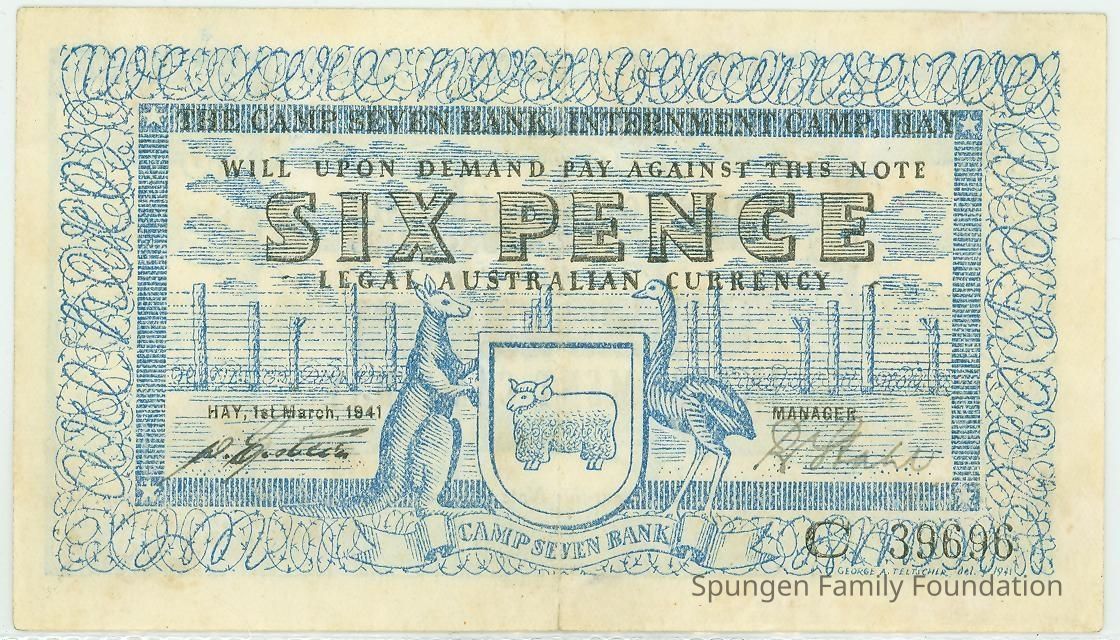
1941, Front side - Scrip with value of six pence from Camp Hay Internment Camp in Australia.
Tan paper with printed text in English using black ink. Printed outline, illustration, and text using blue ink is present. At the center, a depiction of a crest with a sheep/ram at the center. At the left side, a kangaroo is standing with both hands on the crest. The kangaroo is smiling. To the right, an emu/ostrich is standing. Both animals are facing each other. In the background, wooden posts and wire fencing is depicted. Surrounding the text and illustration is barbed wire with a hidden inscription which reads, "we are here because we are here because we are here". At the bottom right, the serial number "C 39696" is printed in black ink. Underneath, a tiny marking of the illustrator's name and date.
Name/Title
F07_P01.1: Camp Hay (Australia) Internment CampsEntry/Object ID
2010.2.1Scope and Content
1941, scrip with value of six pence from Camp Hay Internment Camp in Australia.Context
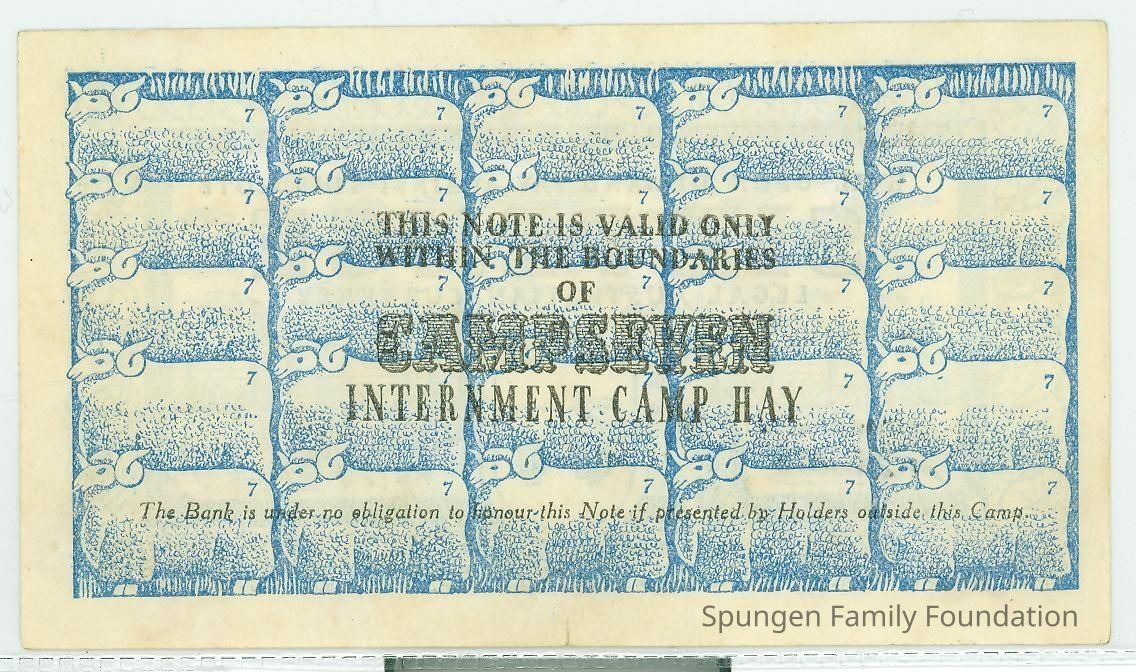
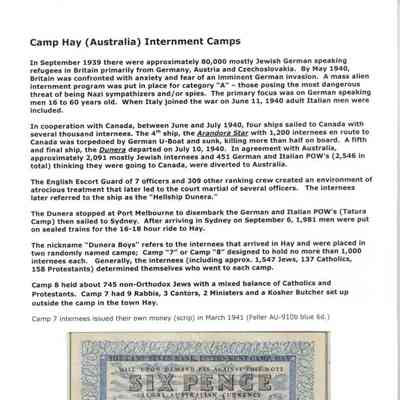
In September 1939 there were approximately 80,000 mostly Jewish German speaking refugees in Britain primarily from Germany, Austria and Czechoslovakia. By May 1940, Britain was confronted with anxiety and fear of an imminent German invasion. A mass alien internment program was put in place for category “A” – those posing the most dangerous threat of being Nazi sympathizers and/or spies. The primary focus was on German speaking men 16 to 60 years old. When Italy joined the war on June 11, 1940 adult Italian men were included. In cooperation with Canada, between June and July 1940, four ships sailed to Canada with several thousand internees. The 4th ship, the Arandora Star with 1,200 internees en route to Canada was torpedoed by German U-Boat and sunk, killing more than half on board. A fifth and final ship, the Dunera departed on July 10, 1940. In agreement with Australia, approximately 2,091 mostly Jewish internees and 451 German and Italian POW’s (2,546 in total) thinking they were going to Canada, were diverted to Australia. The English Escort Guard of 7 officers and 309 other ranking crew created an environment of atrocious treatment that later led to the court martial of several officers. The internees later referred to the ship as the “Hellship Dunera.” The Dunera stopped at Port Melbourne to disembark the German and Italian POW’s (Tatura Camp) then sailed to Sydney. After arriving in Sydney on September 6, 1,981 men were put on sealed trains for the 16-18 hour ride to Hay. The nickname “Dunera Boys” refers to the internees that arrived in Hay and were placed in two randomly named camps; Camp “7” or Camp “8” designed to hold no more than 1,000 internees each. Generally, the internees (including approx. 1,547 Jews, 137 Catholics, 158 Protestants) determined themselves who went to each camp. Camp 8 held about 745 non-Orthodox Jews with a mixed balance of Catholics and Protestants. Camp 7 had 9 Rabbis, 3 Cantors, 2 Ministers and a Kosher Butcher set up outside the camp in the town Hay. ---------------------- Why Hay? The Money (scrip) The locals of Hay Australia like to think that, “Hay is in the middle of everywhere” in New South Wales, 400 kilometers (240 miles) north of Melbourne. Like any military leadership, the Australian military authorities printed their guidelines for selecting sites like Hay which in 1940 had a small population, road/railway connections, clay soil and the Murrumbidgee River water supply: 1. The area should be as flat as possible but with sufficient fall to provide safe drainage. 2. Sandy soil should be avoided as it facilitates (helps) tunneling. 3. There should be sufficient area to space separate camps at least 500 yards (457m)apart. 4. The area should be well away from seaboard but centrally situated and accessible by good roads. 5. Good water supply should be available. 6. Camps should not be erected in thickly populated areas. With Hay being selected, the internees did their best to adapt. Camp 7 for example created schools, a quasi-Parliament, theater groups, work details and a banking system. In early 1941 the Commandant allowed the internees to have money printed outside of Camp 7 at the local newspaper, The Riverine Grazier. A series of three denominations were issued in March-April 1941, designed by internee Georg Teltscher to illustrate life within Camp 7. Georg took the liberty to use a lot of sarcastic humor throughout the design (in sharp contrast to the scrip made for the ghettos and concentration camps in Europe). Within the barbed wire outside frame the phrase “we are here because we are here because we are here“ is repeated. This was the theme song of the camp sang to the tune of Auld Lang Syne and might be an example of the frustration felt by being treated like an enemy. Eppenstein (Andrew) one of Camp 7 leaders, is engraved in the sheep’s wool on the front. Hidden in the wool of sheep on the back of the note are the names of other internees.Collection
Camp Hay Internment CampCategory
Currency