Carrying the Reality of Dehumanization - Being Black and Colored
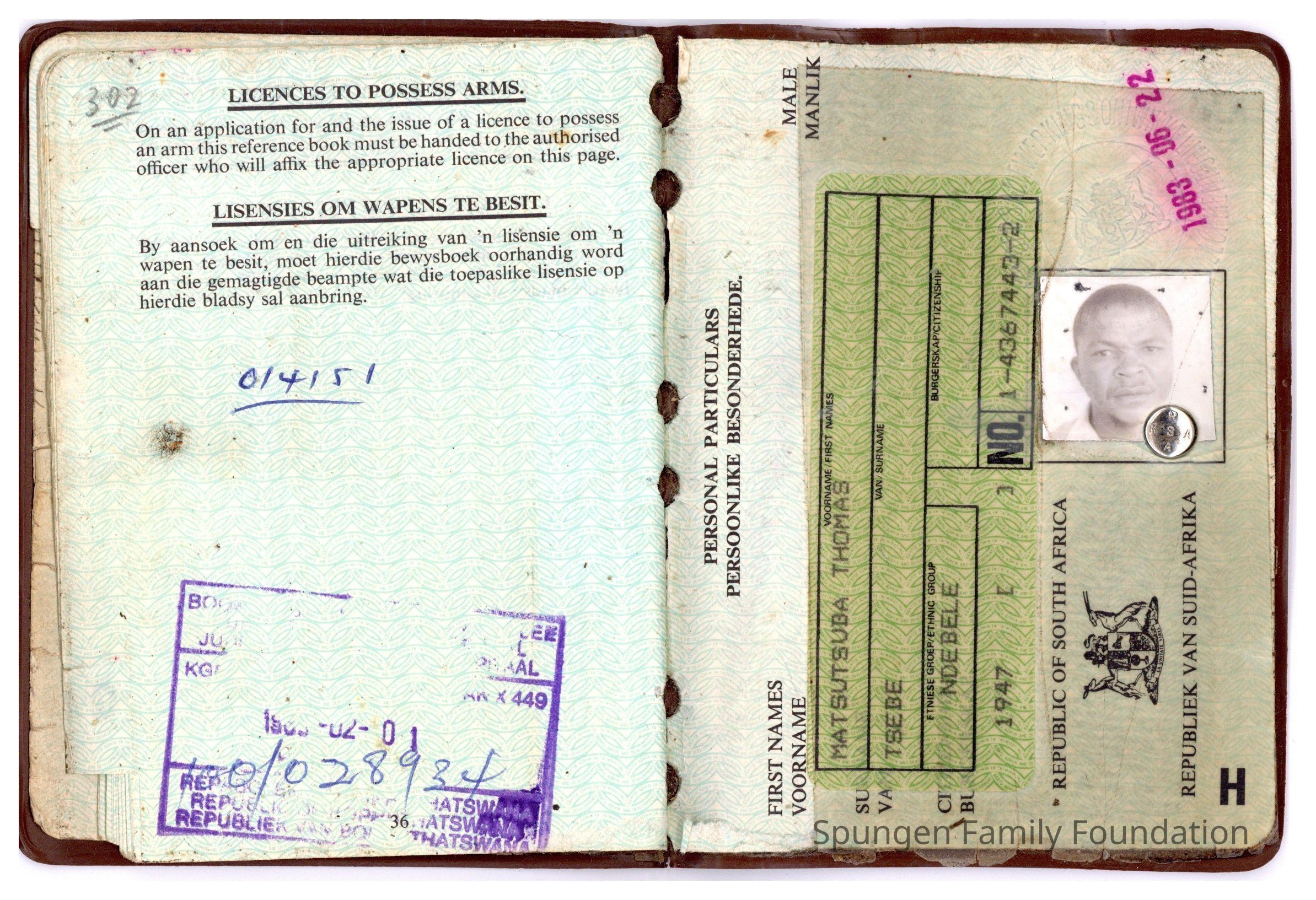
c. 1983 June 22, Front side - Identification pass book which belonged to Thomas Matsutsuba Tsebe.
White paper with light green printed background. Printed text and outline in English and Afrikaans using black ink. At the left side, a faded purple stamp with letters written in blue ink overtop. At the right, the emblem from the Republic of South Africa. Above, a black-and-white photograph depicting Thomas Matsutsuba Tsebe facing forward. He is wearing a white collared shirt.
Name/Title
Carrying the Reality of Dehumanization - Being Black and ColoredEntry/Object ID
2021.1.2Scope and Content
c. 1983 June 22, identification pass book which belonged to Thomas Matsutsuba Tsebe.Context
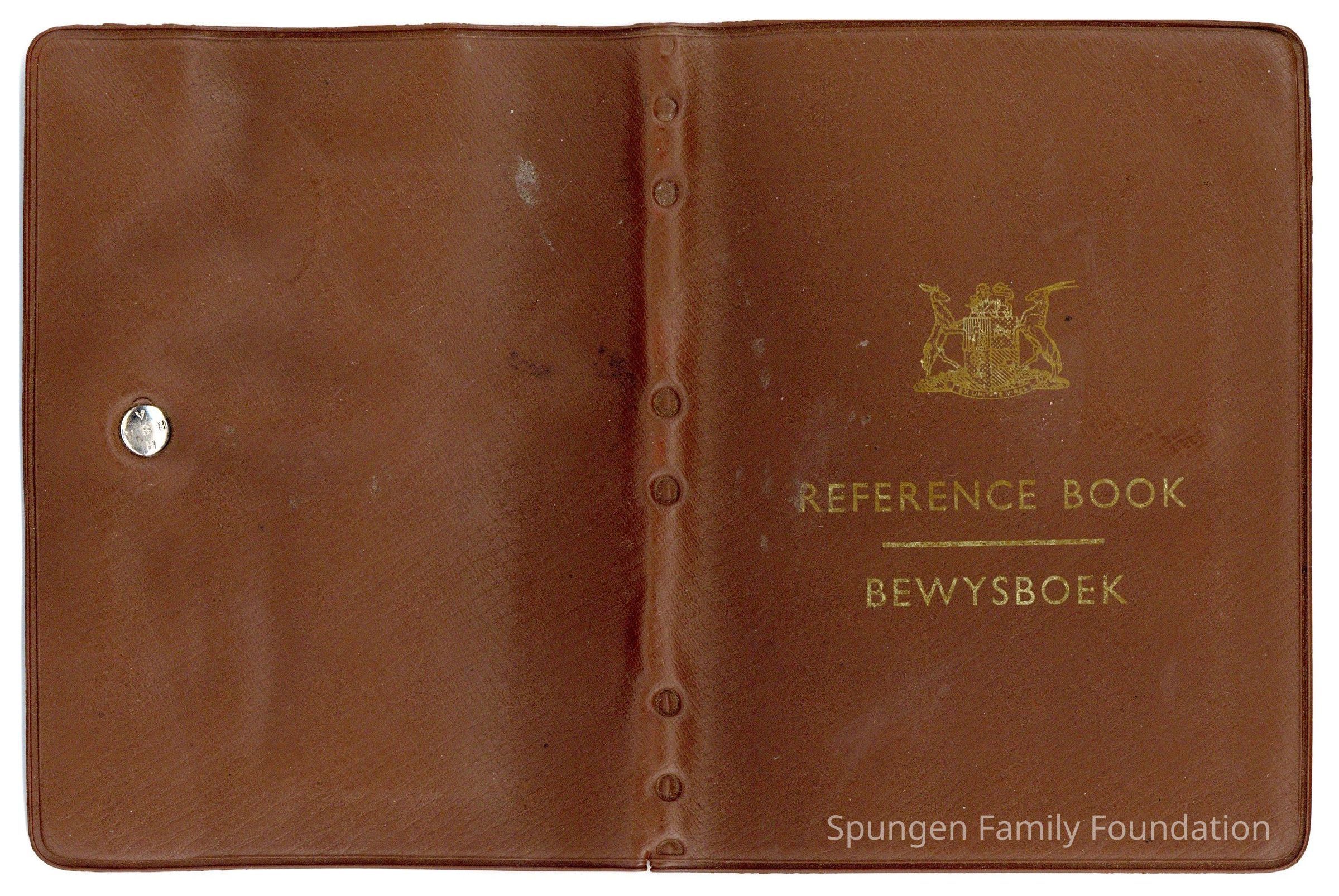
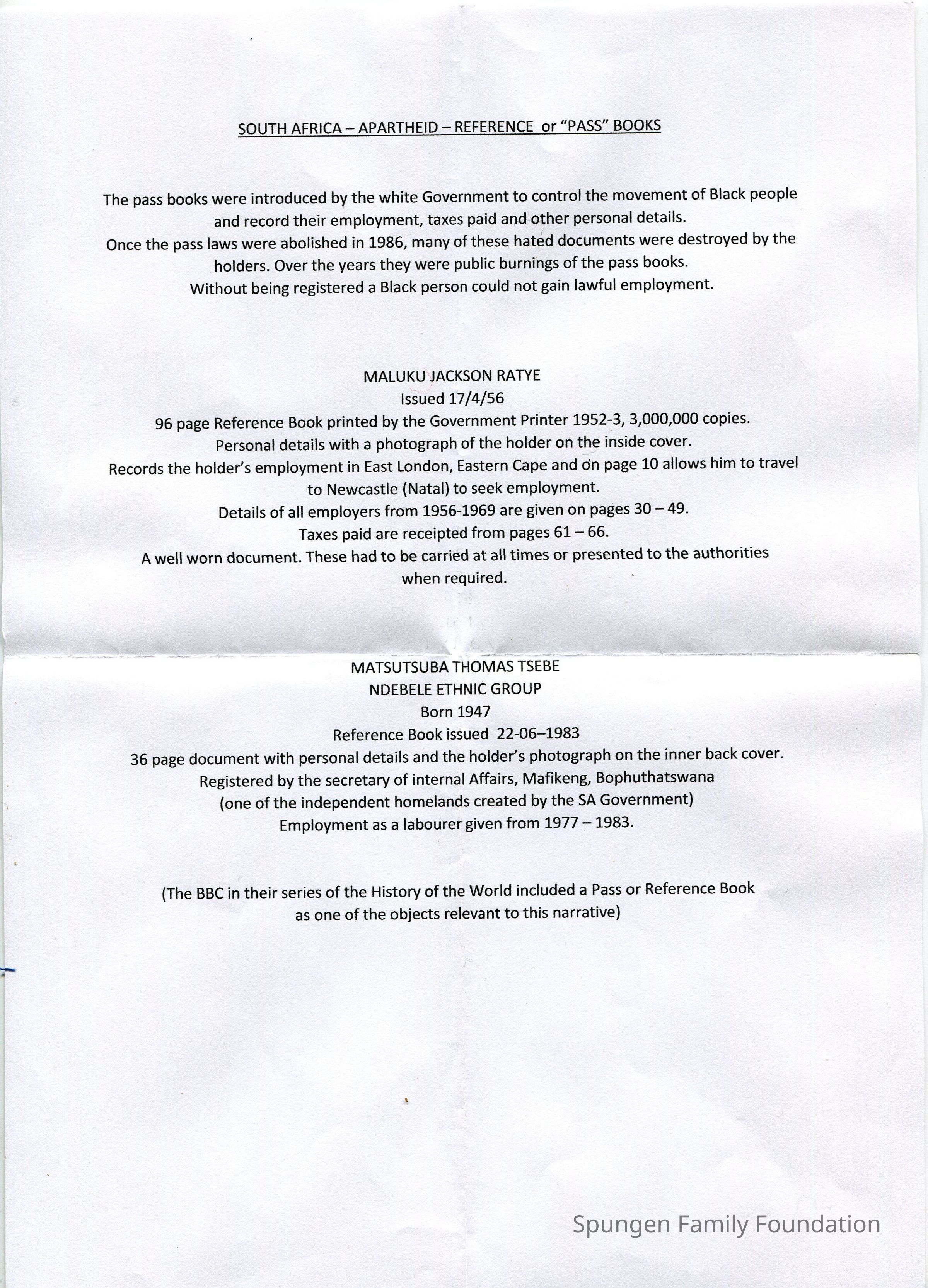
It was Forty One (yes, 41 years after the Holocaust) humanity was confronting On July 24, 1986, as part of a process of removing some apartheid laws, the South African government lifted the requirement to carry passbooks, 3. Ask: What kind of emotional toll do you think carrying a passbook had on the Black population? https://en.wikipedia.org/wiki/Pass_laws In South Africa, pass laws were a form of internal passport system designed to segregate the population, manage urbanization, and allocate migrant labor. Also known as the natives' law, pass laws severely limited the movements of not only black African citizens, but other people as well by requiring them to carry passbooks when outside their homelands or designated areas. Before the 1950s, this legislation largely applied to African men, and attempts to apply it to women in the 1910s and 1950s were met with significant protests. Pass laws were one of the dominant features of the country's apartheid system until it was effectively ended in 1986. https://toursducap.com/en/2015/03/20/the-infamous-dompas-of-apartheid/ The dompas One such law was the ‘dompas’ which literally means ‘dumb pass’. All black people outside the confines of their government designated areas were legally required to carry passbooks, sometimes known as ‘reference’ books. Police officers could apprehend any black person and ask to see it. Failure to produce the dompas resulted in being arrested and imprisoned if one could not pay the required fine. The Black (Natives) Laws Amendment Act of 1952 amended the 1945 Native Urban Areas Consolidation Act, stipulating that all black people over the age of 16 were required to carry passes and that no black person could stay in an urban area more than 72 hours unless allowed to by Section 10.[9] The Natives (Abolition of Passes and Co-ordination of Documents) Act of 1952, commonly known as the Pass Laws Act, repealed the many regional pass laws and instituted one nationwide pass law, which made it compulsory for all black South Africans over the age of 16 to carry the "passbook" at all times within white areas. The law stipulated where, when, and for how long a person could remain. [10] The document was similar to an internal passport, containing details on the bearer such as their fingerprints, photograph, the name of his/her employer, his/her address, how long the bearer had been employed, as well as other identification information. Employers often entered a behavioural evaluation, on the conduct of the pass holder. An employer was defined under the law and could only be a white person. The pass also documented permission requested and denied or granted to be in a certain region and the reason for seeking such permission. Under the terms of the law, any government employee could strike out such entries, basically cancelling the permission to remain in the area. A passbook without a valid entry then allowed officials to arrest and imprison the bearer of the pass. These passes often became the most despised symbols of apartheid. The resistance to the Pass Law led to many thousands of arrests and was the spark that ignited the Sharpeville Massacre on March 21, 1960, and led to the arrest of Robert Sobukwe that day. They are rare as I said earlier. Once the Pass Laws were abolished many of these were destroyed and the social conditions in which many lived were hardly conducive to the preservation of paper documents. The pass books were known as “Reference Books” and were essentially labour documents recording legal employment.Collection
The South African ApartheidCategory
Pass Book