F03_P14: Łódź (Litzmannstadt) Jewish Ghetto JUDENPOST stamps
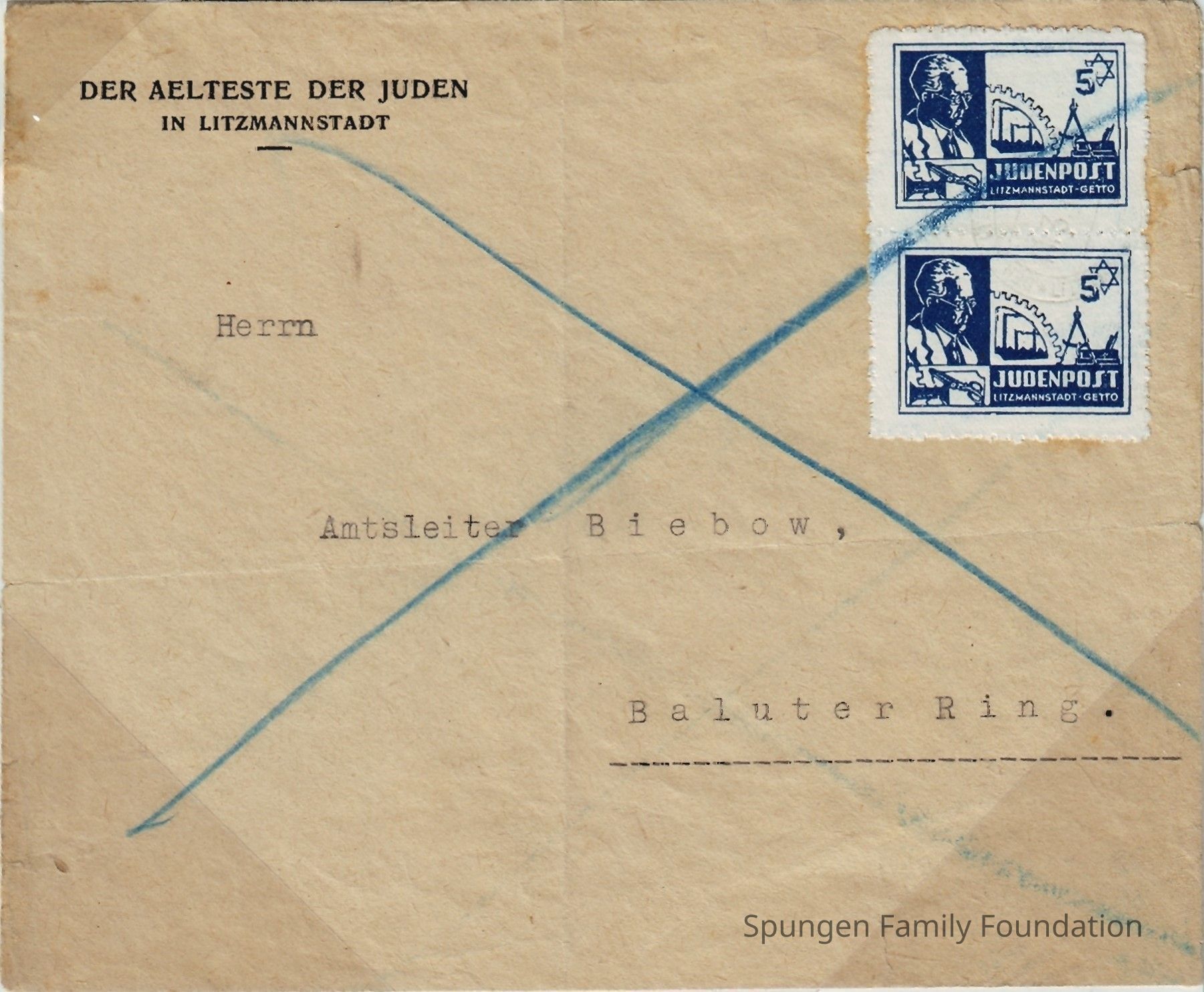
1944 March 11, Front side - Envelope with Judenpost 5-pfennig stamps from the Łódź (Litzmannstadt) Jewish ghetto.
Tan envelope with printed and typed text in German using black ink. At the center, an X marking in blue pencil appears. At the top right corner, two blue 5-pfennig Judenpost stamps from the Łódź (Litzmannstadt) Jewish ghetto appear.
Name/Title
F03_P14: Łódź (Litzmannstadt) Jewish Ghetto JUDENPOST stampsEntry/Object ID
2008.4.56Scope and Content
1944 March 11, envelope with Judenpost 5-pfennig stamps from the Łódź (Litzmannstadt) Jewish ghetto.Context
In March of 1944, postal authorities of the Łódź ghetto produced two sets of local stamps picturing the Jewish Elder, Mordecai Chaim Rumkowski. Both designs are inscribed “JUDENPOST LITZMANNSTADT-GETTO.” Hans Biebow, the Nazi head of the ghetto administration, was a stamp and money collector, which may account for the elegant designs of Łódź ghetto scrip currency and coins. These stamp issues may have been intended to appeal to his collecting habit, but if so, the idea failed. On March 14 Biebow forbade further printing and use of the stamps, and confiscated the unsold supply. A pair of Judenpost 5-pfennig stamps on an envelope of Rumkowski, the Litzmannstadt ghetto Jewish Elder, canceled March 11, 1944, with the Elder’s datestamp, addressed to Nazi administrator Biebow. Being a local stamp, it was valid as postage only inside the ghetto. The address at Baluter Ring was the location of the office where ghetto postal workers exchanged mail with representatives of the German post office. Michel lists and prices the JUDENPOST stamps only in unused condition. Fewer than ten covers have been reported, and the authenticity of several has been challenged. Scholars regard examples bearing the cancellation shown here as genuine, but of unknown origin. Only this cover and one other, also canceled March 11, were used before the date when Biebow ordered them withdrawn. Michel states, “Examples with line perforation guage 11½ probably originate from a private initiative,” but this cover offers evidence that the perforations were intentionally applied at the direction of the Elder.Collection
Nazi Scourge II: Five Frame ExhibitCategory
Cover
Philatelic Material