F10_P14: Holocaust Aftermath: War Crimes Trials
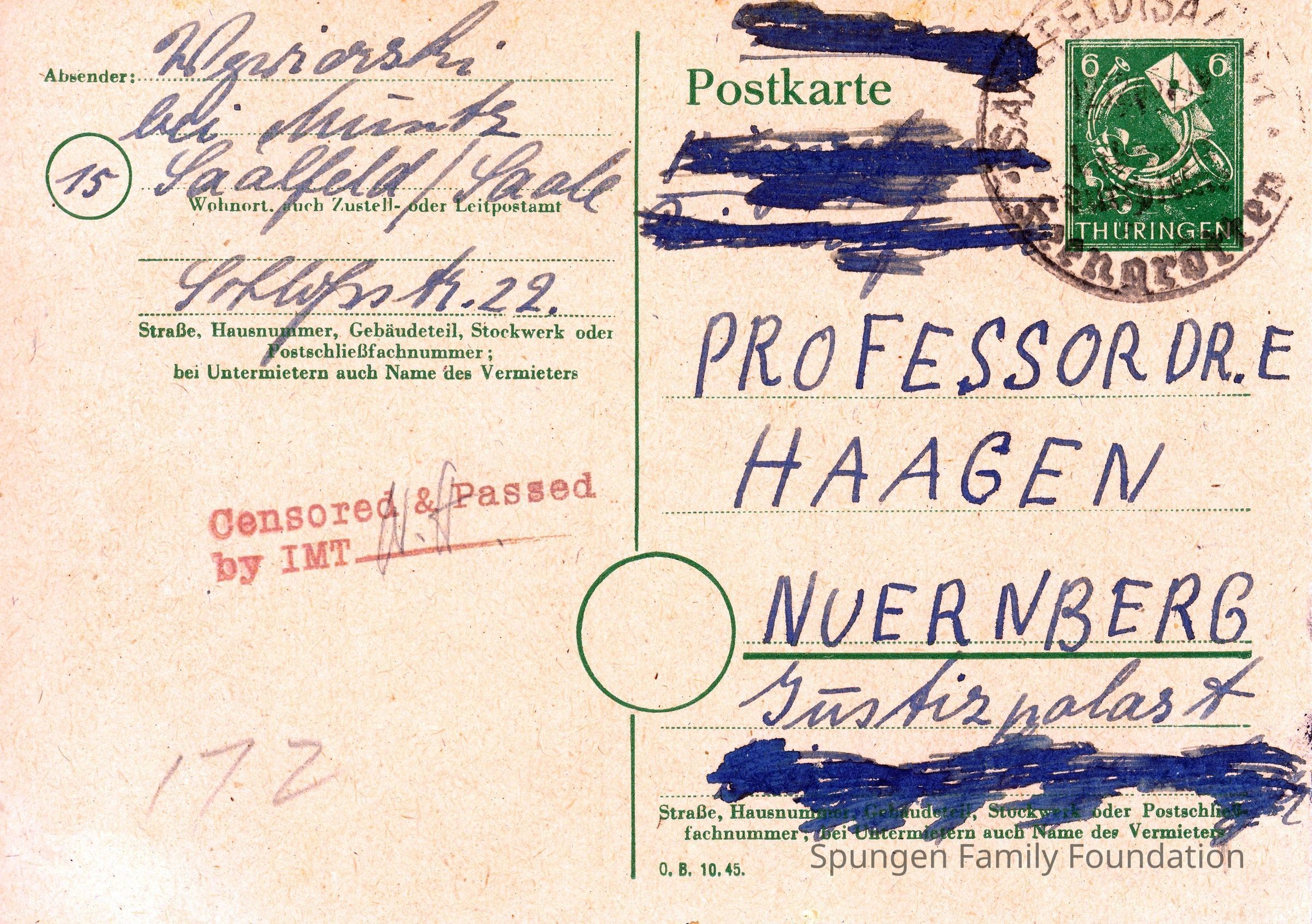
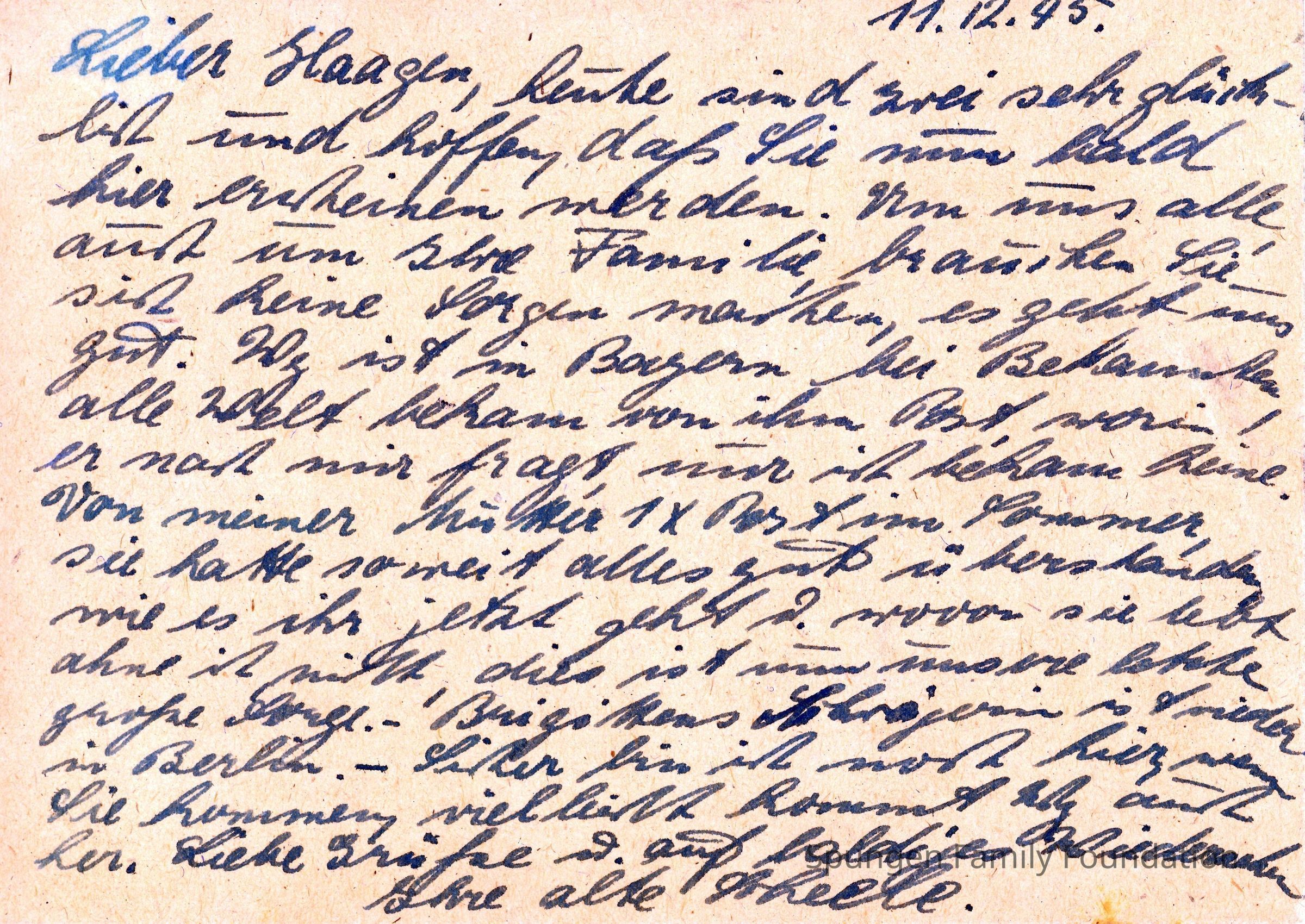
1945 December 11, Front side - Post card to Professor Doctor Eugen von Haagen at the Nuremberg court.
Tan post card with printed text and outline in German using green ink. An imprinted green 6-pfennig stamp depicting a French horn and envelope from the state of Thuringen is present in the top right corner. Printed and cursive handwriting in blue ink appears overall. A red ink censorship stamp appears at the center. A cancellation in the top right corner with illegible date.
Name/Title
F10_P14: Holocaust Aftermath: War Crimes TrialsEntry/Object ID
2007.10.14Scope and Content
1945 December 11, post card to Professor Doctor Eugen von Haagen at the Nuremberg court.Context
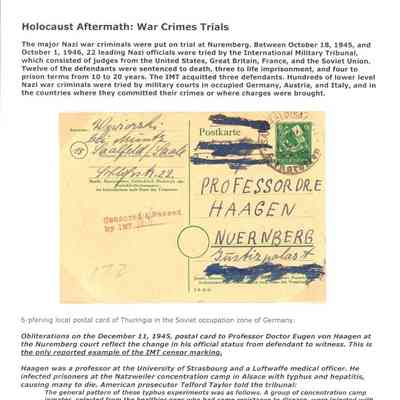
The major Nazi war criminals were put on trial at Nuremberg. Between October 18, 1945, and October 1, 1946, 22 leading Nazi officials were tried by the International Military Tribunal, which consisted of judges from the United States, Great Britain, France, and the Soviet Union. Twelve of the defendants were sentenced to death, three to life imprisonment, and four to prison terms from 10 to 20 years. The IMT acquitted three defendants. Hundreds of lower level Nazi war criminals were tried by military courts in occupied Germany, Austria, and Italy, and in the countries where they committed their crimes or where charges were brought. 6-pfennig local postal card of Thuringia in the Soviet occupation zone of Germany. Obliterations on the December 11, 1945, postal card to Professor Doctor Eugen von Haagen at the Nuremberg court reflect the change in his official status from defendant to witness. This is the only reported example of the IMT censor marking. Haagen was a professor at the University of Strasbourg and a Luftwaffe medical officer. He infected prisoners at the Natzweiler concentration camp in Alsace with typhus and hepatitis, causing many to die. American prosecutor Telford Taylor told the tribunal: The general pattern of these typhus experiments was as follows. A group of concentration camp inmates, selected from the healthier ones who had some resistance to disease, were injected with an anti-typhus vaccine, the efficacy of which was to be tested. Thereafter, all the persons in the group would be infected with typhus. At the same time, other inmates who had not been vaccinated were also infected for purposes of comparison. These unvaccinated victims were called the 'control' group. But perhaps the most wicked and murderous circumstance in this whole case is that still other inmates were deliberately infected with typhus with the sole purpose of keeping the typhus virus alive and generally available in the bloodstream of the inmates. Prosecutors brought evidence against Haagen, and he testified before the tribunal as a recalcitrant witness. He escaped prosecution at Nuremberg after U.S. intelligence agents recruited him to Project Paperclip, a secret Cold War program that employed German scientists in biomedical and aerospace military research. In 1951, French authorities arrested Haagen, convicted him of war crimes, and sentenced him to 20 years in prison.Collection
Nazi Scourge I: Primary ExhibitionCategory
Post Card
Philatelic Material