F01_P07: Concentration Camps Oranienburg and Hammerstein 1933 and 1934
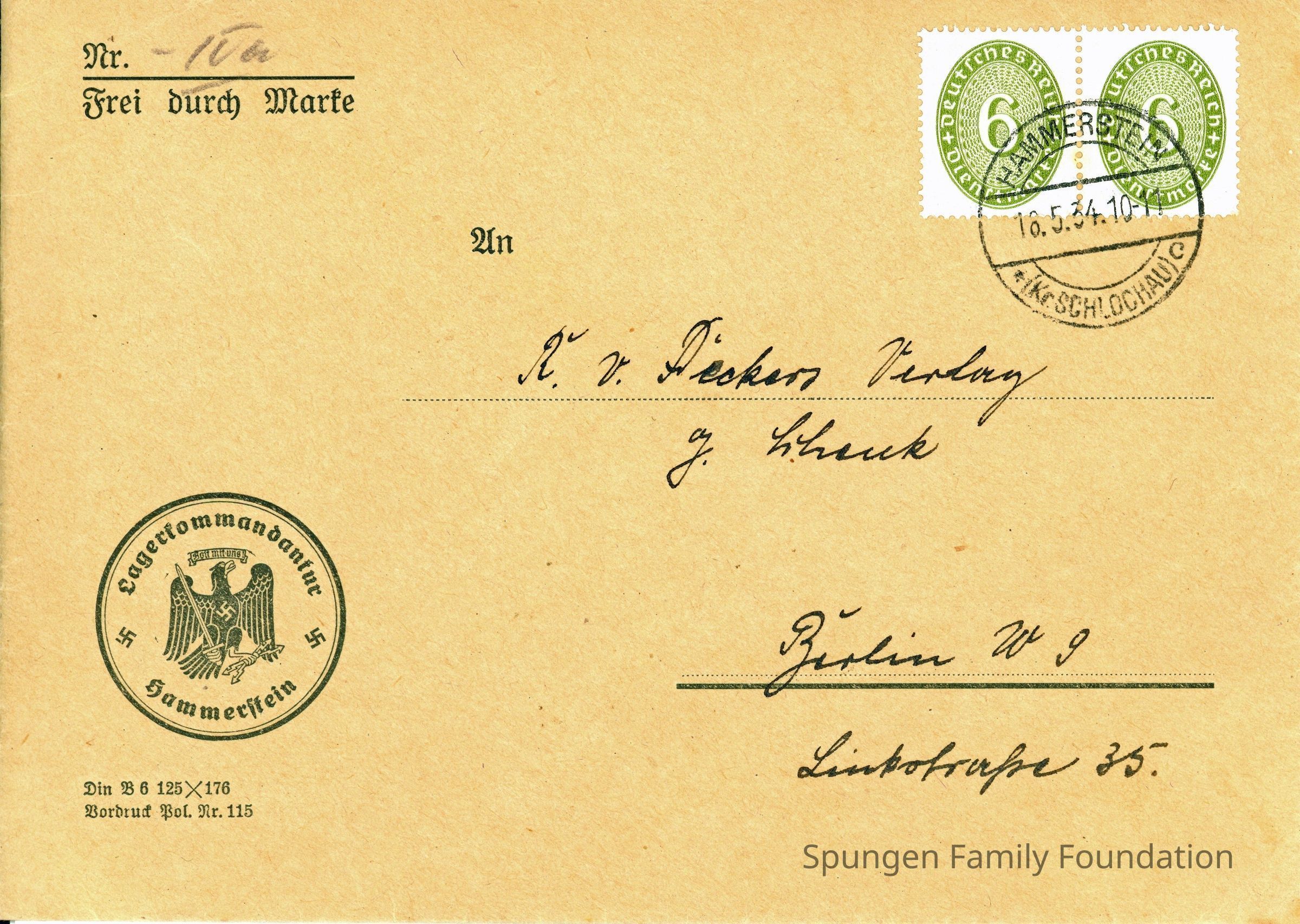
1934 May 18, Front side - Envelope containing release document sent from Oranienburg concentration camp to Hammerstein concentration camp.
Tan envelope with printed text and outline in German using black ink. At the center, cursive handwriting in black ink is present. At the top right corner, two green 6-pfennig stamps are present. Overtop, a black ink cancellation dated May 18, 1934 appears. At the bottom left, a black ink overprint stamp reads, "Lagerkommandantur" and depicts the Reichsadler symbol.
Name/Title
F01_P07: Concentration Camps Oranienburg and Hammerstein 1933 and 1934Entry/Object ID
2007.1.7Scope and Content
1934 May 18, envelope containing release document sent from Oranienburg concentration camp to Hammerstein concentration camp.Context
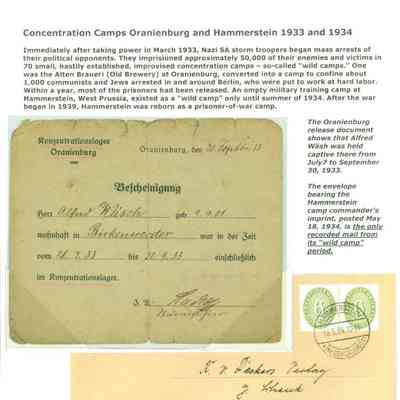
Immediately after taking power in March 1933, Nazi SA storm troopers began mass arrests of their political opponents. They imprisoned approximately 50,000 of their enemies and victims in 70 small, hastily established, improvised concentration camps – so-called “wild camps.” One was the Alten Braueri (Old Brewery) at Oranienburg, converted into a camp to confine about 1,000 communists and Jews arrested in and around Berlin, who were put to work at hard labor. Within a year, most of the prisoners had been released. An empty military training camp at Hammerstein, West Prussia, existed as a “wild camp” only until summer of 1934. After the war began in 1939, Hammerstein was reborn as a prisoner-of-war camp. The Oranienburg release document shows that Alfred Wäsch was held captive there from July 7 to September 30, 1933. The envelope bearing the Hammerstein camp commander’s imprint, posted May 18, 1934, is the only recorded mail from its “wild camp” period.Collection
Nazi Scourge I: Primary ExhibitionCategory
Cover
Philatelic Material