F05_P01: Jewish Ghetto Theresienstadt Rabbi Leo Baeck
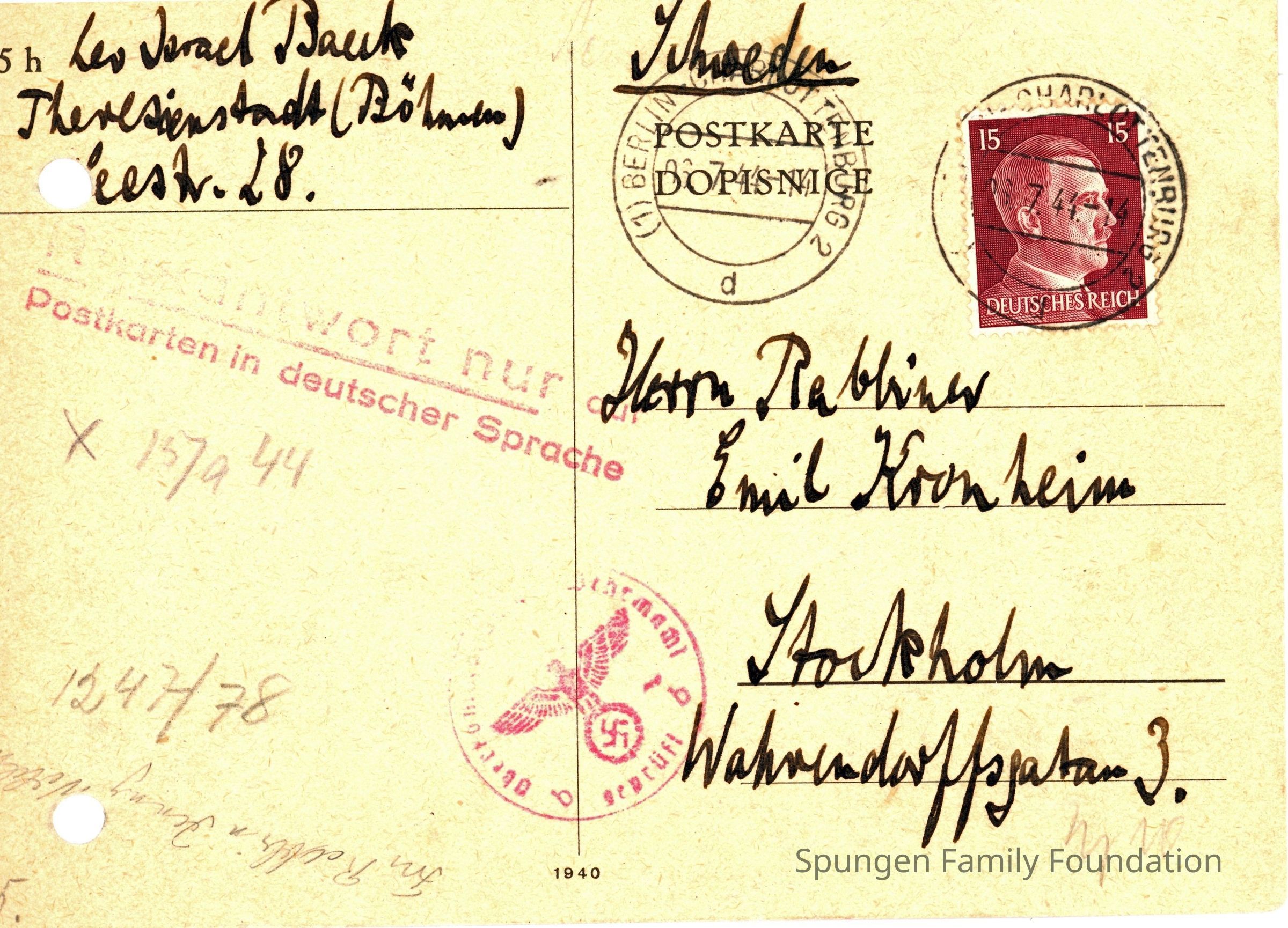
1944 January 23, Front side - Post card from Rabbi Leo Baeck to Rabbi Emil Kronheim.
Yellow-tan post card with cursive handwriting in black ink. At the top right is a dark-red 15-pfennig stamp depicting Adolf Hitler facing to the right. Overtop is a cancellation dated July 6, 1944. At the bottom left is handwritten text and numbers in pencil. At the bottom center is a stamp depicting the Reichsadler in red ink.
Name/Title
F05_P01: Jewish Ghetto Theresienstadt Rabbi Leo BaeckEntry/Object ID
2007.5.1Scope and Content
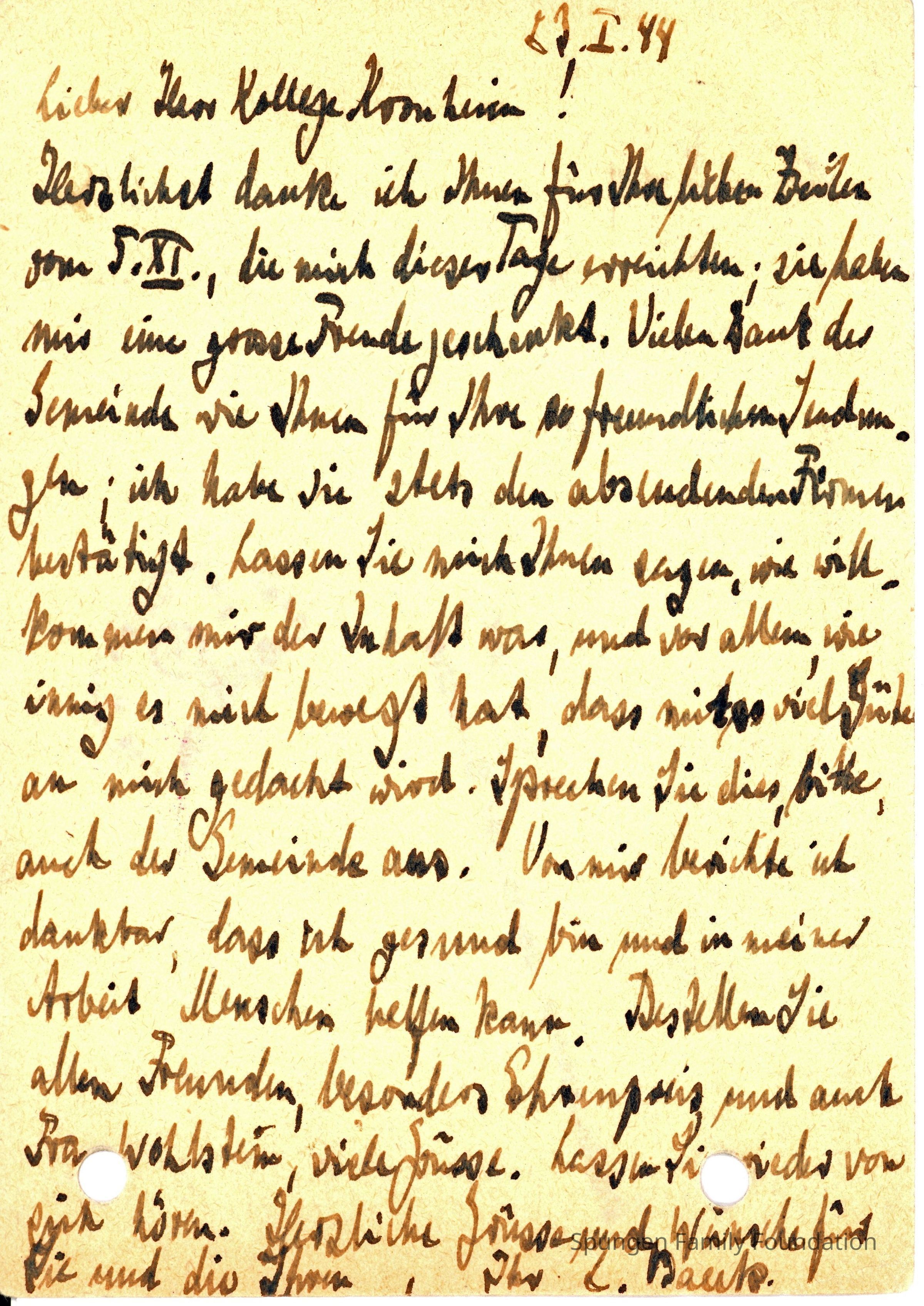
1944 January 23, post card from Rabbi Leo Baeck to Rabbi Emil Kronheim.Context
On November 24, 1941, Terezín became the Theresienstadt ghetto, to which the Nazis expelled 140,000 Jews, the majority of whom eventually perished in death camps. Cultural life flourished in the ghetto even as residents were being dispatched to the gas chambers of Auschwitz, and living conditions were more humane there than at any of the other Jewish ghettos established by the Nazis. Theresienstadt was the only ghetto that permitted foreign visitors, albeit under carefully managed conditions. The most prominent inmate was Rabbi Leo Baeck, the philosopher and theologian who had been chairman of the General Association of German Rabbis in the 1920s. Under the Nazis he was president of the Reich Representation of German Jews and its successor organization, the Reich Association of Jews in Germany, until it was dissolved in June 1943. Rabbi Baeck refused opportunities to leave Germany, believing it was his duty to stay, to serve the Jewish community in its time of greatest need. He was deported to Theresienstadt in 1943; after liberation in May 1945, he settled in London, where he served as chairman of the Council for Jews from Germany. Until this post card was discovered in 1999, Rabbi Baeck's family and colleagues believed that no correspondence from his incarceration at Theresienstadt had survived. Rabbi Baeck had written to Rabbi Emil Kronheim of Stockholm on January 23, 1944, but the card was evidently held by the Nazis for more than five months without explanation before being posted on July 6 from Berlin Charlottenburg. It expresses gratitude for a November 5 card or letter, and for parcels received from Rabbi Kronheim's congregation, but elliptical wording has led one of Rabbi Baeck’s assistants at Theresienstadt to suggest that it may have contained an informally coded message as well. The straight line marking on the front states, "Reply only by postcard written in German." As a German Jew, Rabbi Baeck was required to call himself Leo Israel Baeck as the sender.Collection
Nazi Scourge I: Primary ExhibitionCategory
Post Card
Philatelic Material