F05_P04: Jewish Ghetto Theresienstadt, Deutschland
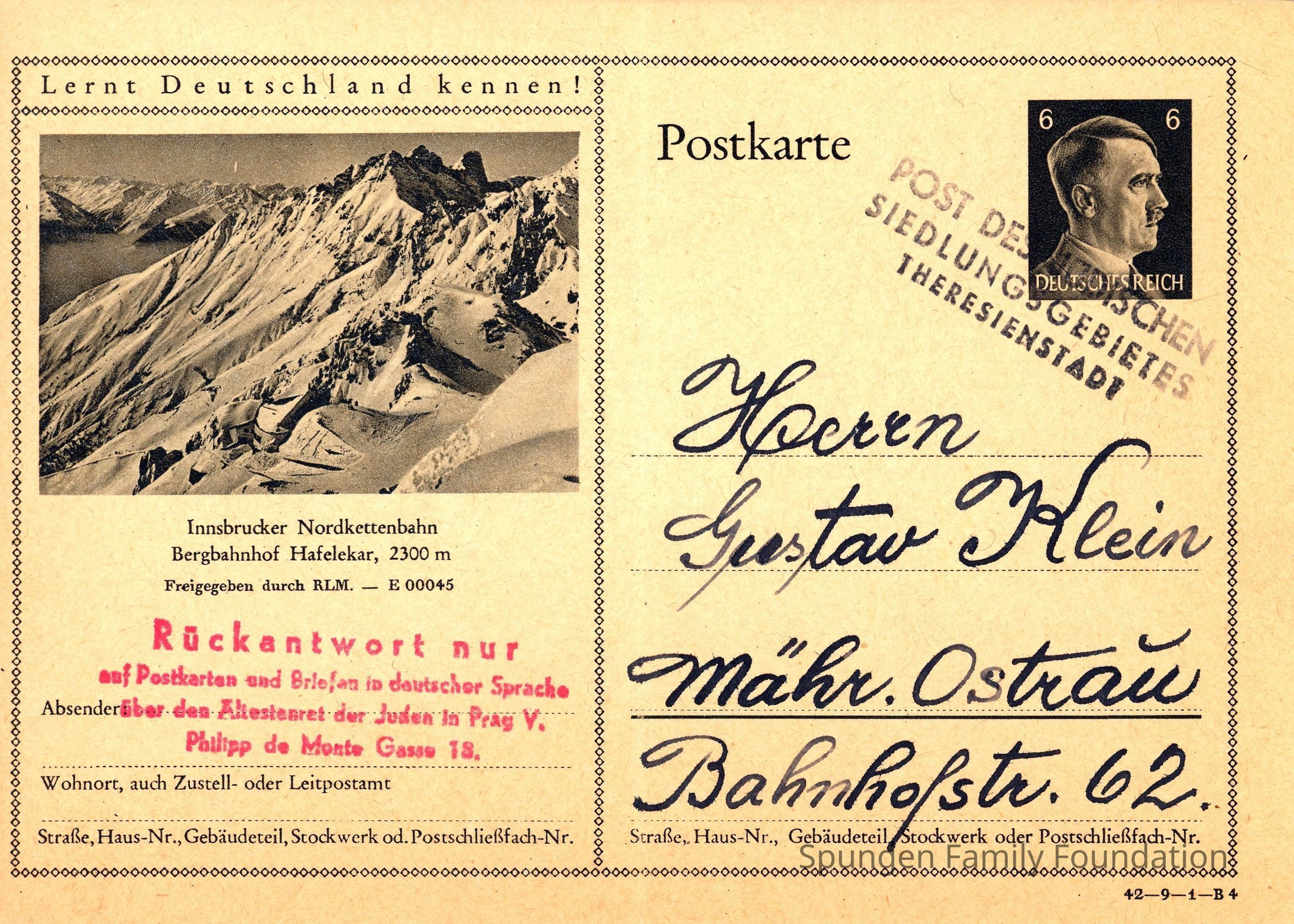
c. 1940s, Front side - Post card from propaganda tactic encouraging visit to Nazi Germany.: Tan post card (appears yellow via scan) with printed German in black ink as outline of post card. Cursive handwriting in black ink is present. At the bottom left, a red ink stamp in German is seen. At the top right a 6-pfennig imprinted stamp depicting Adolf Hitler facing to the right. At the top left printed in German states, "Lernen Deustchland kennen!" or "Get to know Germany!" in English. Directly underneath is a photograph of the Innsbrucker Nordkettenbahn, a ski area in Austria.
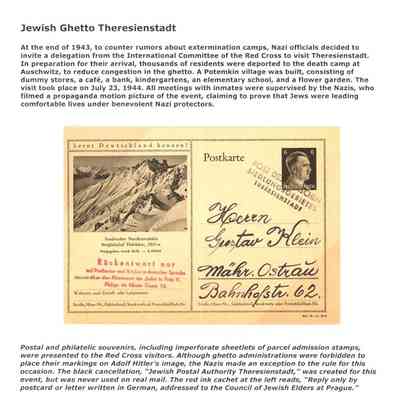
c. 1940s, Front side - Post card from propaganda tactic encouraging visit to Nazi Germany.

Tan post card (appears yellow via scan) with printed German in black ink as outline of post card. Cursive handwriting in black ink is present. At the bottom left, a red ink stamp in German is seen. At the top right a 6-pfennig imprinted stamp depicting Adolf Hitler facing to the right. At the top left printed in German states, "Lernen Deustchland kennen!" or "Get to know Germany!" in English. Directly underneath is a photograph of the Innsbrucker Nordkettenbahn, a ski area in Austria.

Name/Title

F05_P04: Jewish Ghetto Theresienstadt, Deutschland

Entry/Object ID

2007.5.4

Scope and Content

c. 1940s, post card from propaganda tactic encouraging visit to Nazi Germany.

Context

At the end of 1943, to counter rumors about extermination camps, Nazi officials decided to invite a delegation from the International Committee of the Red Cross to visit Theresienstadt. In preparation for their arrival, thousands of residents were deported to the death camp at Auschwitz, to reduce congestion in the ghetto. A Potemkin village was built, consisting of dummy stores, a café, a bank, kindergartens, an elementary school, and a flower garden. The visit took place on July 23, 1944. All meetings with inmates were supervised by the Nazis, who filmed a propaganda motion picture of the event, claiming to prove that Jews were leading comfortable lives under benevolent Nazi protectors. Postal and philatelic souvenirs, including imperforate sheetlets of parcel admission stamps, were presented to the Red Cross visitors. Although ghetto administrations were forbidden to place their markings on Adolf Hitler's image, the Nazis made an exception to the rule for this occasion. The black cancellation, "Jewish Postal Authority Theresienstadt," was created for this event, but was never used on real mail. The red ink cachet at the left reads, "Reply only by postcard or letter written in German, addressed to the Council of Jewish Elders at Prague."

Collection

Nazi Scourge I: Primary Exhibition

Category

Post Card
Philatelic Material

Lexicon

Nomenclature 4.0

Nomenclature Primary Object Term

Postcard

Nomenclature Sub-Class

Writing Media

Nomenclature Class

Written Communication T&E

Nomenclature Category

Category 06: Tools & Equipment for Communication

Archive Details

Date(s) of Creation

circa 1940 - circa 1945

Primary Language

German

Ethnography

Cultural Region

Region

Central Europe

Continent

Europe

Dimensions

Dimension Description

Measurement of the full length and width of the archive.

Width

4-1/8 in

Length

5-13/16 in

Relationships

Related Places

Place

* Untyped Place

Theresienstadt

County

Czechoslovakia

Region

Central Europe

Continent

Europe

Research Notes

Research Type

Curator

Person

C. Walrich

Date

Dec 11, 2025

Notes

More information about the staging of the Theresienstadt Ghetto for the International Committee of the Red Cross can be found at the USHMM Encyclopedia. A quote from their webpage: "On June 23, 1944, as planned, two delegates from the International Red Cross and one from the Danish Red Cross visited the ghetto, accompanied by Theresienstadt commandant SS First Lieutenant Karl Rahm and one of his deputies. The facility had been "cleaned up" and rearranged as a model village. Hints that all was not well included a bruise under the eye of the "mayor" of the "town," a part played by Paul Eppstein, the Elders' Council member representing German Jews. Despite these hints, the International Red Cross inspectors were taken in. This was in part because they expected to see ghetto conditions like those in occupied Poland with people starving in the streets and armed policemen on the perimeter." https://encyclopedia.ushmm.org/content/en/article/theresienstadt-red-cross-visit

General Notes

Note Type

Cataloging Note

Note

C. Walrich - Updated (Dec 11 2025) C. Walrich - Updated Title (Feb 26 2026) C. Walrich - Back-Up Material (Mar 9 2026) C. Walrich - Back-Up PDF (May 6 2026)