F09_P04: The Gypsy Holocaust Nazi genocide of the Roma, Sinti, and Jenische people
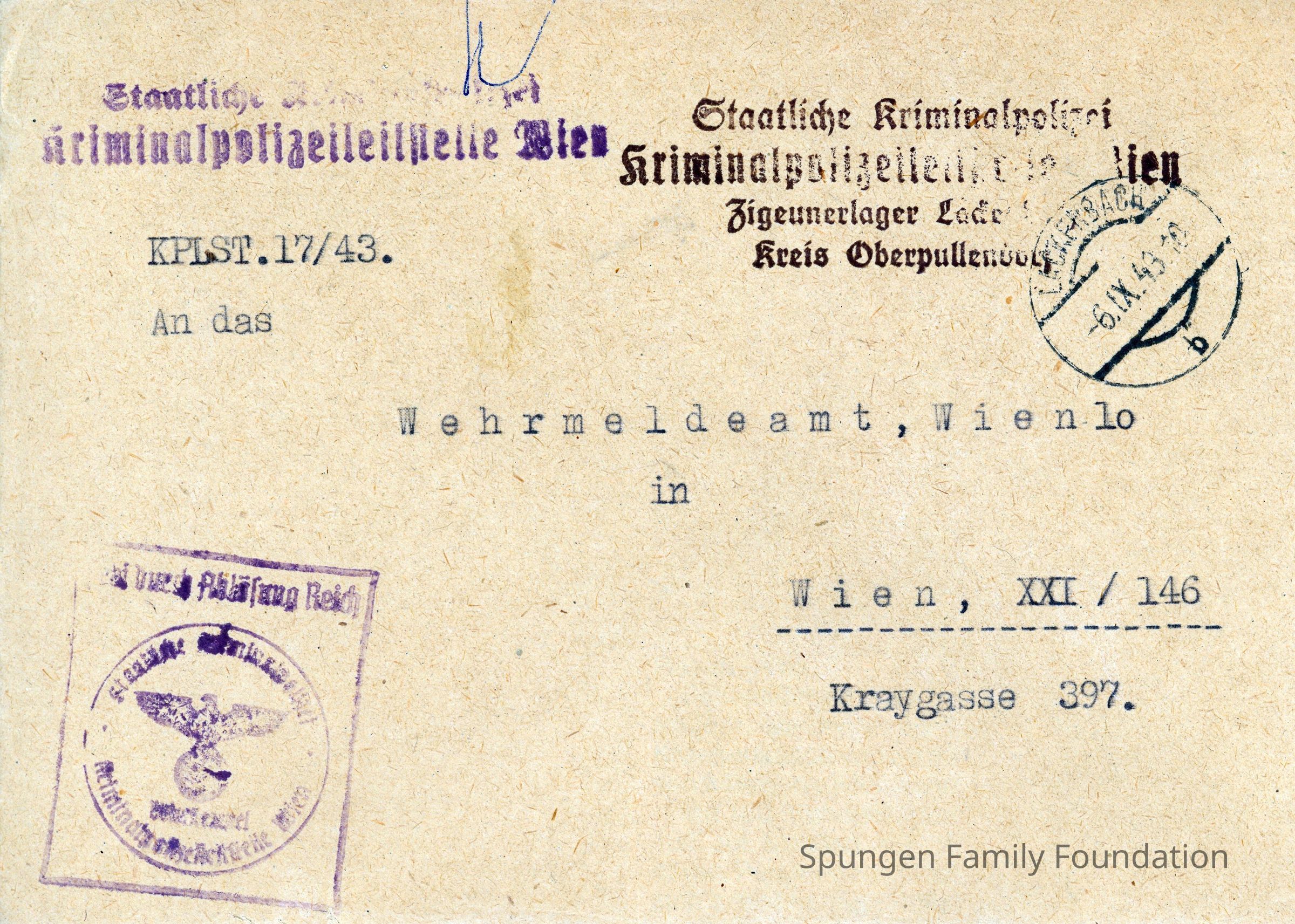
1943 September 6, Front side - Envelope from CPA of Gypsy Camp Lackenbach to military office in Vienna.
Tan envelope with typed text as the address in German using black ink. At the center right is a cancellation dated September 6, 1943. Directly up and to the left is a black overprint stamp from the CPA office. At the top left is a purple overprint stamp from the CPA office in Vienna. At the bottom left is a purple overprint stamp depicting the Reichsadler.
Name/Title
F09_P04: The Gypsy Holocaust Nazi genocide of the Roma, Sinti, and Jenische peopleEntry/Object ID
2007.9.4Scope and Content
1943 September 6, envelope from CPA of Gypsy Camp Lackenbach to military office in Vienna.Context
Nazi doctrine concerning the nomadic Roma, Sinti, and Jenische people of Europe was sometimes inconsistent and contradictory, but Nazi treatment of Gypsies was harsh and murderous. Gypsies were treated as racial inferiors and classified as "asocial elements" and "work-shy." Repression and confinement of Gypsies were assigned to the criminal police (Kriminalpolizei or Kripo). On December 8, 1938, Heinrich Himmler issued the "Decree for Combating the Gypsy Plague," which required identification and registration of all Gypsies, forcible settlement, "the racial separation of the Gypsies from the German people and the prevention of racial mixing," and confinement. Thousands were sent to concentration camps and thousands more were subjected to compulsory sterilization. Special Zigeunerlager (Gypsy camps) were built in Austria. The Lackenbach camp opened on November 23, 1940, and still held captives when it was liberated in March 1945. A September 6, 1943, official mail postage free cover from the criminal police administration of Gypsy Camp Lackenbach to a military registration office in Vienna. With the outbreak of war, Nazi policy toward Gypsies radicalized. Thousands were transported to ghettos and camps in Poland. Einsatzgruppen on the Eastern Front murdered thousands more. A Gypsy family camp was established at Auschwitz-Birkenau in March 1943. Gypsies were subjected to cruel medical experiments at Auschwitz and Natzweiler-Struthof, and were gassed to death at all the Nazi extermination camps. Precise statistics do not exist, but historians estimate that approximately one million Gypsies lived in Europe before the war, and that the Germans and their allies killed up to 220,000 of them.Collection
Nazi Scourge I: Primary ExhibitionCategory
Cover
Philatelic Material