Julius Streicher
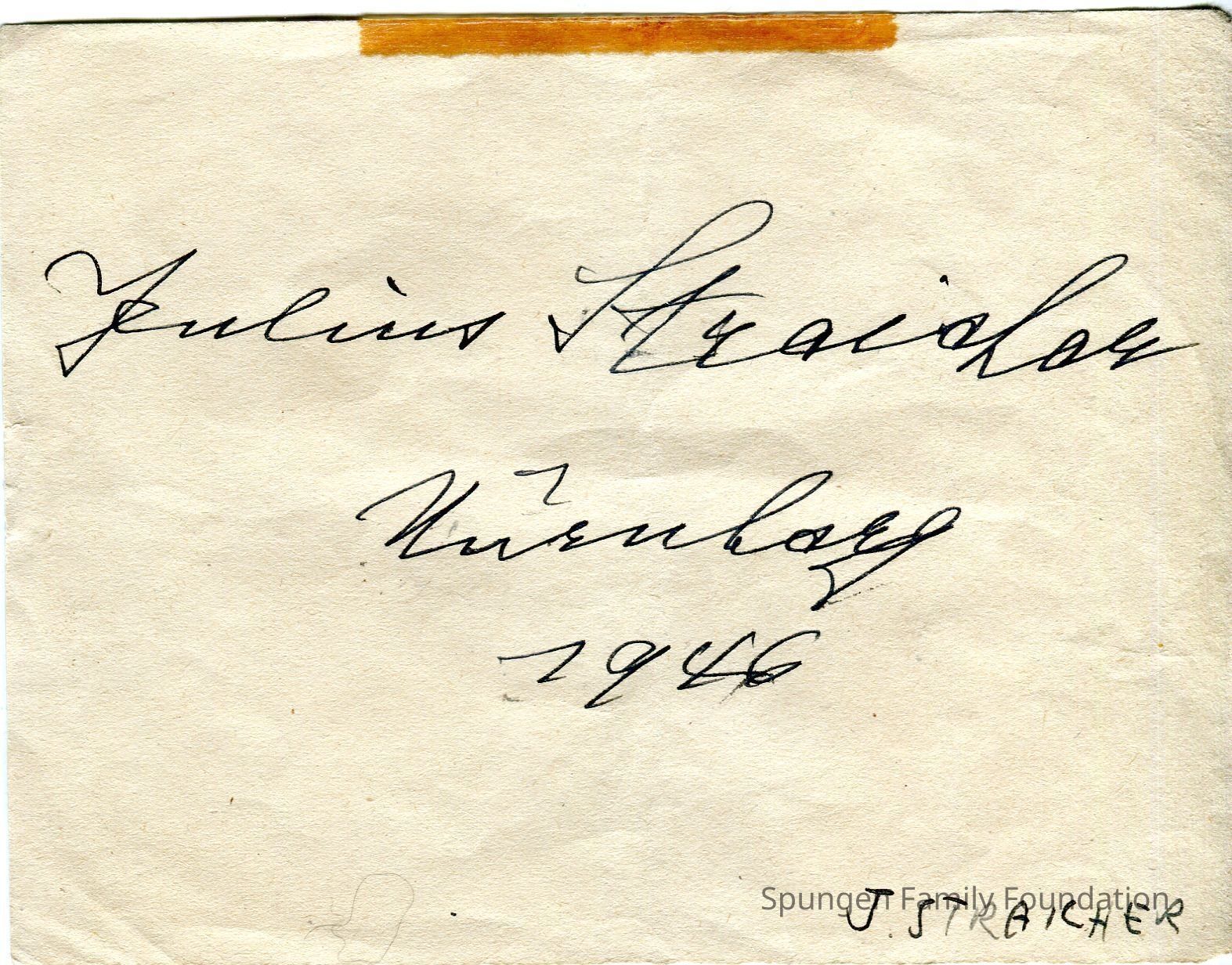
1946, Front side - Note card with Julius Streicher signature from the Palace of Justice in Nuremberg, Germany.
Name/Title
Julius StreicherEntry/Object ID
2026.7.19Scope and Content
1946, note card with Julius Streicher signature from the Palace of Justice in Nuremberg, Germany.Context
Former Regional Leader of Franconia and a member of the Reichstag, Julius Streicher maintained a vital role in the Nazi Party. Streicher is notable for the creation of incredulously antisemitic newspaper Der Stürmer. The publication of the newspaper brought immense wealth to Streicher, profiting off of his hatred of Jewish people. In 1914, Streicher joined the Imperial German Army and was awarded the Iron Cross 1st and 2nd Class. Yet, Streicher displayed poor behavior while he was enlisted, with officers and leadership being aristocratic compared to his children as one of nine children to an elementary school teacher and his wife. Arguably, Streicher’s influence for Der Stürmer includes his desire for wealth and respect. In November 1919, Streicher joined the Deutschsozialistische Partei (DSP), an organization similar to the NSDAP. Although an active member, Streicher was unimpressed with the lack of antisemitism. He pushed other members to adopt antisemitic ideology, though plenty of opposition was expressed. In 1921, Streicher joined the Deutsche Werkgemeinschaft (DWG) and hoped they would be united in antisemitism. Yet, it prevailed he was criticized for his beliefs. Ultimately, Streicher joined the Nazi Party in 1922, bringing members from his previous organizations. After hearing Adolf Hitler speak in Munich, Streicher described it as a religious experience and that he felt destined to serve Hitler. Unwavering devotion, Streicher continued to develop Der Stürmer gaining attention from the Nazi Party and Streicher was elected as deputy of the Reichstag. Additionally, Streicher became a member of the Sturmabteiling (SA) in 1934. A year later, Hitler named Streicher to the Academy of German Law. Streicher had a close relationship with Hitler, but not everyone in his close circle considered Streicher intellectual or a friend. Hermann Göring disliked Streicher and forbade his staff from reading Der Stürmer. In 1938, Streicher was accused of keeping Jewish property following Kristallnacht. Moreover, he was exposed for spreading false rumors about Göring, one namely that he was impotent. Hitler himself was loyal to Streicher, considering him a good friend never minding the others who disliked him. In 1945, Streicher was captured by the Allies and transported to Nuremberg, Germany where he would undergo trial. Streicher’s reputation as a lewd and sick man preceded him. Majority of the prisoners at the Palace of Justice refused to speak or eat with him. The Nuremberg psychiatrist Douglas Kelley claimed Streicher was obsessed with “the Jewish problem” and would speak about it for 24 hours a day, it consumed his every thought. Streicher was sentenced to death on October 1, 1946 and 15 days later Streicher was executed by hanging for being found guilty of crimes against humanity.Collection
Nazi Party SignaturesCategory
Note
Philatelic Material