Karl Dönitz
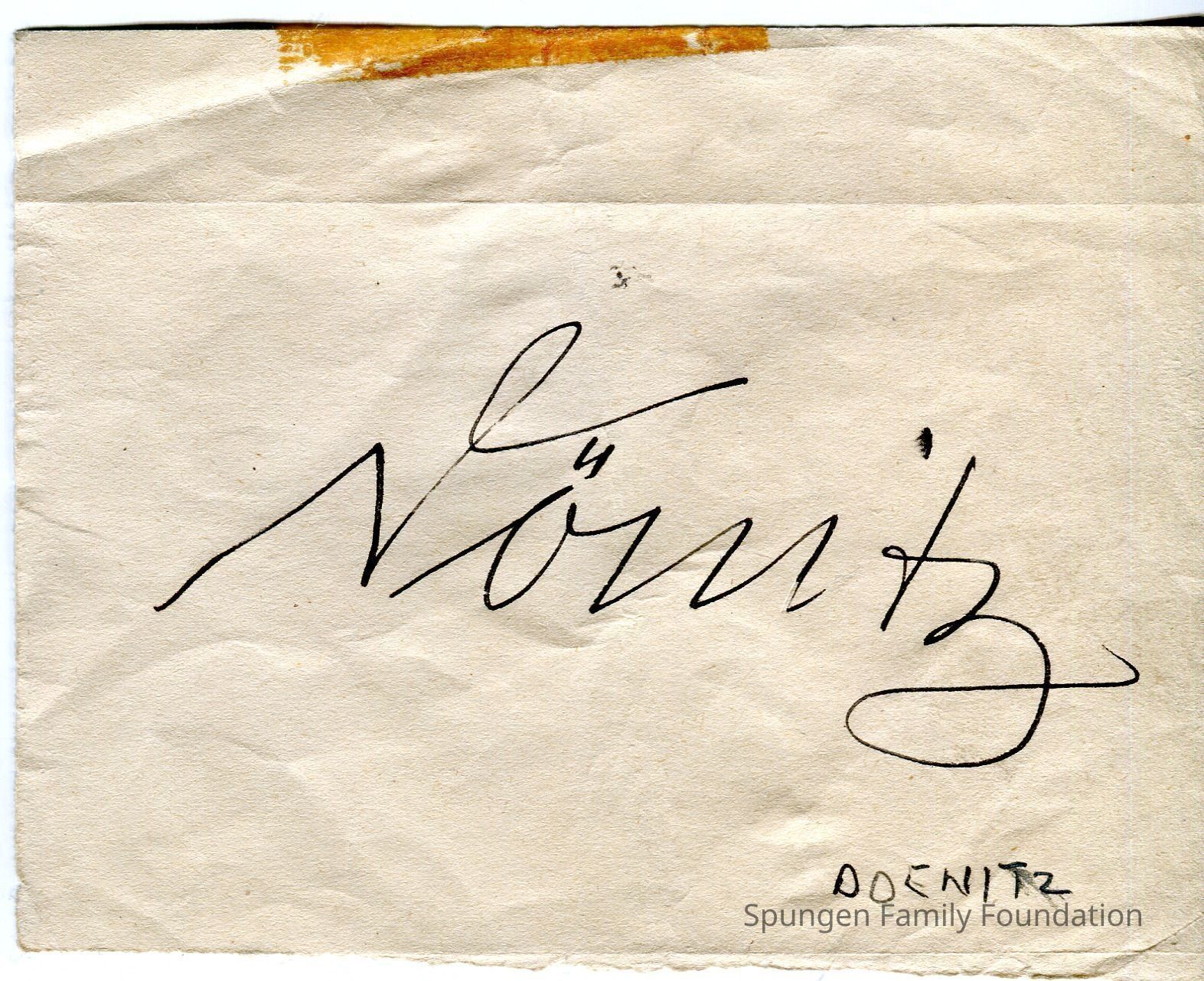
1946, Front side - Note card with Karl Dönitz signature from the Palace of Justice in Nuremberg, Germany.
Tan note card with cursive signature and printed handwriting in German using black ink.
Name/Title
Karl DönitzEntry/Object ID
2026.7.1Scope and Content
1946, note card with Karl Dönitz signature from the Palace of Justice in Nuremberg, Germany.Context
Karl Dönitz was the Supreme Commander of the Kriegsmarine, the Nazi’s naval force. Dönitz was one of Adolf Hitler’s most trusted Nazi leaders. At the time of his suicide, Hitler appointed Dönitz as Head of the State as Hitler’s successor. In his early years, at age nineteen, Dönitz enlisted in the Kaiserliche Marine or Imperial Navy of the German Empire. From his enlistment in 1913, Dönitz made a career in the naval force and was commissioned as an officer. Dönitz continued to climb ranks throughout World War I and the Interwar period. After Germany invaded Poland in 1939, Dönitz immediate concern for the structure of the naval force was apparent. The striking issue was the lack of readied warships. After his promotion to Konteradmiral or Commander of Submarines in October 1939, Dönitz ordered a building program take place, with numbers of ships steadily increasing by 1941. Dönitz’ efforts and loyalty towards the Kriegsmarine gained his respect with Hitler. Although Hitler appointed Dönitz as his successor, Dönitz was not a part of Hitler’s inner circle. Yet, his dedication to the Nazi regime remained important. After the fall of the Third Reich, Karl Dönitz was tried for war crimes in Nuremberg, Germany in 1946. Ultimately, he was found guilty of his crimes and attributions to the Nazi regime and sentenced to ten years of prison. After completing his sentence, Dönitz resided in a small village in West Germany where he wrote memoirs before his death in 1980. Aside from his career and involvement as a Nazi military leader, Dönitz did not describe himself as a political figure. In one his books, he claimed he did not have influence on the ideologies the Nazis implemented. Evidently, Dönitz was proudly antisemitic but attempted to evade any accusations of it.Collection
Nazi Party SignaturesCategory
Note
Philatelic Material