1_01: Renata Laxova (neé Polgarova)
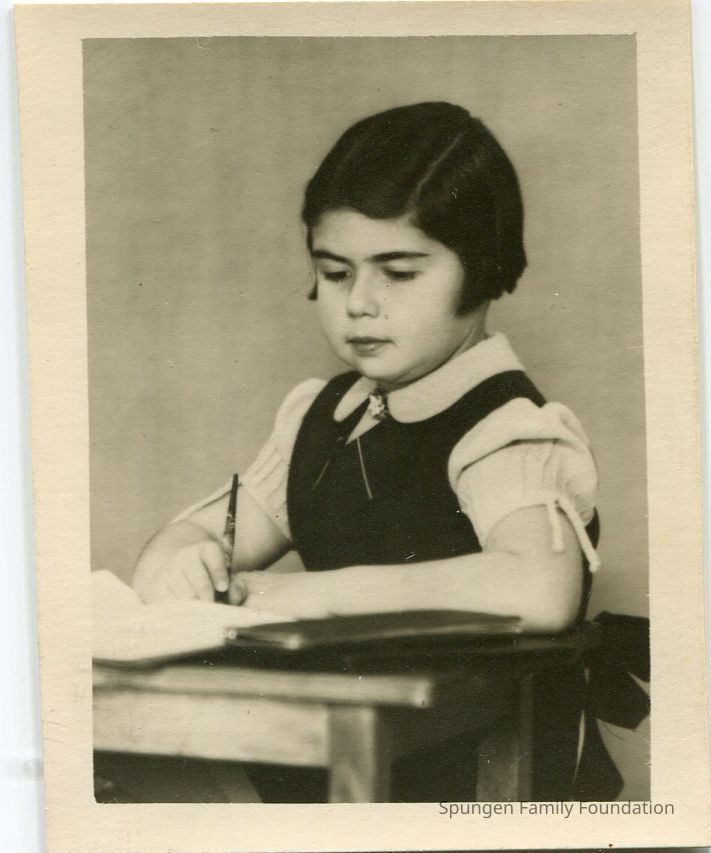
c.1937-1938, Front side - Photograph of Renata Laxova in the first grade.
Black-and-white photograph of Renata Laxova. Renata is seen sitting at a desk. She has a writing utensil in her right hand. In front of her is paper and books. She is wearing a black dress with puffy white sleeves and a collar. She has a short, dark haircut and a side part. Renata's attention is seen focused on the contents on her desk.
Name/Title
1_01: Renata Laxova (neé Polgarova)Entry/Object ID
2019.1.1.aScope and Content
c.1937-1938, photograph of Renata Laxova in the first grade.Context
Renata Polgarova was born an only child on July 15, 1931 in Brno, Czechoslovakia. When she was eight years old, her parents sent her alone on a train bound for England to escape Nazi occupation. She arrived in England on August 2, 1939 as a child refugee and spent the war with the Quaker family of Harry and Edna Daniels. Renata survived the Holocaust thanks to Sir Nicholas Winton and the “Children’s Section” of the British Committee for Refugees from Czechoslovakia, which rescued at least 669 Czech children – most of them Jewish – on so-called “kindertransports.” Renata was on the last transport to arrive safely. Before the war, some 13,000 Jewish people lived in Brno. After the war, approximately 1,000 returned. That number included Renata’s parents (Mikulas Polgar and Nelly Polgarova), both of whom survived separately in harrowing circumstances. On August 1, 1946, seven years to the day she left, Renata returned to Czechoslovakia at age 15. As far as she knows, she is the only Jewish child from Brno who reunited with both parents after World War II. As a young adult, Renata studied genetics and pediatric medicine in Brno, earning a medical degree and a PhD. In 1951, she became Renata Laxova when she married Tibor Lax, who was one of only four people to survive the Holocaust from his extended family of 120. After the Soviet invasion of Czechoslovakia in August 1968, Renata escaped a second time to England – this time with her husband and their two daughters. They were again given refuge by the Daniels family. Eventually they all immigrated to Madison, Wisconsin, USA. Amid the turmoil of war and genocide, Renata’s family was able to save a substantial amount of correspondence, drawings, photographs, and other materials related to her journey. Renata is the author of Letter to Alexander, a memoir of surviving the Holocaust. Her material is now being used for educational purposes around the world. Throughout her life, Dr. Renata Laxova has maintained a close relationship with the Daniels family. Her foster brother Harry Daniels, who was two years younger than Renata, later moved to the Netherlands, where his family resides today in Waginengen and Utrecht. So unique was the relationship between the families that the younger Harry Daniels and his wife Els named their first-born daughter Renate. Renata Laxova’s first-born daughter is named Daniela, after the Daniels family.Collection
KindertransportCategory
Photograph