Never Again? 49 Years Later
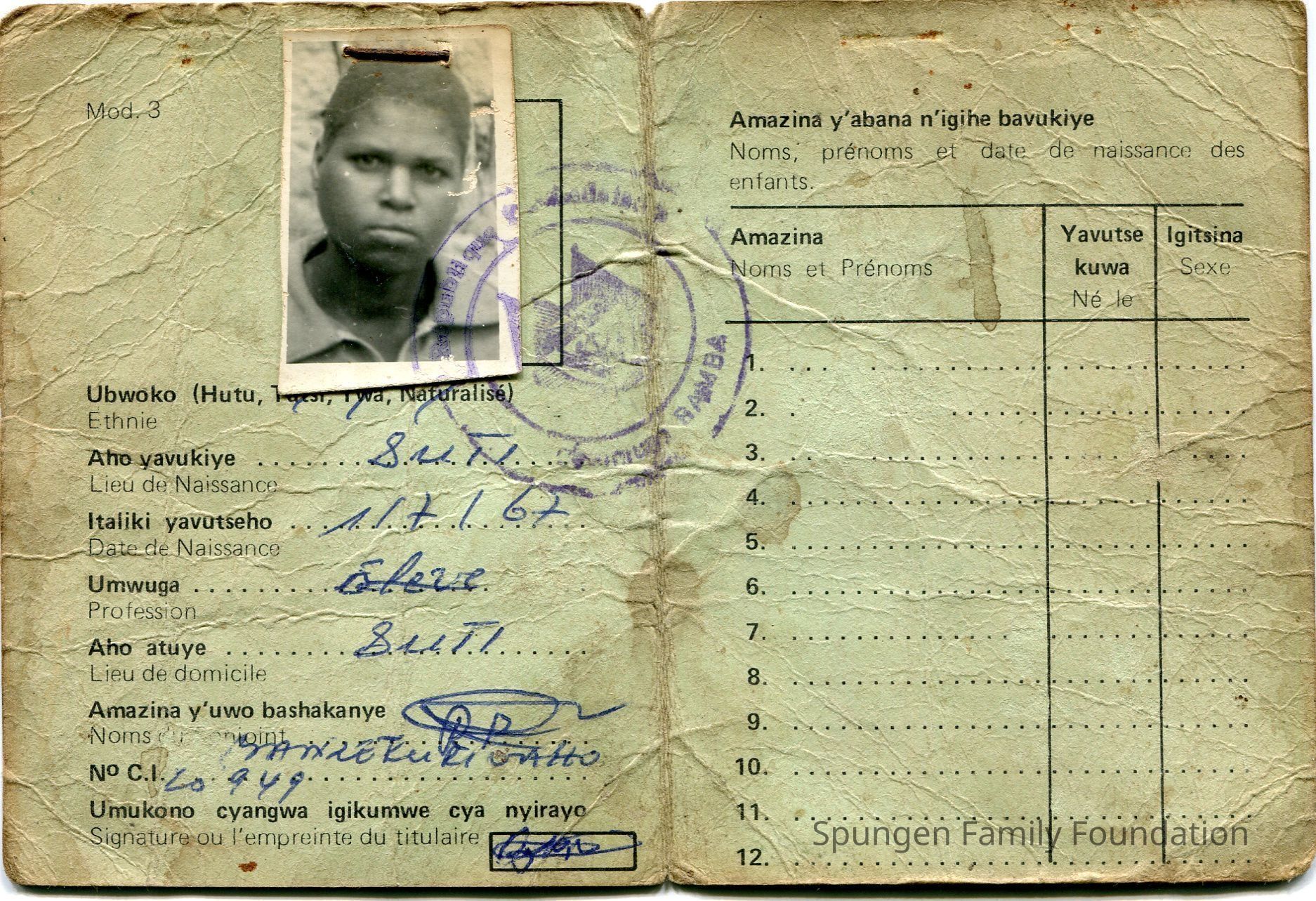
c.1990s, Front side - Identification pass from Vestine Baribane, a Hutu, Pentecostal Christian who experienced the Rwandan Genocide, 1994.
Green paper with black-and-white photograph. Printed text in Swahili and French using black ink is present. At the left side, cursive handwriting in blue ink. At the top left, a black-and-white photograph of Vestine Baribane wearing a solid color, collared shirt and facing toward the camera. She has a short, dark haircut. At the center, a black ink overprint stamp from the Republic of Rwanda.
Name/Title
Never Again? 49 Years LaterScope and Content
c.1990s, identification pass from Vestine Baribane, a Hutu, Pentecostal Christian who experienced the Rwandan Genocide, 1994.Context
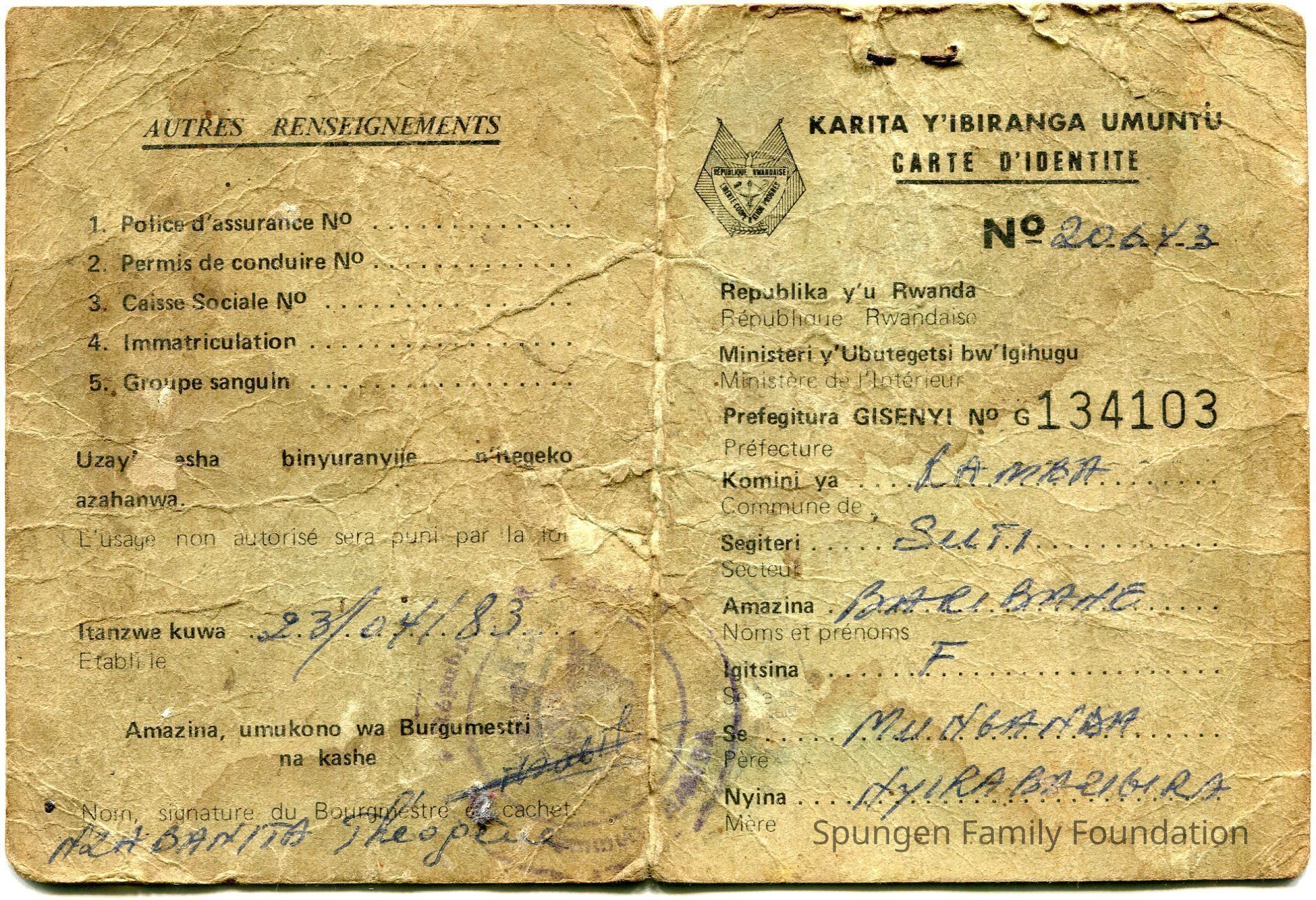
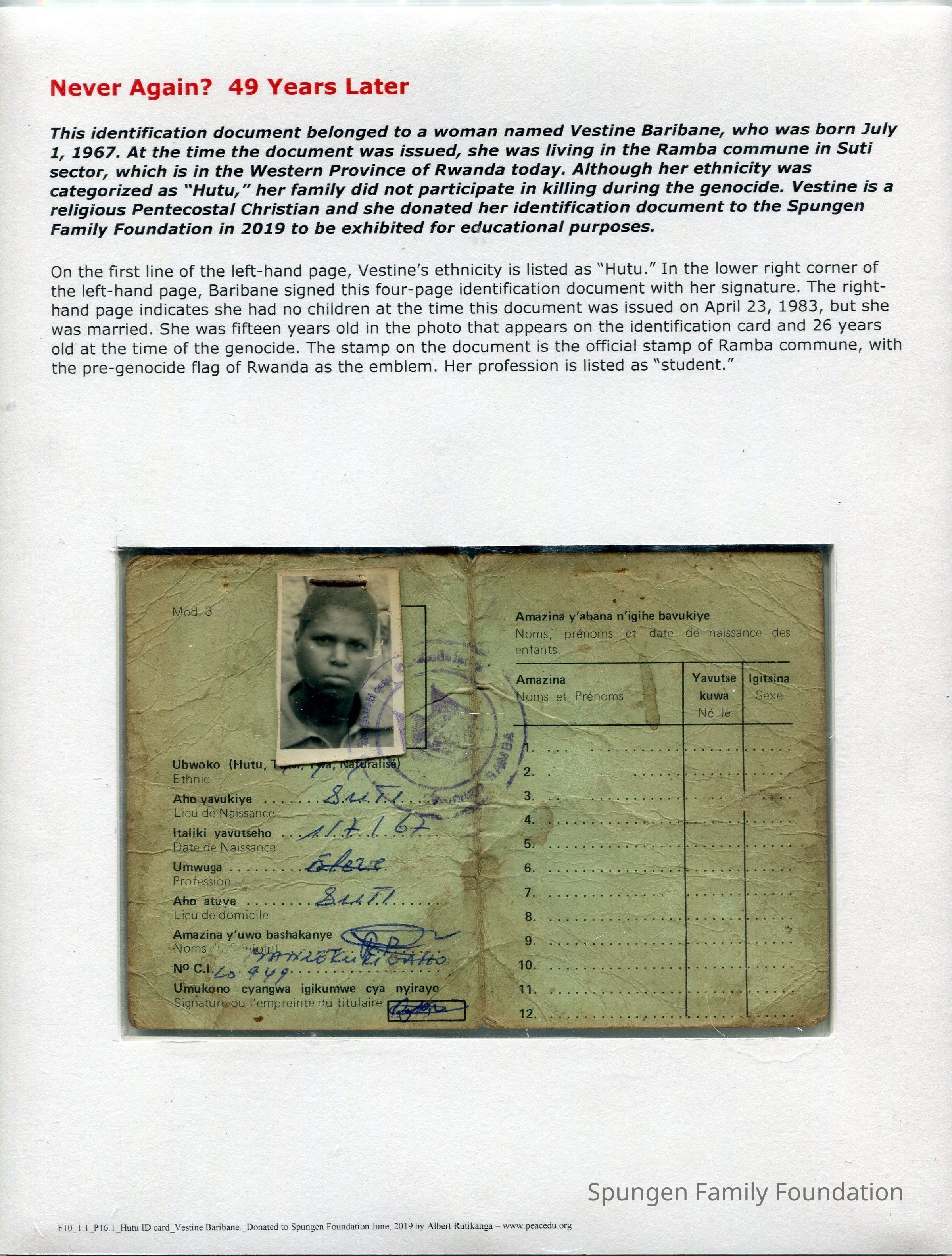
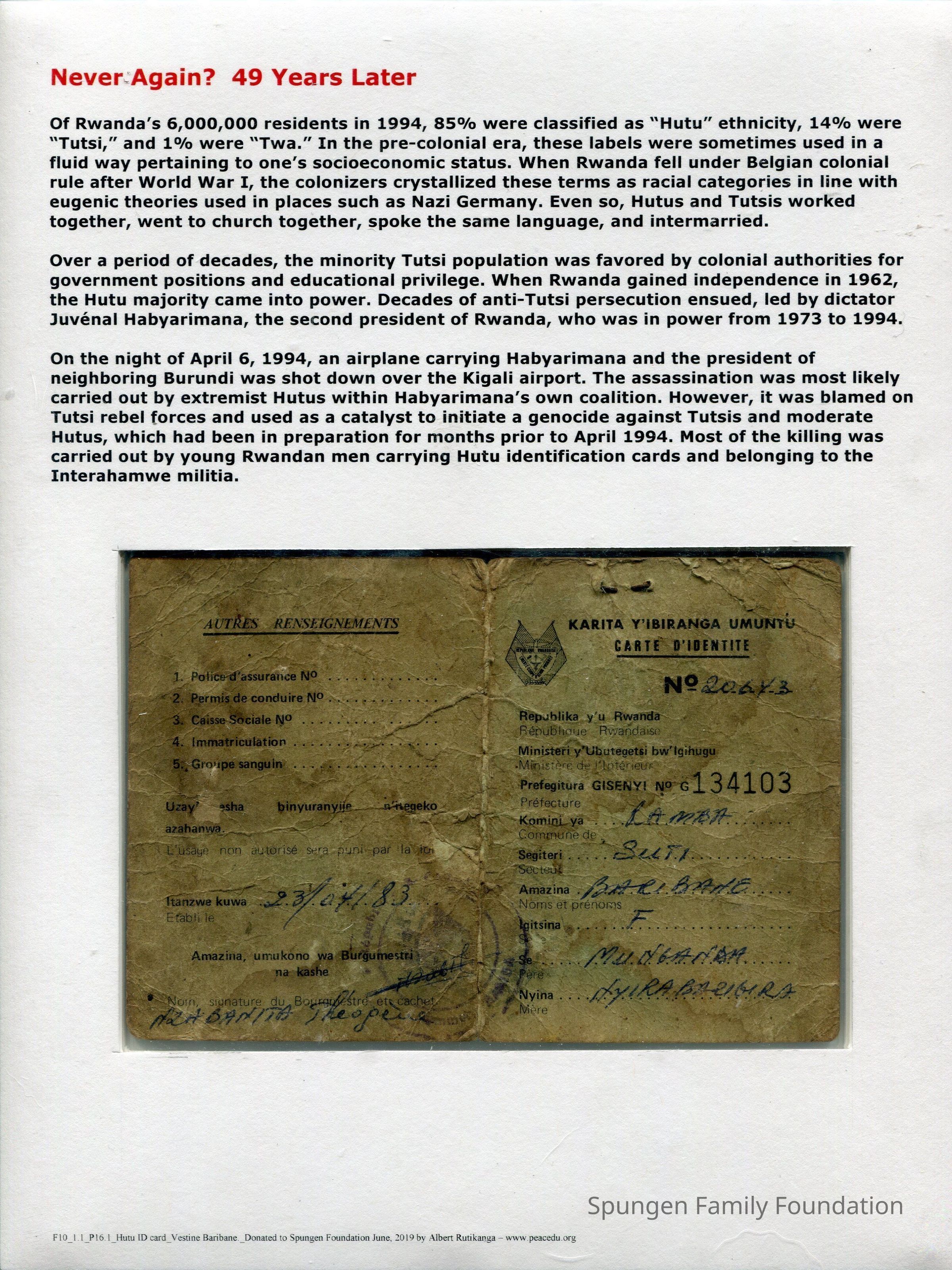
This identification document belonged to a woman named Vestine Baribane, who was born July 1, 1967. At the time the document was issued, she was living in the Ramba commune in Suti sector, which is in the Western Province of Rwanda today. Although her ethnicity was categorized as “Hutu,” her family did not participate in killing during the genocide. Vestine is a religious Pentecostal Christian and she donated her identification document to the Spungen Family Foundation in 2019 to be exhibited for educational purposes. On the first line of the left-hand page, Vestine’s ethnicity is listed as “Hutu.” In the lower right corner of the left-hand page, Baribane signed this four-page identification document with her signature. The right-hand page indicates she had no children at the time this document was issued on April 23, 1983, but she was married. She was fifteen years old in the photo that appears on the identification card and 26 years old at the time of the genocide. The stamp on the document is the official stamp of Ramba commune, with the pre-genocide flag of Rwanda as the emblem. Her profession is listed as “student.” Of Rwanda’s 6,000,000 residents in 1994, 85% were classified as “Hutu” ethnicity, 14% were “Tutsi,” and 1% were “Twa.” In the pre-colonial era, these labels were sometimes used in a fluid way pertaining to one’s socioeconomic status. When Rwanda fell under Belgian colonial rule after World War I, the colonizers crystallized these terms as racial categories in line with eugenic theories used in places such as Nazi Germany. Even so, Hutus and Tutsis worked together, went to church together, spoke the same language, and intermarried. Over a period of decades, the minority Tutsi population was favored by colonial authorities for government positions and educational privilege. When Rwanda gained independence in 1962, the Hutu majority came into power. Decades of anti-Tutsi persecution ensued, led by dictator Juvénal Habyarimana, the second president of Rwanda, who was in power from 1973 to 1994. On the night of April 6, 1994, an airplane carrying Habyarimana and the president of neighboring Burundi was shot down over the Kigali airport. The assassination was most likely carried out by extremist Hutus within Habyarimana’s own coalition. However, it was blamed on Tutsi rebel forces and used as a catalyst to initiate a genocide against Tutsis and moderate Hutus, which had been in preparation for months prior to April 1994. Most of the killing was carried out by young Rwandan men carrying Hutu identification cards and belonging to the Interahamwe militia.Collection
The Rwandan GenocideCategory
Identification Card
Philatelic Material