Rudolf Hess
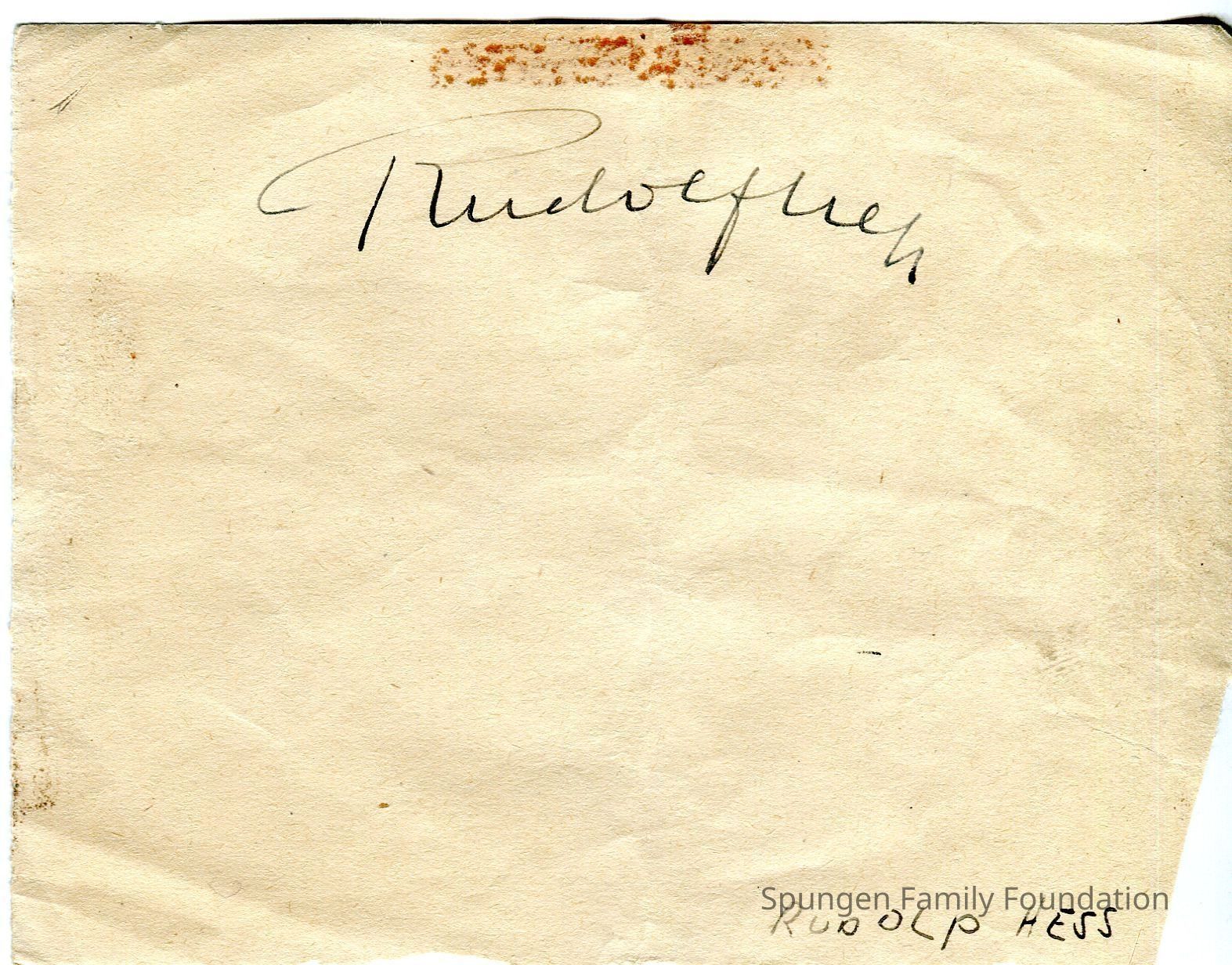
1946, Front dsiote card with Rudolf Hess signature from the Palace of Justice at Nuremberg, Germany.
Tan note card with cursive signature and printed handwriting in German using black ink.
Name/Title
Rudolf HessEntry/Object ID
2026.7.7Scope and Content
1946, note card with Rudolf Hess signature from the Palace of Justice at Nuremberg, Germany.Context
Rudolf Walter Richard Hess was Deputy to the Führer of the Nazi Party until 1941 when he fled Germany for Scotland, attempting to negotiate a peace treaty with the United Kingdom’s Duke of Hamilton. Before his departure, Hess provided Karlheinz Pintsch a letter addressed to Adolf Hitler with his plans listed. Upon receiving the letter, Hitler was immensely worried Hess had incited a coup d'état. British authorities arrested Hess and held him in custody until the end of World War II, when he was placed on trial in 1946 at Nuremberg, Germany. Hitler had removed Hess from power, despite his custody in the United Kingdom. Hitler went on further to rid the position of the Deputy to the Führer. Hess was tried for crimes against peace and conspiring against Germany. He was sentenced to life in Spandau Prison in West Berlin, Germany. He remained there for 41 years until committing suicide by hanging in 1987 at age 93. Hess had expressed rooted antisemitism well before World War II. At the end of World War I, Hess had joined the Thule Society, an antisemitic right-wing group. According to Hess himself, he believed that Egypt made him a nationalist, the war made him a socialist, and Munich made him an antisemite. In addition to his strong antisemite and nationalistic views, Hess was devoutly loyal to Hitler, seeking his approval. Yet, with a less political role, Hess’s responsibilities became few and far between during the war. Ultimately, seeking the peace negotiation with the United Kingdom had incited hope within Hess that he would help progress a war victory. Hess is buried in Wunsiedel, a small German town. His gravestone had since been a destination for neo-Nazi visits. The parish council of Wunsiedel chose not to renew the gravesite under Hess and removed his remains, cremated, and gave the ashes to his family members.Collection
Nazi Party SignaturesCategory
Note
Philatelic Material