Walther Funk
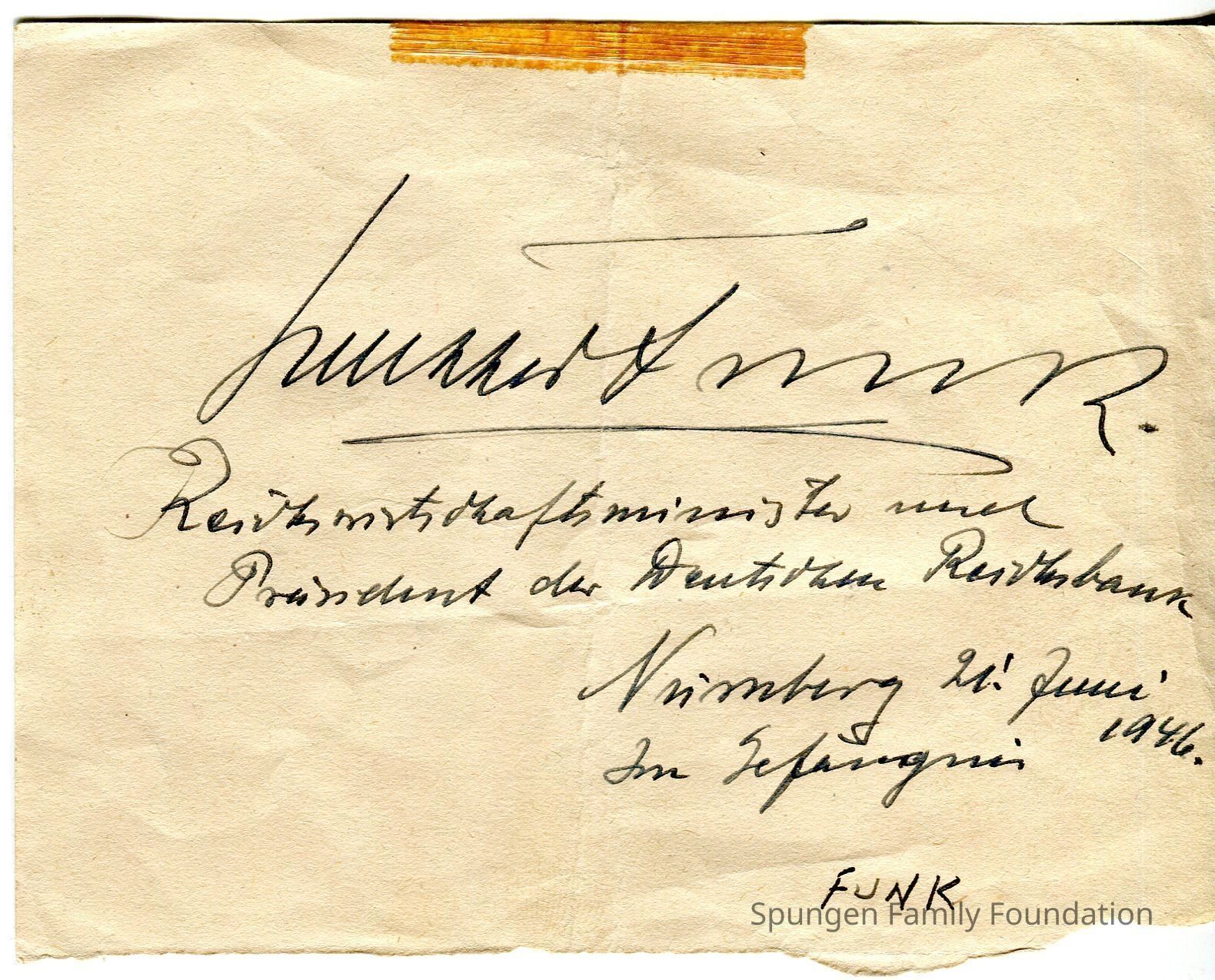
1946, Front side - Note card with Walther Funk signature from the Palace of Justice in Nuremberg, Germany.
Tan note card with cursive signature and printed handwriting in German using black ink.
Name/Title
Walther FunkEntry/Object ID
2026.7.5Scope and Content
1946, note card with Walther Funk signature from the Palace of Justice in Nuremberg, Germany.Context
Walther Immanuel Funk served as the Reichsminister for the Economy from 1939-1945 and additionally as president of the Reichsbank beginning in 1939. In his career, Funk was largely responsible for managing the mobilization of the economy and exploiting Jewish people in ghettos and concentration camps by raiding their assets. In 1914, Funk enlisted in the infantry division of the Imperial Germany Army. Two years later, Funk was wounded in action and discharged. Following the armistice, Funk began working as a journalist and eventual editor of a moderate-right financial newspaper. Funk was a nationalist and anti-Marxist who believed in the mission of the Nazi party. After connecting with Adolf Hitler through Gregor Strasser, an early leader of the Nazi party, Funk was elected as a Reichstag deputy. Through his loyalty and economic expertise, Adolf Hitler named Funk in his will and desired for him to continue as Reichsminister. Unwritten into the plan for the Flensburg Government formed by Karl Dönitz and Lutz Graf Schwerin von Krosigk, Funk’s career as Reichsminister was over. Less than a month later, Funk was arrested and to be put on trial at the Palace of Justice in Nuremberg. Funk was accused on multiple accounts and exposed for stealing Jewish property, gold jewelry, and specifically gold teeth he had extracted from the mouths of Jews in concentration camps. On trial at Nuremberg, Funk was visibly emotional, even crying at photo and video evidence of the murders at the concentration camp. According to Hjlamar Schacht, Funk seemed unable to grasp the serious nature of the responsibilities he assumed. Hermann Göring even went as far to call Funk as “insignificant subordinate”. Ultimately, Funk served eleven years at Spandau Prison in Berlin, Germany. In 1957, Funk was granted compassionate release for poor health. He died from diabetes complications three years later.Collection
Nazi Party SignaturesCategory
Note
Philatelic Material