Name/Title
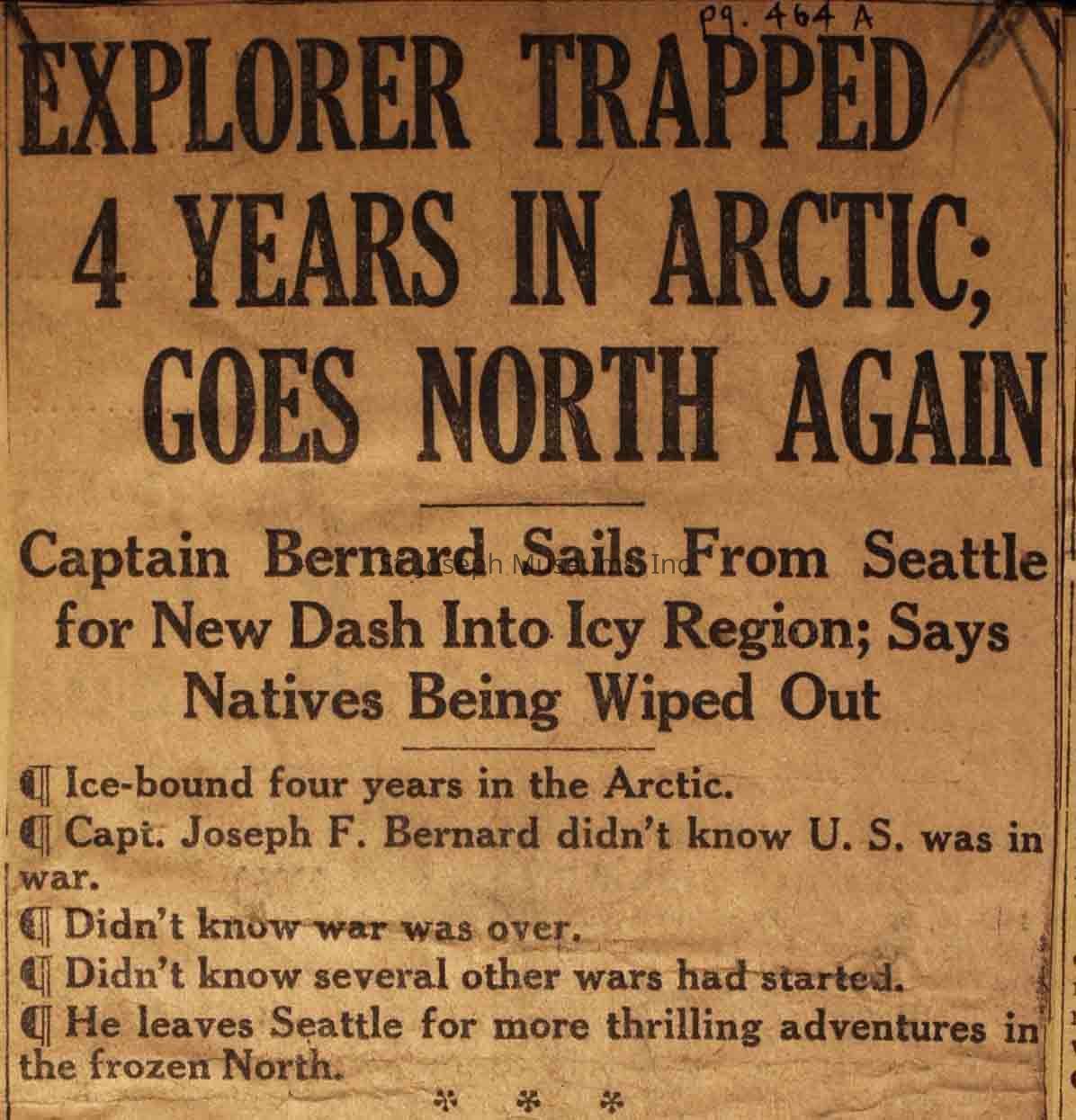
Newspaper Article entitled "Explorer Trapped 4 Years In Arctic; Goes North Again"Entry/Object ID
Q1430.634.464ABDescription
Newspaper article entitled "Explorer Trapped 4 Years in Arctic; Goes North Again" about Captain Joseph F. Bernard's travels.
Page A has 6 columns; page B has 7 columns. Vol I pg. 464A-B
A.
* Ice-bound four years in the Arctic
* Capt. Joseph F. Bernard didn't know U. S. was in war
* Didn't know war was over
* Didn't know several other wars had started
* He leaves Seattle for more thrilling adventures in the freezing North
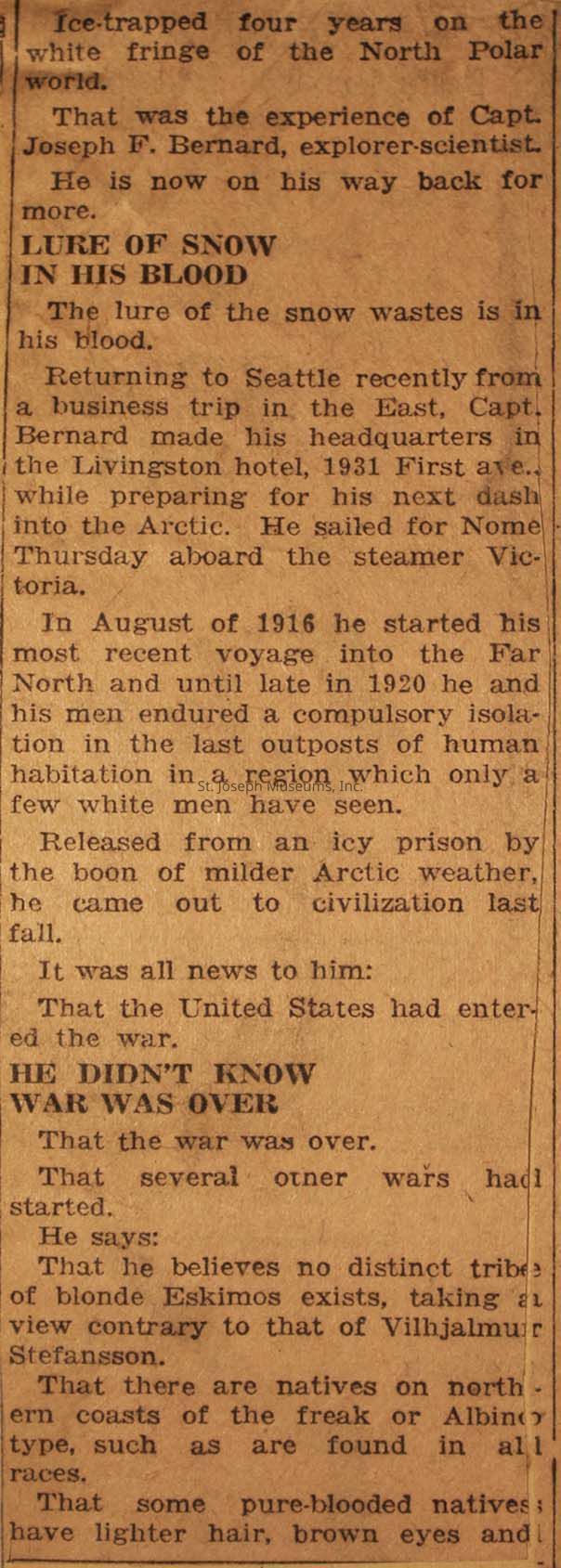
The article recounts the extraordinary experiences of Capt. Joseph F. Bernard, an explorer-scientist who was ice-trapped for four years at the North Polar fringe. Capt. Bernard, driven by a passion for snow exploration, recently returned to Seattle after a business trip in the East and planned another Arctic expedition, having made the Livingston Hotel his base.
LURE OF SNOW IN HIS BLOOD
His last expedition in 1916 led to four years of isolation in the Arctic, during which significant world events unfolded unbeknownst to him, such as the United States entering the war. Bernard disputes earlier claims about the existence of a distinct tribe of blonde Eskimos, offering alternative theories about lighter-haired natives on the northern coasts, differing from the views of other explorers. HE DIDNT KNOW WAR WAS OVER
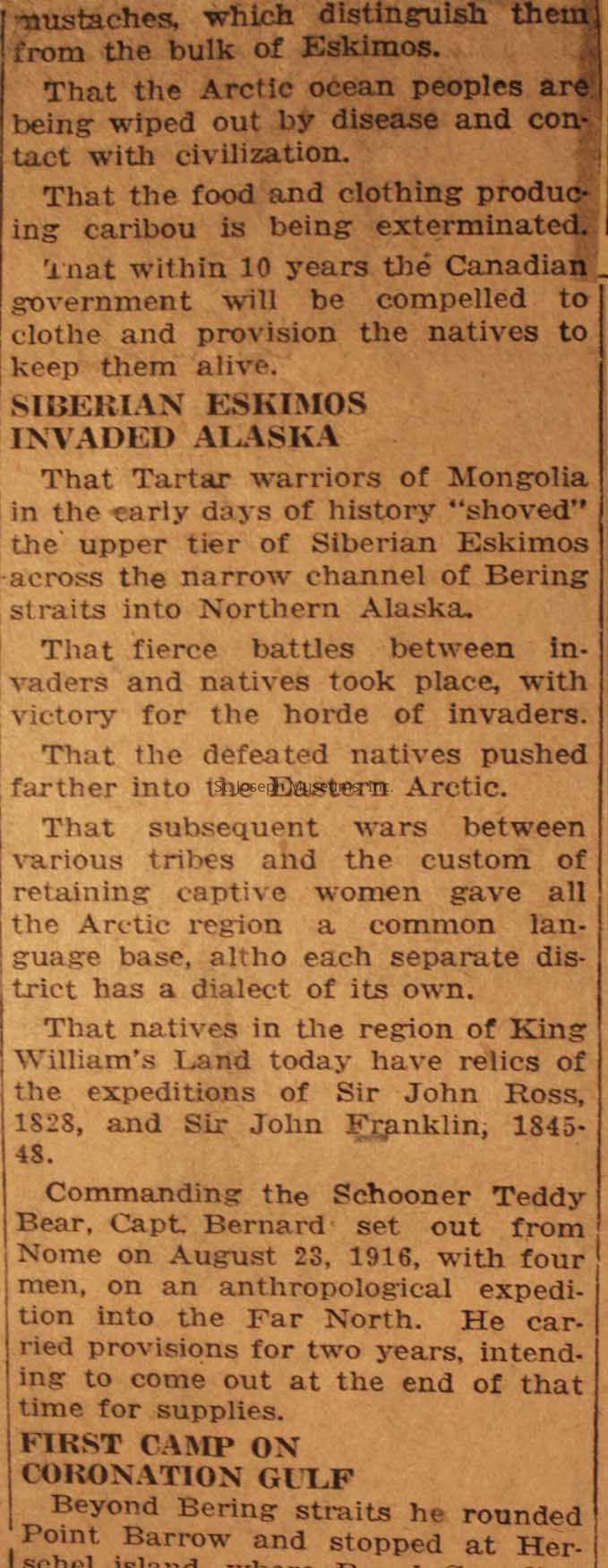
It highlights that the Arctic Ocean peoples face extinction due to disease and contact with civilization, which has also led to the potential extermination of caribou, their food and clothing source. It states that within a decade, the Canadian government may need to intervene to sustain these populations. Lastly, it recounts Captain Bernard's 1916 expedition from Nome, detailing his preparations for a two-year anthropological journey into the Far North.
SIBERIAN ESKIMOS INVADED ALASKA
The article describes historical invasions where Tartar warriors pushed Siberian Eskimos into Alaska, resulting in fierce battles. The defeated natives migrated further east in the Arctic. It mentions common language development due to tribal wars and captivity practices. Further, it discusses the discovery of relics by natives from expeditions by Sir John Ross and Sir John Franklin.
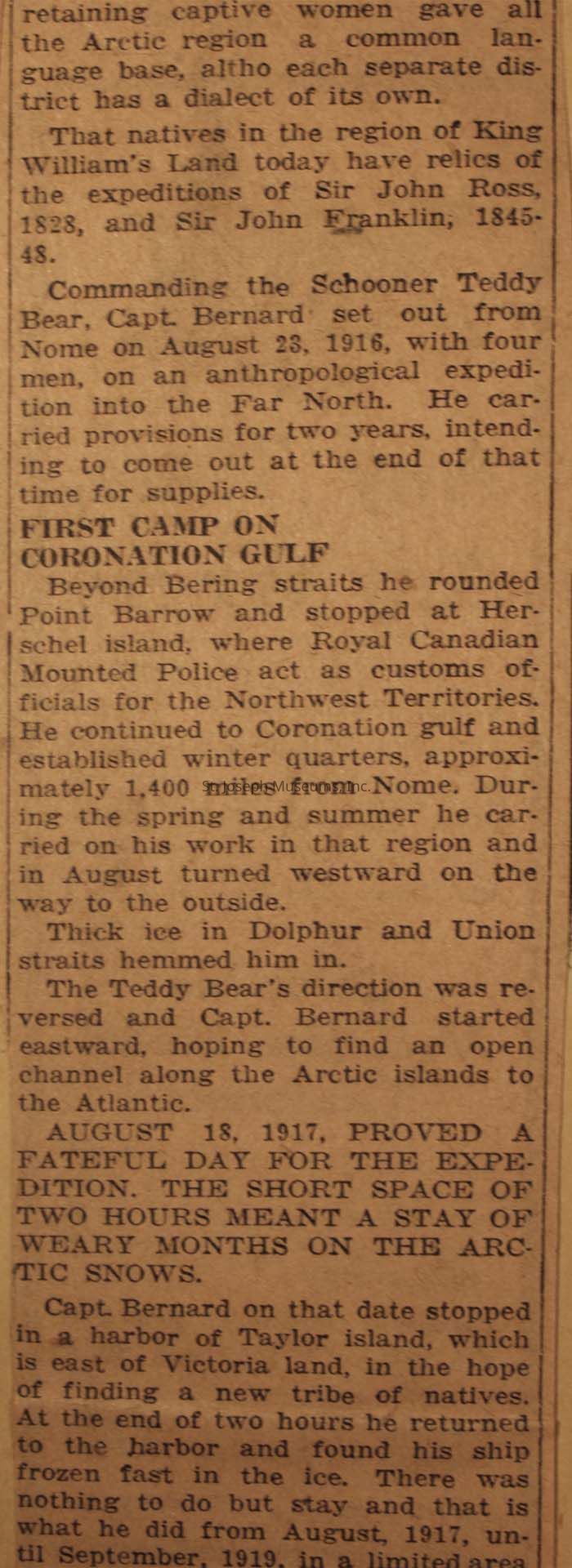
FIRST CAMP ON CORONATION GULF
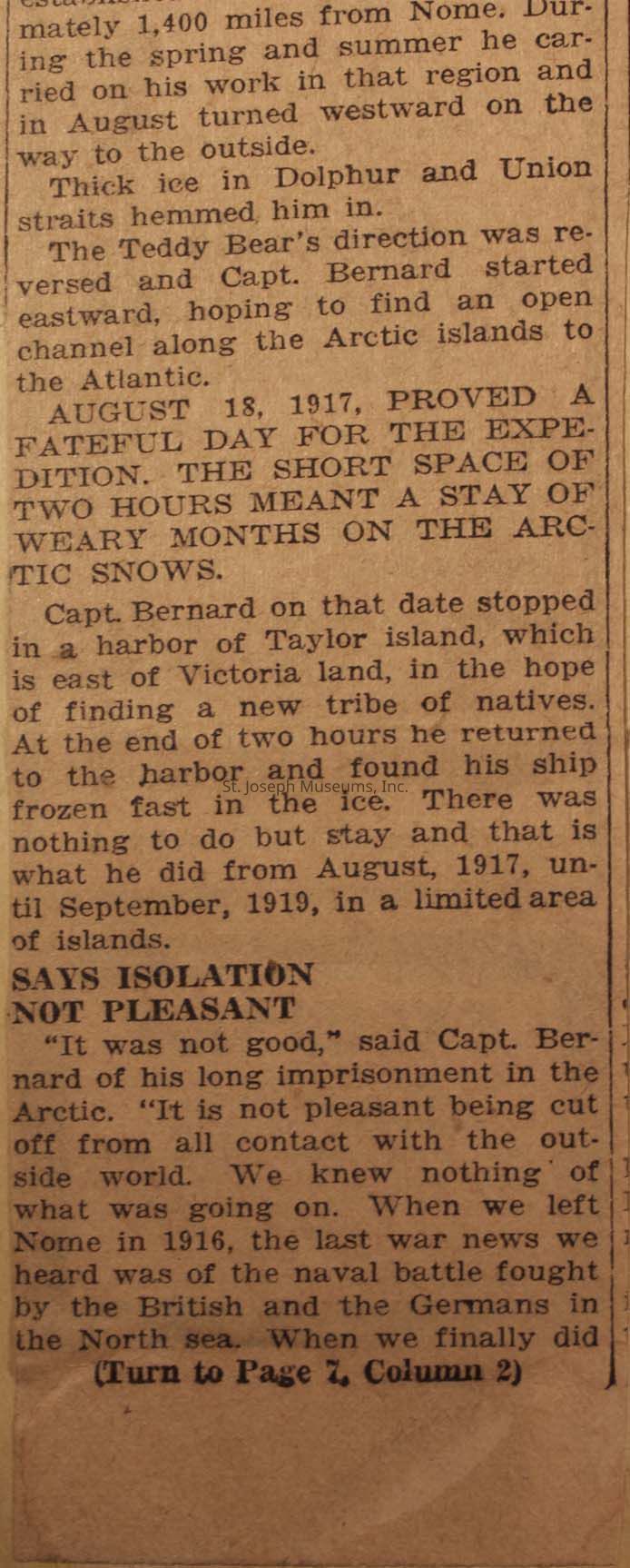
The article about a 1916 expedition led by Capt. Bernard aboard the schooner Teddy Bear, which departed from Nome on August 28. The team aimed for an anthropological study in the Far North, provisioning for two years, and stopped at various locations including Point Barrow and Herschel Island. They established a winter camp in Coronation Gulf, 1,400 miles from Nome. Thick ice hampered their journey in Dolphur and Union straits, forcing a return and attempted eastward passage along Arctic islands. On August 18, 1917, ice trapped the ship in a Taylor Island harbor, compelling a prolonged stay until September 1919.
SAYS ISOLATION NOT PLEASANT
On August 18, 1917, while stopping at Taylor Island's harbor to search for a new tribe, Bernard faced a significant setback when his ship became frozen in ice. Consequently, he and his crew were isolated from the outside world from August 1917 to September 1919. Bernard described the isolation as unpleasant, highlighting the crew's lack of contact and information about world events during their prolonged stay. (Turn to Page t, Column 2)
WE'RE PRISONERS OF THE NORTH
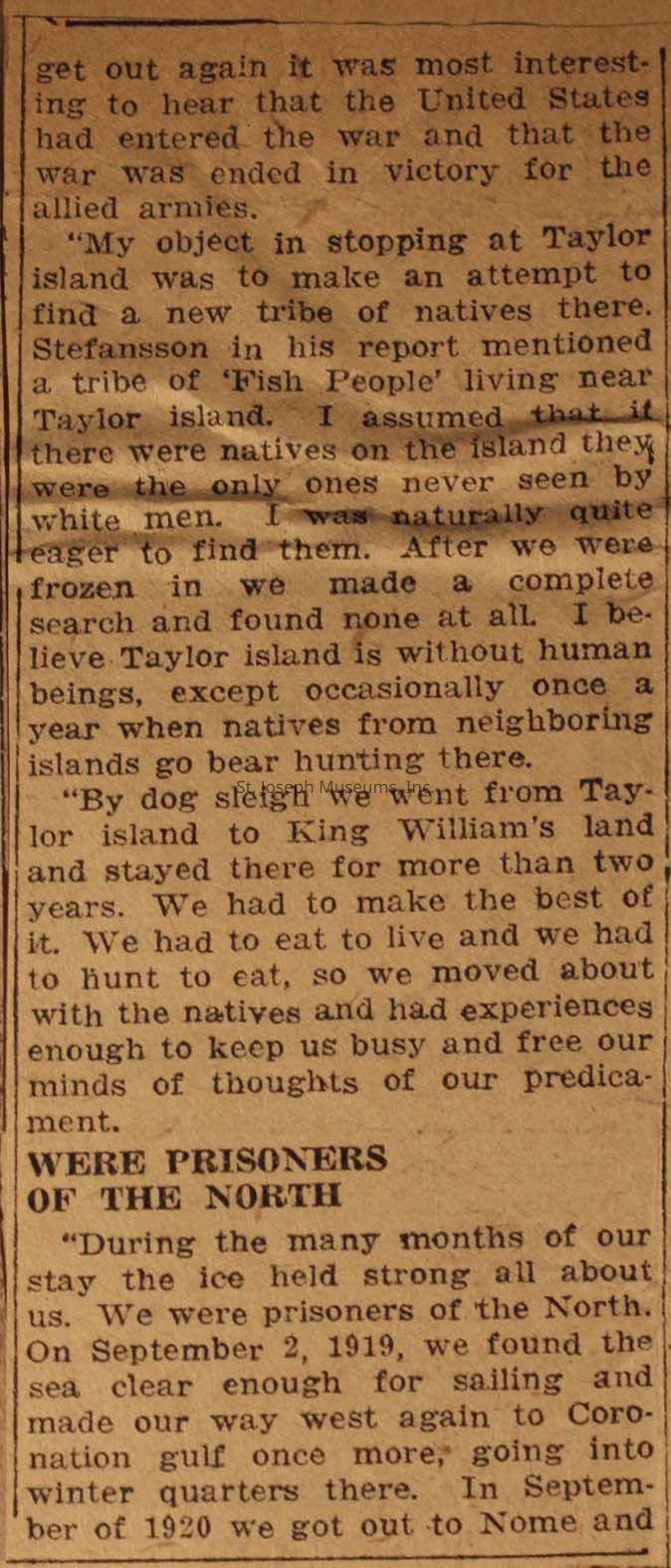
It mentions the United States entering the war and its eventual victory. The author describes an expedition to Taylor Island, seeking a rumored native tribe called the "Fish People," only to find no inhabitants except occasional bear hunters. The narrative includes traveling by dog sleigh to King William's land, where they lived with natives for over two years, adapting to local survival methods. They were effectively "prisoners of the North" due to persistent ice, staying until September 2, 1919, when the sea cleared for their westward return to Coronation Gulf.
B.
FIND TRACES OF EARLY EXPEDITIONS
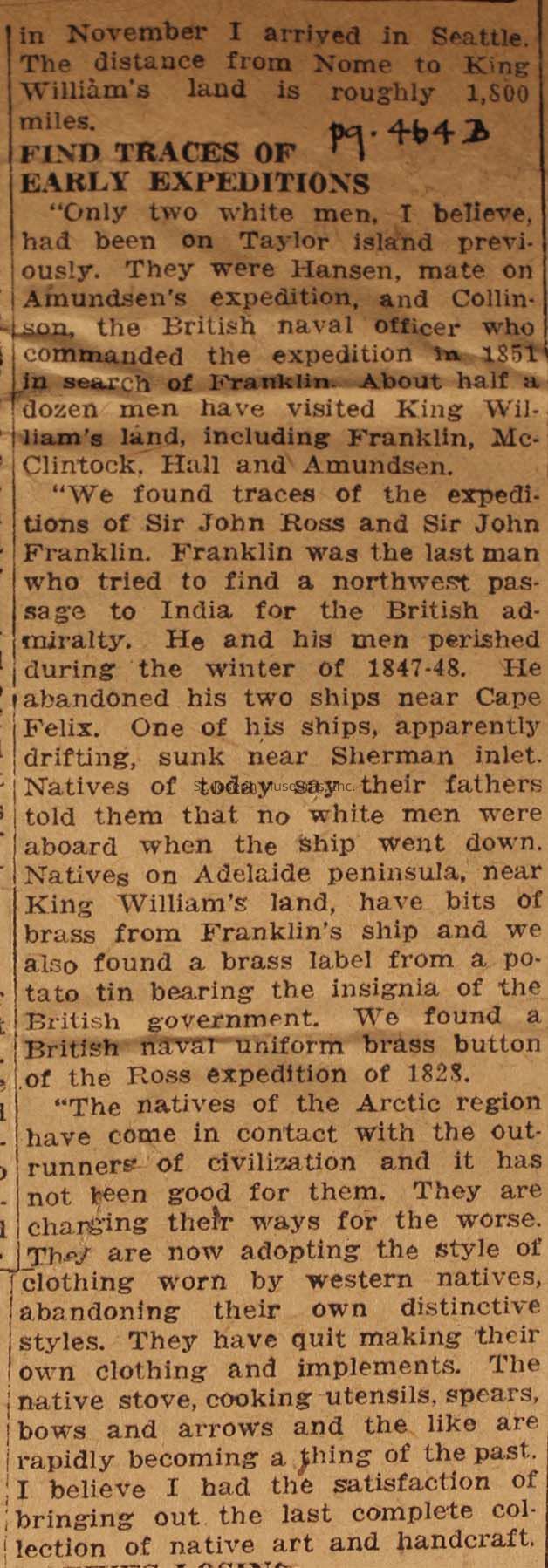
The sub-article discusses the limited number of explorers—Hansen from Amundsen's and Collinson from a British naval expedition searching for Franklin—who had visited Taylor Island. The article references various explorers who visited King William's land, including Franklin, McClintock, Hall, and Amundsen, highlighting discoveries of remnants from Sir John Ross and Sir John Franklin's expeditions. It notes Franklin's attempt to find a northwest passage in 1847-48, mentioning the sinking of his ship near Sherman Inlet and how local natives have artifacts from these expeditions. The article reflects on the negative impact of civilization on Arctic natives, noting a shift in their lifestyle and crafts due to Western influences, resulting in the decline of indigenous traditions and practices.
NATIVES LOSING VALUABLE GAME
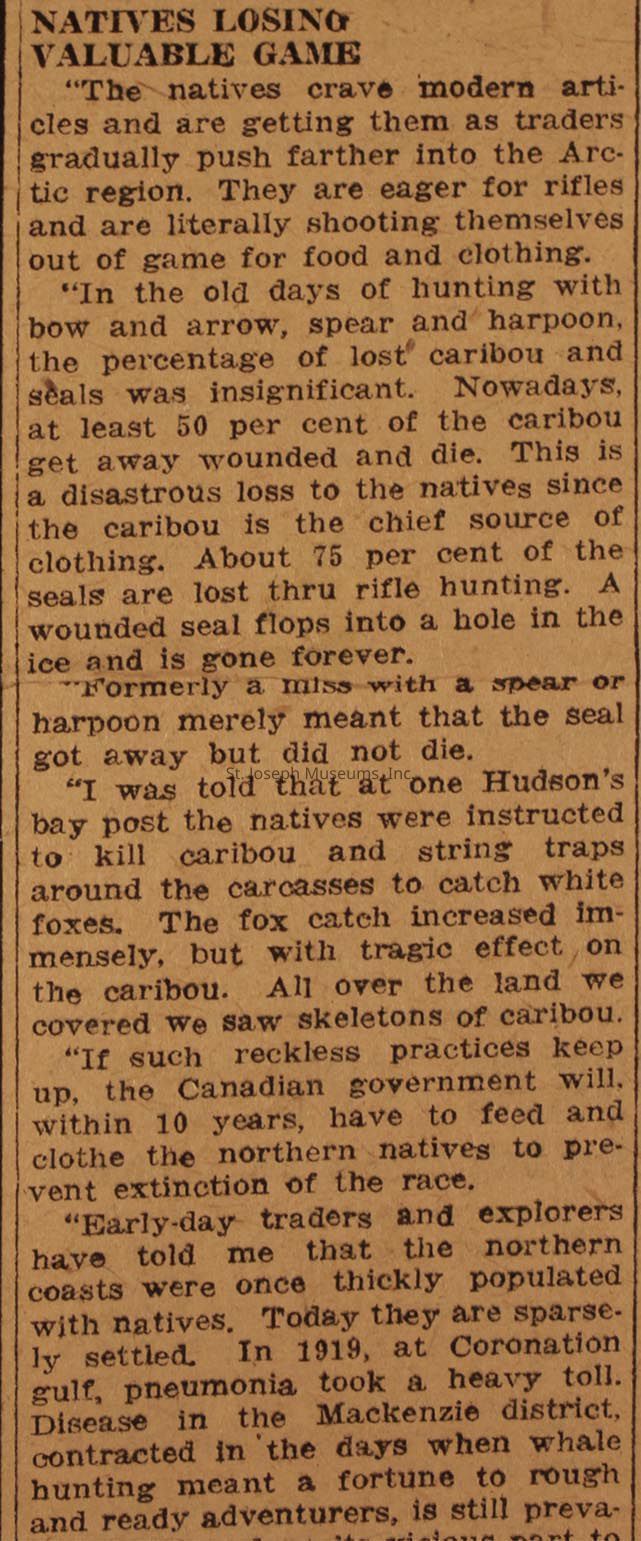
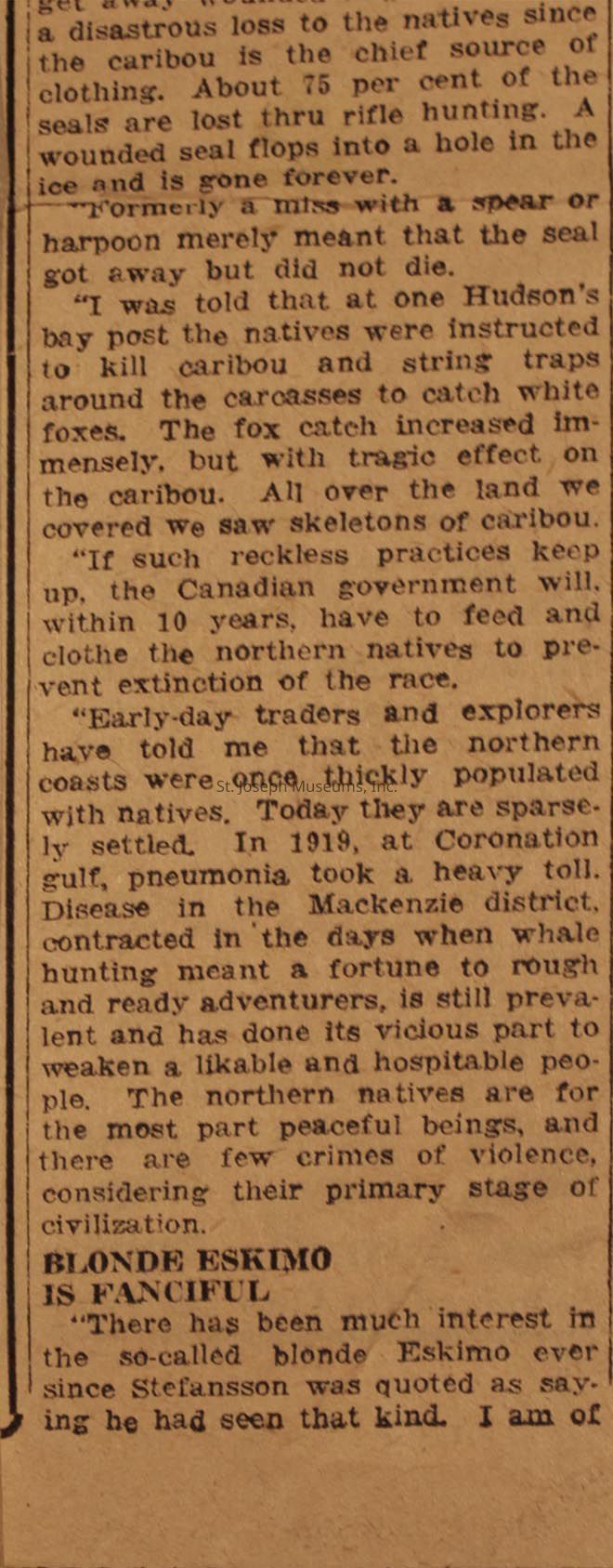
The article continues by discussing the impact of modern hunting practices on native populations in the Arctic region. It highlights how the introduction of rifles has led to significant losses of caribou and seals, which are vital for food and clothing. It contrasts these losses with traditional hunting methods using bows, arrows, spears, and harpoons, which resulted in fewer wounded animals escaping. The text mentions that at least 50% of caribou are now lost, along with about 75% of seals. It explains that this has a disastrous effect on the natives, as caribou are a chief resource. Additionally, the article covers how natives were sometimes instructed to use caribou carcasses to lure and trap white foxes, further depleting caribou numbers. This practice is deemed reckless, potentially leading to a governmental obligation to support northern natives to prevent their extinction. Early traders and explorers also note a decline in native population due to disease and changing environmental conditions.
BLOND ESKIMO IS FANCIFUL
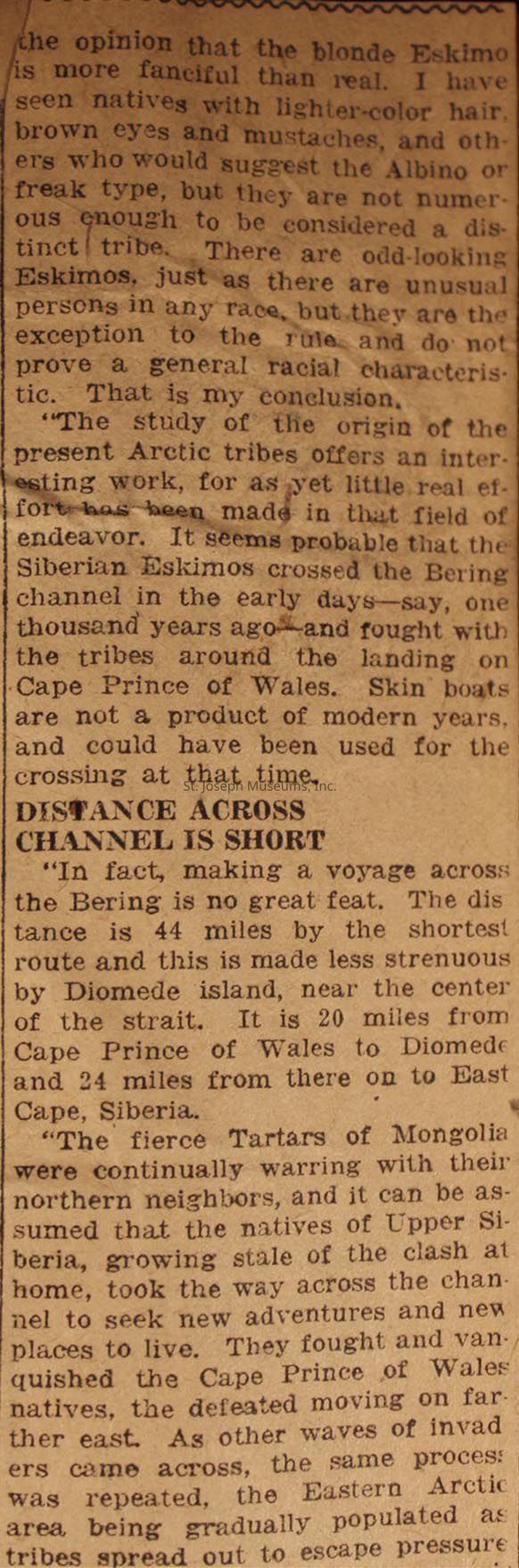
This section discusses the concept of "blonde Eskimos" and describes them as more fanciful than real. It mentions that some natives have lighter features but are not a distinct tribe, suggesting they are exceptions. The article delves into the origins of Arctic tribes, theorizing that Siberian Eskimos crossed the Bering Channel thousands of years ago, possibly using skin boats, and interacted with local tribes.
DISTANCE ACROSS CHANNEL IS SHORT
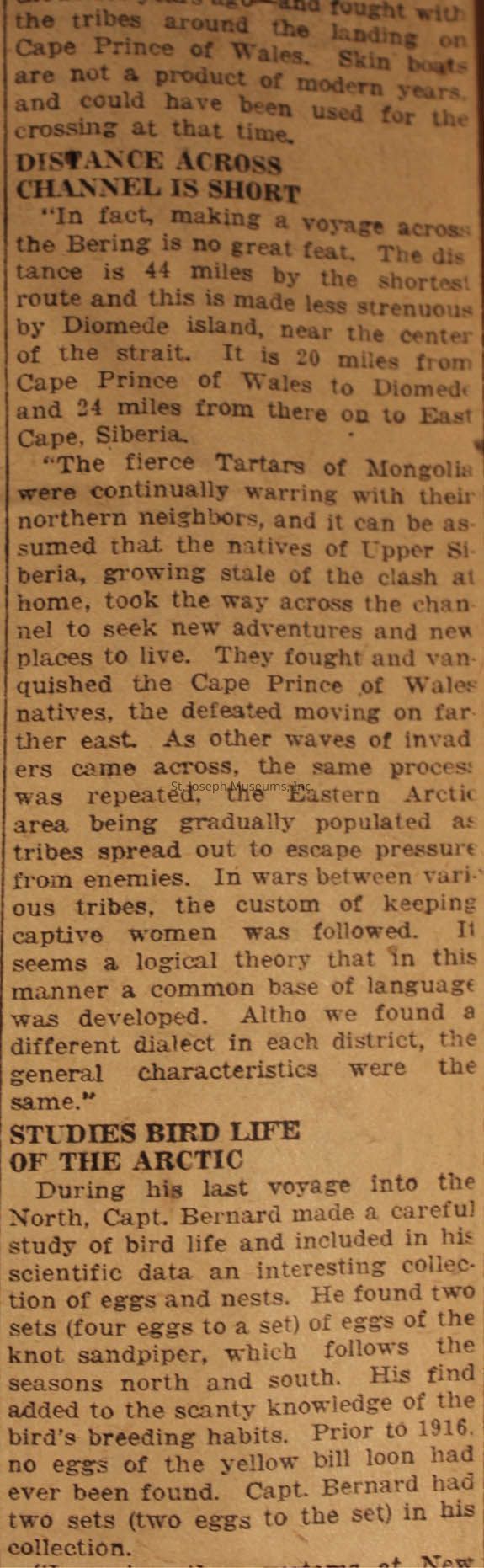
It notes that the Bering Channel is short, facilitating travel. The article details how the distance of 44 miles at its shortest point is manageable, with Diomede Island marking a key midpoint. The article also touches upon historical conflicts, suggesting Tartars of Mongolia fought with northern neighbors, pushing Siberian natives across the channel in search of new lands and adventures. As invaders moved eastward, this narrative of migration and settlement was repeated in the Eastern Arctic.
STUDIES BIRD LIFE OF THE ARTIC
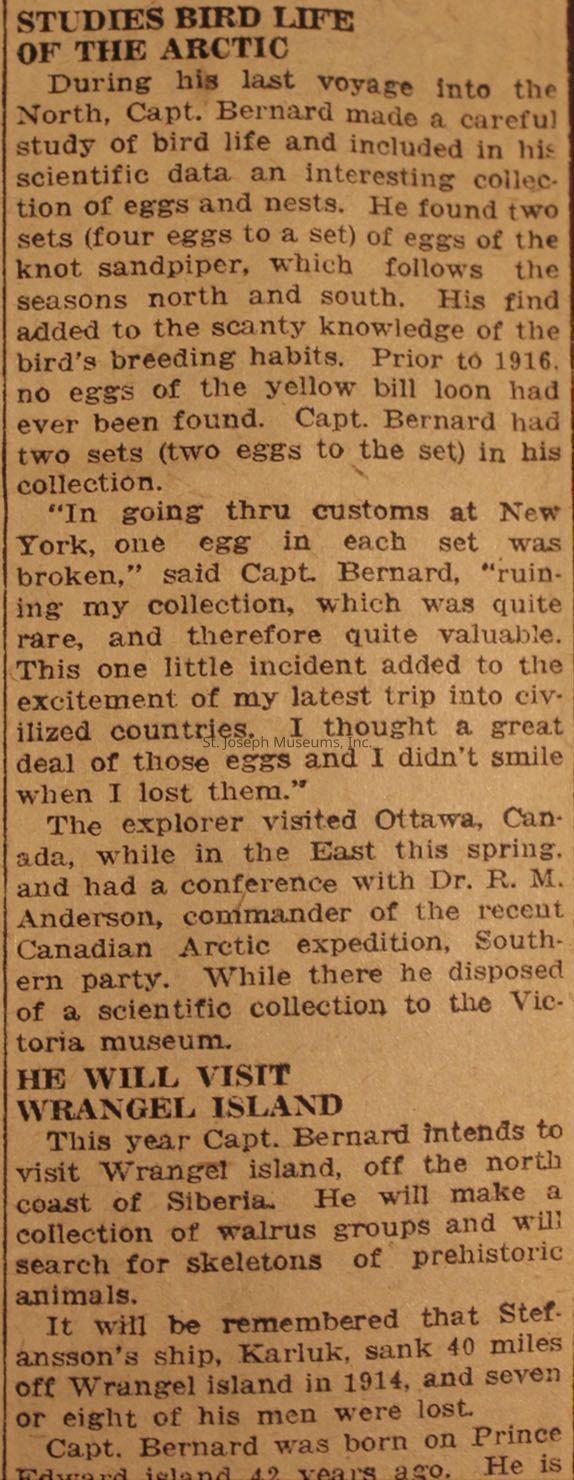
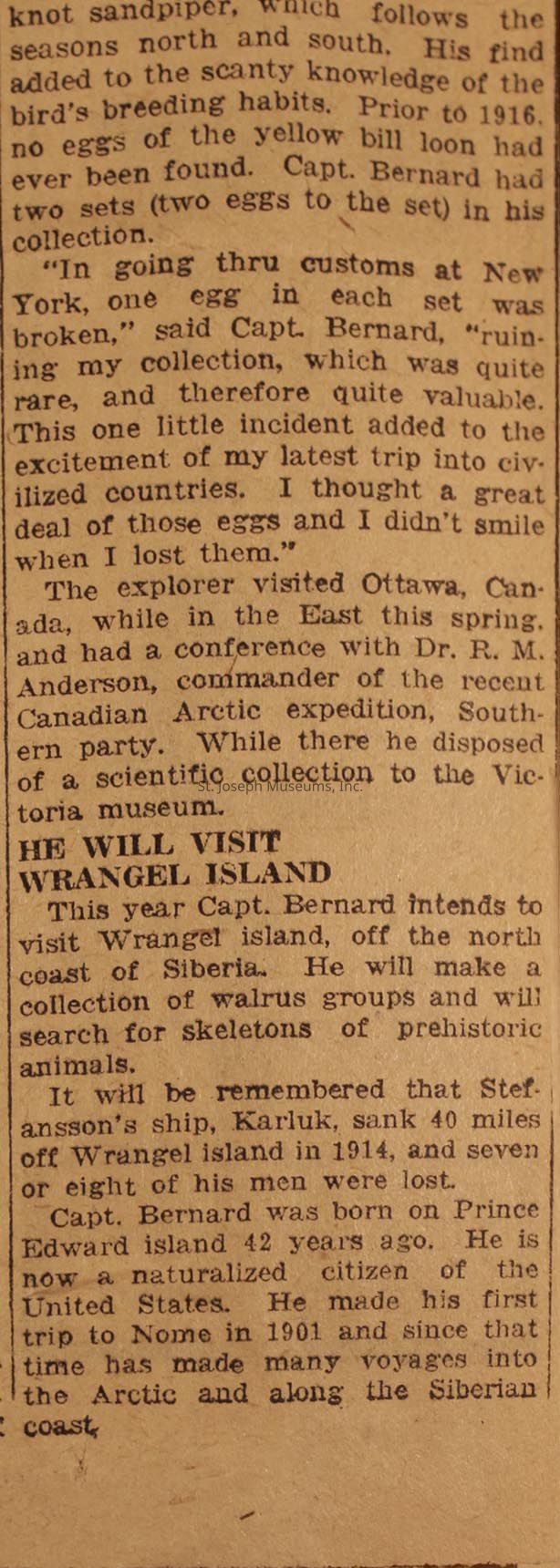
Additionally, the article highlights how these movements may have influenced linguistic developments. The second part focuses on Captain Bernard's study of bird life in the Arctic, describing his collection of knot sandpiper eggs and the significance of his findings in understanding avian breeding habits, particularly noting the absence of certain species’ eggs before 1916.
HE WILL VISIT WRANGEL ISLAND
The newspaper clipping details Capt. Bernard's experiences and future plans. During a visit to Ottawa, Canada, Bernard had discussions with Dr. R. M. Anderson of the Canadian Arctic expedition and contributed a scientific collection to the Victoria museum. The article also mentions Bernard's planned expedition to Wrangel Island off Siberia to collect walrus groups and search for prehistoric animal skeletons. It recalls the 1914 sinking of Stefansson’s ship, Karluk, near Wrangel Island and Bernard’s past voyages from his first trip to Nome in 1901 to his explorations of the Arctic and Siberian coasts.Subject
Captain Joseph F. Bernard
ArcticSubject Person/Organization
Harry L. George Collection