Name/Title
A Real City in 1861 St. Joseph History Article, 1938Entry/Object ID
AM1992.9.19Scope and Content
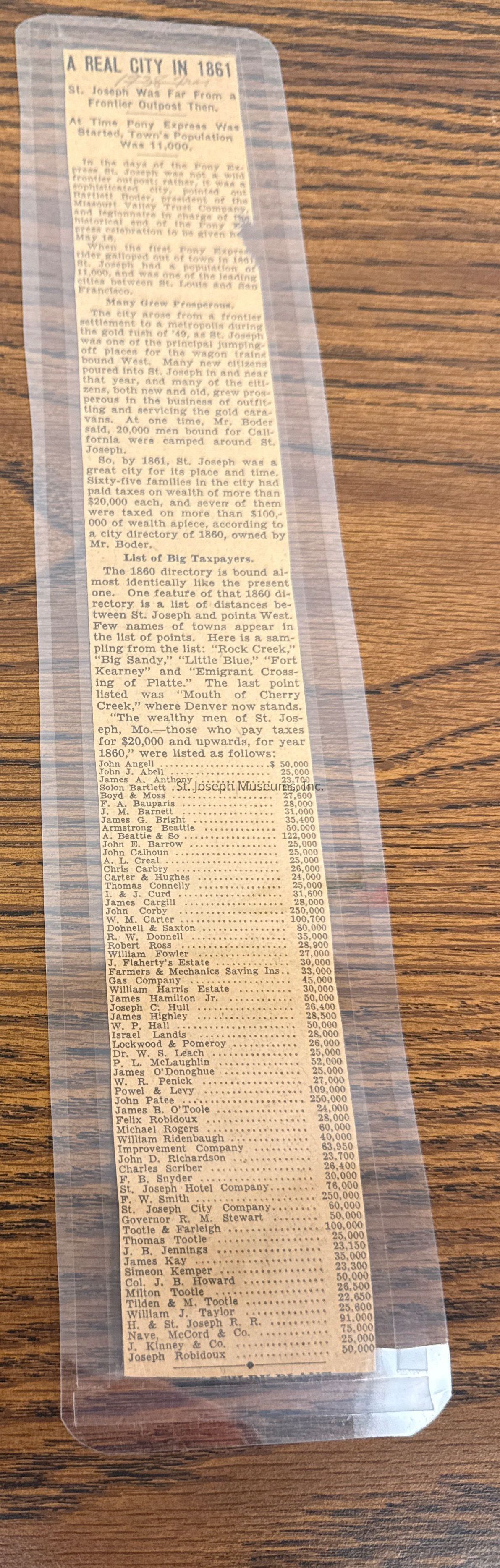
A Real City in 1861, 1938. The sub headings of the article are: St. Joseph Was Far from a Frontier Outpost Then. At time Pony Express was started, Town's Population Was 11,000.
In the days of the Pony Express St. Joseph was not a wild frontier outpost; rather, it was a sophisticated city, pointed out Bartlett Boder, president of the Missouri Valley Trust Company, and legionnaire in charge of the historical end of the Pony Express celebration to be given May 16.
When the first Pony Express rider galloped out of town in 1861, St. Joseph had a population of 11,000 and was one of the leading cities between St. Louis and San Francisco.
The city arose from a frontier settlement to a metropolis during the gold rush of '49 as St. Joseph was one of the principal jumping off places for the wagon trains bound West. Many new citizens poured into St. Joseph in and near that year, and many of the citizens, both new and old, grew prosperous in the business of outfitting and servicing the gold caravans. At one time, Mr. Boder said, 20,000 men bound for California were camped around St. Joseph.
By 1861 St. Joseph was a great city for its place and time. Sixty-five families in the city had paid taxes on wealth of more than $20,000 each, and seven of them were taxed on more than $100,000 of wealth apiece, according to a city directory of 1860. One feature of that directory is a list of distances between St. Joseph and points West.
Few names of towns appear in the list of points. A sample of the directory is: Rock Creek, Big Sandy, Little Blue, Fort Kearney and Emigrant Crossing of Platte, The last point listed was Mouth of Cherry Creek where Denver now stands.Lexicon
Search Terms
Gold Rush, St. Joseph History, St. Joseph, 1861, Western Migration, St. Joseph as a Jumping Off Point, Trails, Oregon-California Trail, St. Joe RoadRelationships
Related Person or Organization
Person or Organization
Bartlett Boder