Name/Title
Administrative RecordsEntry/Object ID
2014.2.3293Scope and Content
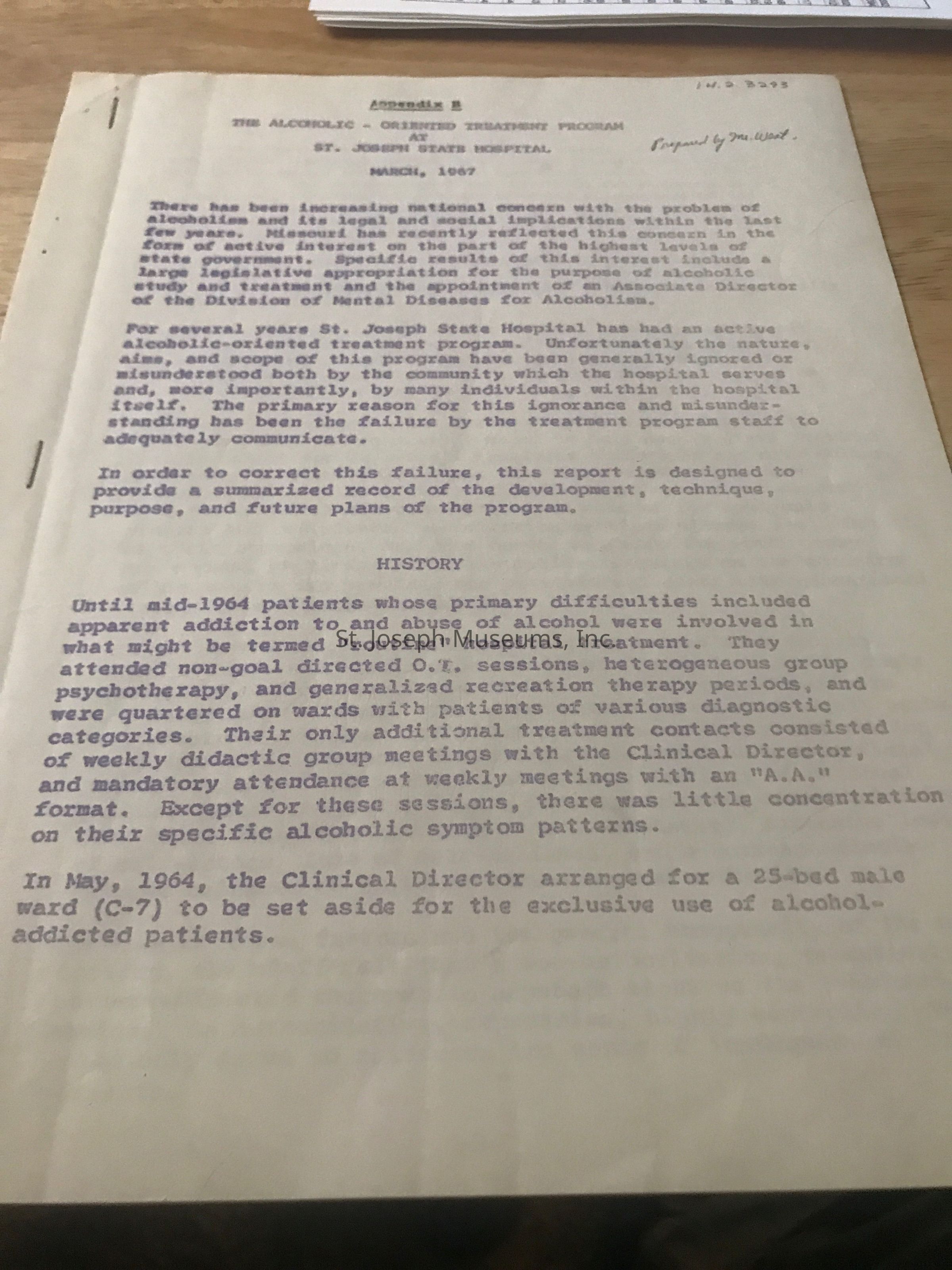
An eight page one-sided mimeograph copy of 'Appendix B, The Alcoholic - Oriented Treatment Program At St. Joseph State Hospital, March, 1967'. A handwritten notation in the upper right side corner "Prepared by Mo. West" It is stapled 3 times along the left hand side and is on plain white paper.Context
There has been increasing national concern with the problem of alcoholism and its legal and social implications within the last few years. . . . . .
For several years St. Joseph State Hospital has had an active alcoholic-oriented treatment program. . . . . .
In order to correct this failure, this report is designed to provide a summarized record of the development, technique, purpose, and future plans of the program.
HISTORY
Until mid-1964 patients whose primary difficulties included apparent addiction to and abuse of alcohol were involved in what might be termed "routine" hospital treatment. . . . .
In May, 1964, the Clinical Director arrange for a 25-bed male wared (C-7) to be set aside for the exclusive use of alcohol-addicted patients.
Several months later he requested that several departments within the hospital furnish staff (on a voluntary basis) in order to expand the therapeutic opportunities for the C-7 patients. . . . .
Nursing services responded to his request by providing a complement of aides to staff the ward and a part-time R. N. to perform general nursing duties and to interact therapeutically with the patients.
Other departments contributed staff on a less extensive basis. . . . .
Inevitably, attempts began for developing a more integrated approach; the treatment staff began to hold weekly staff meetings and to search for an overall treatment philosophy and methodology. . . . . .
The present treatment philosophy emerged not so much from the staff's increasing experience and knowledge, but more from their recognition of the needs and traits of the "typical" patients who inhabited the ward. . . . . .
In view of these factors and general homogeneity of the ward setting, the staff felt that a non-authoritarian, essentially patient-directed therapeutic approach might be the treatment of choice. . . . .
-2-
Therefore the patients were given relatively free rein in establishing the structure of the program. One of their first moves (made as a result of staff suggestion) was the formation of a self-government process. . . . . . .
Problems of social control, ward management, work assignments, ground and town pass policy, and even transfer and discharge recommendations were increasingly left up to the patient group. . . . .
Although limited self-government had been previously instituted in other areas of the hospital, it quickly became clear that the C-7 program was enough of an innovation to stimulate a good deal of resistance. For example, one of the first patient "suggestions" made was that the ward doors be unlocked. . . .
Recently there has been increasing acceptance of the C-7 experiencement. This is exemplified by a recent incident; . . . .
Explicit fear of the social power of patients by hospital staff is probably the rarest and healthiest phenomenon that could occur in a large mental hospital.
TREATMENT PHILOSOPHY
The general therapeutic philosophy implicitly contained in the current program can probably best be expressed in terms of the following four goals:
1.) Elevation of self-esteem and personal regard by allowing the patients to experience successful self-
reliance through the medium of ward government.
2.) Recognition of severe drinking and associated social deterioration as changeable patterns of behavior
which can be reversed by means of external help and increasing internal resources and strengths.
3.) Familiarization with alternate, more acceptable, and more self sulfilling (fulfilling) behavior patterns in
the hope of inducing attitudinal changes.
4.) Education concerning community facilities providing long term out-of-hospital help for the alcoholic:
A.A., vocational rehabilitation, etc.
THE PATIENTS
The program is alcoholic-oriented, but is not suitable for every alcoholic admitted to the hospital, nor is it necessarily restricted to patients meeting the diagnostic criteria of alcoholism.
The patient-directed nature of the process demands that the patient at least display a moderate degree of readiness for independent decision making. . . . .
Certain aspects of it (A. A. oriented meetings and alcohol education sessions) would be appropriate for those hospital patients who share alcoholic difficulties. . . .
-4-
In any event, the "ideal" patient in terms of responses to the program would meet the rough criteria described previously; he would be intellectually integrated, reasonably verbal, dependent, and lacking in self-esteem and self-confidence. . . .
The current relative scarcity of women alcoholic in-patients precludes the establishment of a separate ward patterned after C-7 for their use. . . .
The size of the group involved in the program at any time varies from a low of 4 or 5 members to approximately 30. . . .
THE MECHANICS OF THE PROGRAM
Patients are presently admitted to a receiving ward (usually W-5) and remain there for one to ten days. . . .
Ideally, patients who might profit from the C07 program are recommended to the Clinical Director for evaluation, and upon his approval, are transferred to the alcoholic ward. . . .
Patients who are not ready for or cannot adjust to the C-7 setting quickly bring themselves to the attention of the patient group which has been quite effective in recommending that they be re-transferred. . . .
-5-
For several years alcoholic treatment in this hospital has involved an in-patient stay of approximately six weeks. . . .
Their feelings in this regard are understandable: They are assured by some of the hospital staff as well as authorities outside that they will be here exactly six weeks. . . .
In any event, the new patient on the ward is oriented by the others, usually given a ward work assignment, and quickly acclimates himself to his new surroundings.
The staff regards the most beneficial aspect of the program to be the patient-directed atmosphere of the ward milieu. . . . .
The patient group has assumed the responsibility of placing the new patient into an off-ward industrial massignment after he has been on the ward a few days. . . .
PROGRAM FORMAT
The program patients hold daily group meetings at 8:30-9:30 A. M. which are led by the patient-chairman. . . . . . . . . . . . . . . . . . . . . . . . . The ward attendant sits in on all of these
-6-
meetings and acts as a agent of continuity, while the other staff members (industrial therapist, activity therapist, chaplain, psychologist, and nurse) serve as rotating "resource people" who attend the meetings only on specified days of the week. . . . .
On Saturdays, the Clinical Director holds a meeting with a didactic format.
The regional A. A. groups have consistently contributed personnel to address the program patients on one evening during the week. These sessions have the structure of an "open" A. A. meeting.
Every other week, the consultant from the Kansas City Council on Alcoholism meets with the patients in an educational and counseling capacity.
In addition to these structured aspects of the program, the patients have access to self-determined recreational and free time activities, and also receive medical, nursing, and individual counseling services as required.
PROGRAM RESULTS
No explicit qualitative or quantitative evaluation has been made of this program to date.
Many of the patients return to the hospital and to the program several times. The general approach to recidivism has been: "Maybe it;ll take this time".
Almost all of the patients have histories of treatment and/or incarceration in other facilities, and are generally regarded as "hard core misfits" by their communities. . . .
RESEARCH
The relative autonomy of this program is suitable for controlled research projects.
To date, no validly structured projects have been initiated by the program staff.
-7-
However, a study of muscle deterioration is alcoholics is being made by the Neurology Department of Kansas City General Hospital. . . . The project is currently on-going, and the results are to be presented to the A. M. A. convention in the summer of 1967.
PROGRAM NEEDS
1). Improved physical facilities and ward maintenance.
2). Increased staff education particularly in the specifics of alcoholism.
2). Expansion of staff to include a social worker (all patient-community interaction is presently handled by the Clinical Director personally) and a vocational consultant.
4). Increased participation in the program by the present staff.
5). Involvement of all hospitalized alcoholics in the purely alcoholic aspects of the program.
6). More suitable ward accomodations for the women patients. (It has been suggested that they be housed on one of the open woman's wards, preferably W-2)
In relation to thi, a longer term goal in some sort pf sexually integrated program facility. . . . .
At the present time there is no alcoholic program in which the woman alcoholic is given the attention accorded her male counterpart. . . . .
To improve the treatment measures for this group, then, will probably entail a significantly larger number of patients to economically justify the increased attention. . . . . .
7). Increased follow-up including improved after-care arrangements, statistical data gathering, program evaluation, etc.
-8-Lexicon
Nomenclature 4.0
Nomenclature Primary Object Term
ReportNomenclature Sub-Class
Administrative RecordsNomenclature Class
Documentary ObjectsNomenclature Category
Category 08: Communication Objects