Name/Title
ArticleEntry/Object ID
2022.2.240Scope and Content
Article written by Mary Alicia Owen, of the famed Owen Sisters, on the life of Saint Joseph, Missouri’s founder, Joseph Robidoux.
Article is typed in blue ink and held tigether by one rusting staple in the top left corner.Context
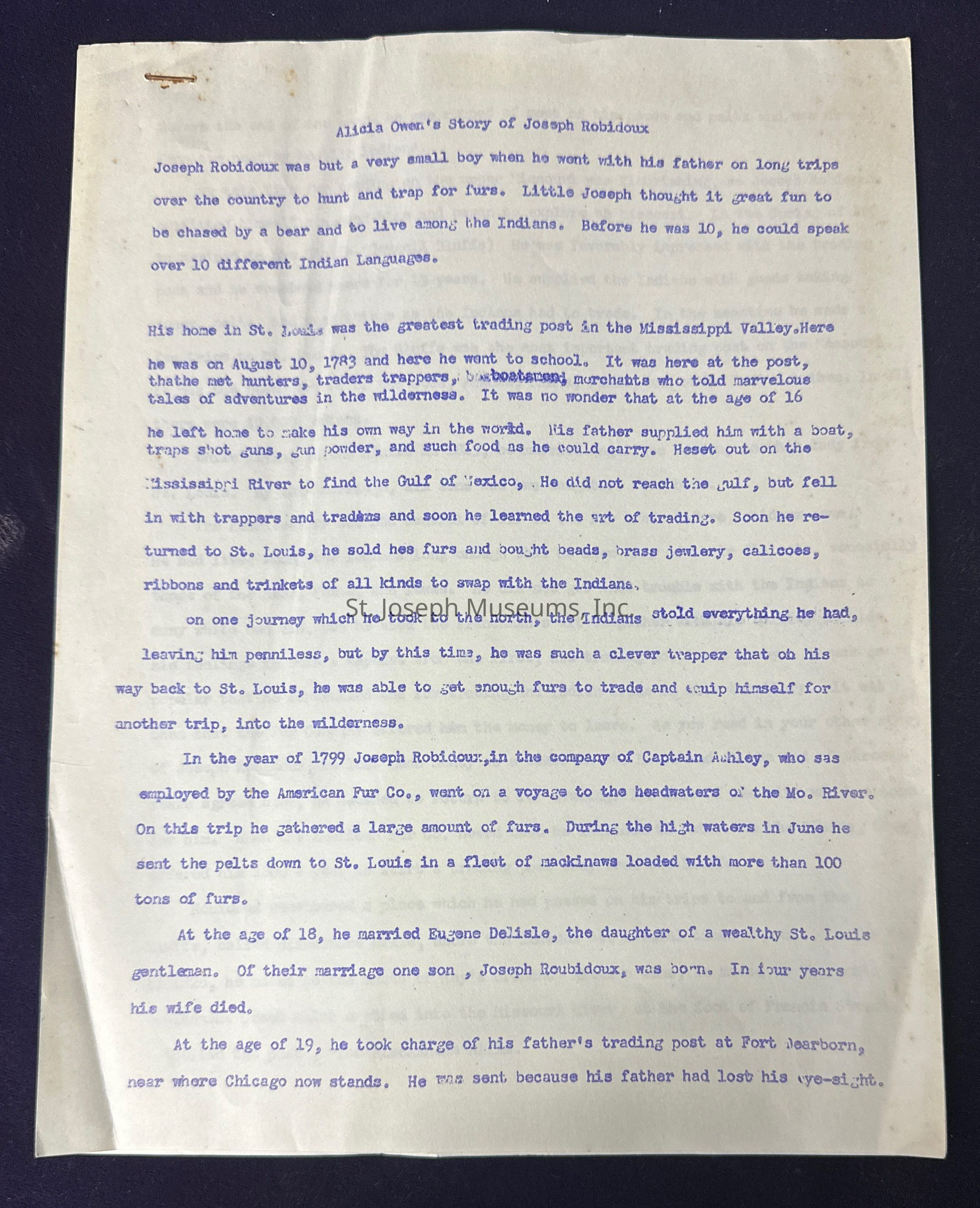
Alicia Owen's Story of Joseph Robidoux
Joseph Robidoux was but a very small boy when he went with his father on long trips over the country to hunt and trap for furs. Little Joseph thought it great fun to be chased by a bear and to live among the Indians. Before he was 10, he could speak over 20 different Indian Languages.
His home in St. Louis was the greatest trading post in the Mississippi Valley. Here he was on August 10, 1783 and here he went to school. It was here at the post, that he met hunters, traders, trappers, boatmen, merchants who told marvelous tales of adventures in the wilderness. It was no wonder that at the age of 16 he left home to make his own way in the world. His gather supplied him with a boat, traps, shot guns, gun powder, and such food as he could carry. He set out on the Mississippi River to find the gulf of Mexico. He did not reach the gulf, but fell in with trappers and traders and soon he learned the art of trading. Soon he returned to St. Louis, he sold his furs and bought beads, brass jewlery, calicoes, ribbons and trinkets of all kinds to swap with the Indians. On one journey which he took to the north, the Indians stole everything he had, leaving him penniless, but by this time, he was such a cleaver trapper that on his way back to St. Louis, he was able to get enough furs to trade and eqiup himself for another trip, into the wilderness.
In the year 1799 Joseph Robidoux, in the company of Captain Achley, who was employed by the American Fur Co., went on a voyage to the headwaters of the Mo. River. On this trip he gathered a large amount of furs. During the high waters in June he sent the pelts down to St. Louis in a fleet of mackinaws loaded with more than 100 tons of furs.
At the age of 18, he married Eugene Delisle, the daughter of a wealthy St. Louis gentleman. Of their marriage one son, Joseph Roubidoux, was born. In four years his wife died.
At the age of 19, he took charge of his father's trading post at Fort Dearborn, near where Chicago now stands. He was sent because his father lost hie eye-sight.
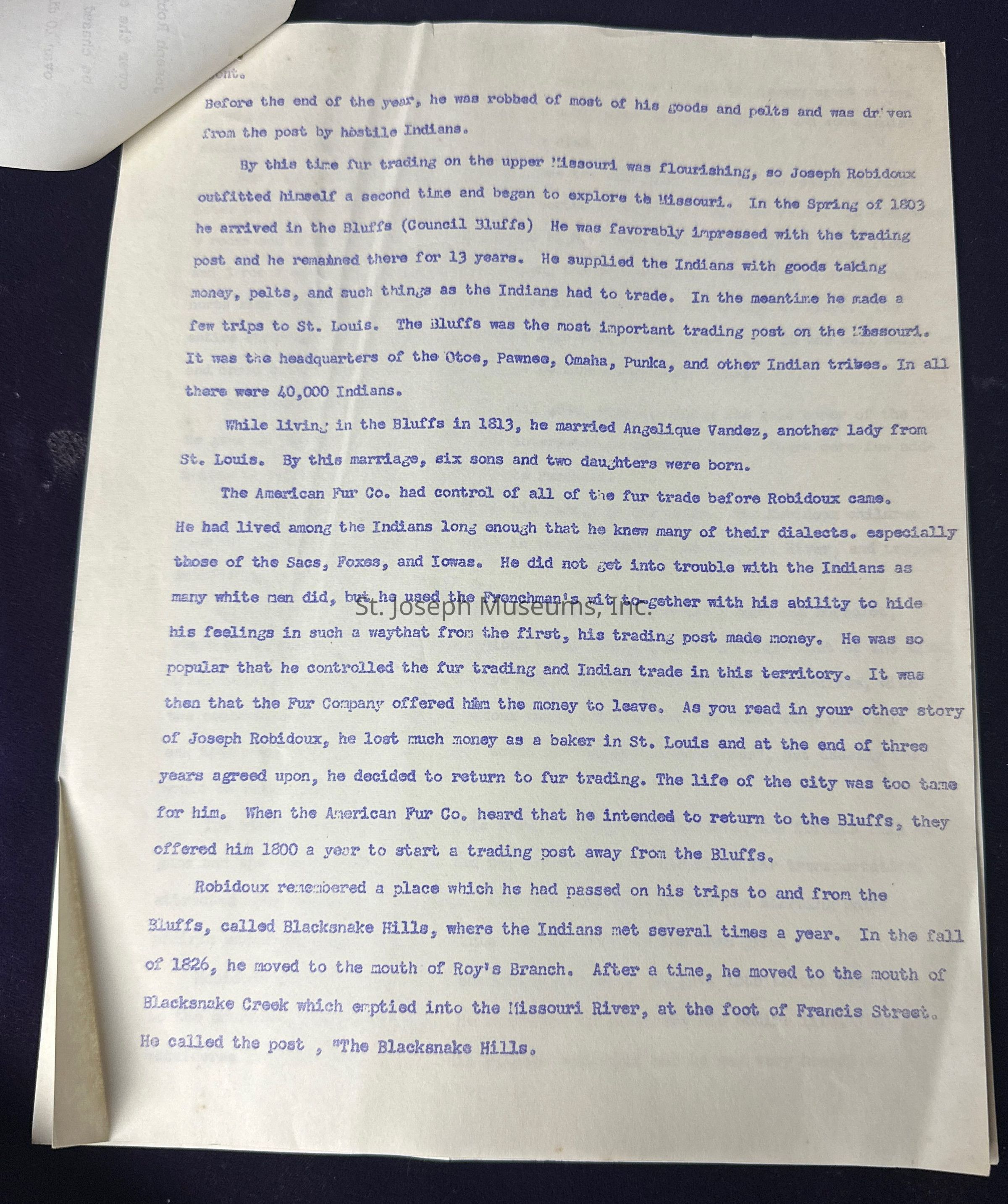
Before the end of the year, he was robbed of most of his goods and pelts and was driven from the post by hostile Indians.
By this time fur trading on the upper Missouri was flourishing, so Joseph Robidioux outfitted himself a second time and began to explore the Missouri. In the spring of 1803 he arrived in the Bluffs (Council Bluffs) he was favorable impressed with the trading post and he remained there for 13 years. He supplied the Indians with goods taking money, pelt, and such things as the Indians had to trade. In the meantime he made a few trips to St. Louis. The Bluffs was the most important trading post on the Missouri. It was the headquarters of the Otoe, Pawnee, Omaha, Punka and other Indians tribes. In all there were 40,000 Indians.
While living in the Bluffs in1813, he married Angelique Vandez, another lady from St. Louis. By this marriage, six sons and Two daughters were born.
The American Fur Co. had control of all of the fur trades before Robidoux came. He had lived among the Indians long enough that he knew many of their dialects, especially those of the Sacs, Foxes, and Iows. He did not get into trouble with the Indians as many white men did, but he used the Frenchman's wit together with his ability to hide his feeling in such a way that from the first, his trading post made money. He was so popular that he controlled the fur trading and Indian trade in this territory. It was than that the Fur Company offered him money to leave. As you read in your other stories of Joseph Robidoux, he lost much money as a baker in St. Louis and at the end of three years agreed upon, he decided to return to fur trading. The life of the city was too tame for him. When the American Fur Co. heard that he intended to return to the bluff, they offered him 1800 a year to start a trading post away from the Bluffs.
Robidioux remembered a place which he had passed on his trips to and from the Bluffs, called Blacksnake Hills, where the Indians met several times a year. In the fall of 1826, he moved to the mouth of Roy's Branch. After a time, he moved to the mouth of Blacksnake Creek which emptied in the Missouri River, the the foot of Francis Street. He called the post, "The Blacksnake Hills."
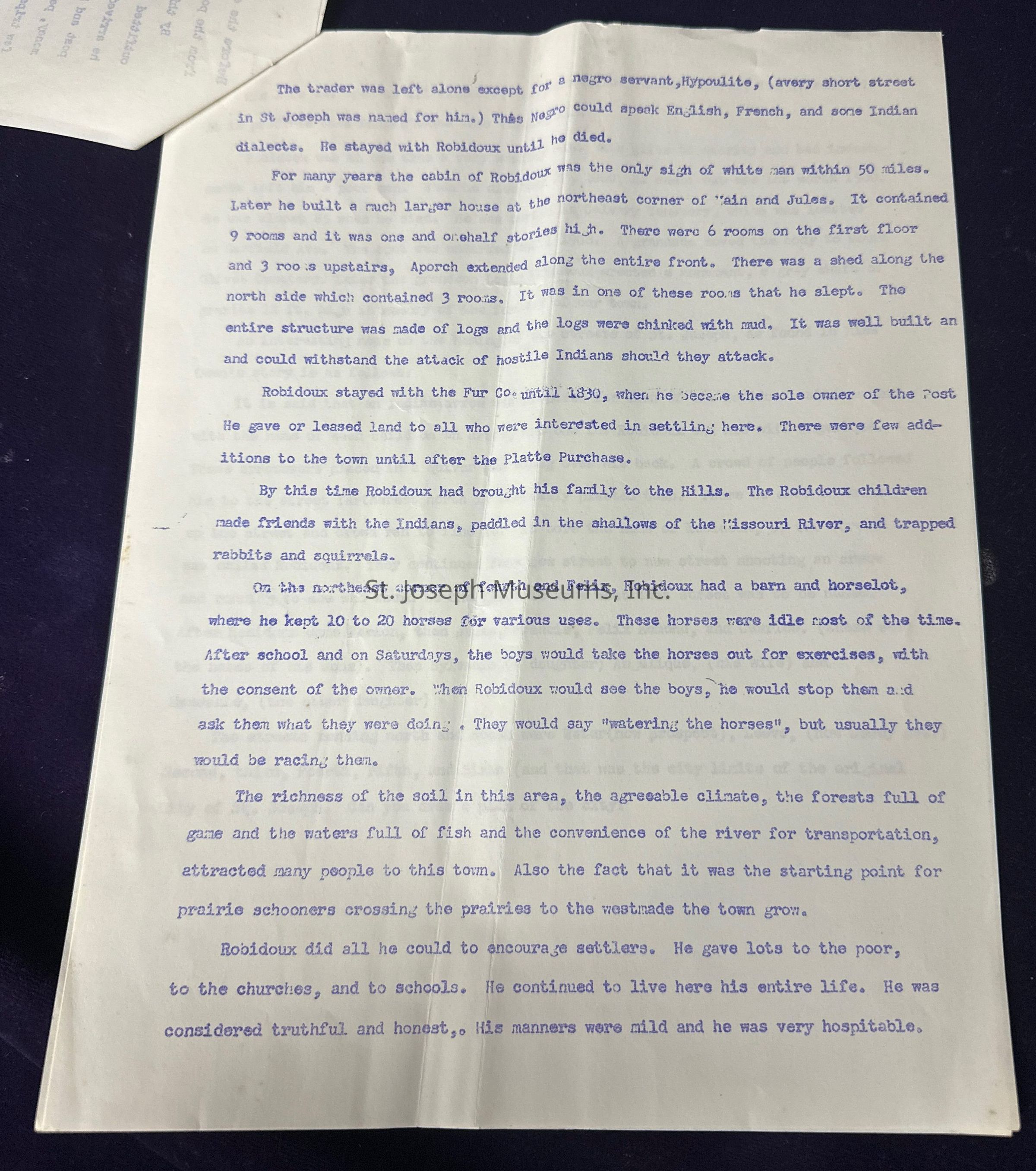
The trader was left alone except for a negro servant, Hypoulite, (every short street in St. Joseph was named for him.) This Negro could speak English, French, and some Indian dialects. He stayed with Robidoux until he died.
For many years the cabin of Robidoux was the sight of white man within 50 miles. Later he built a much larger house at the northeast corner of Main and Jules. It contained 9 rooms and it was one and half stories high. There were 6 rooms on the first floor and 3 rooms upstairs. A porch extended along the entire front. There was a shed along the north side which contained 3 rooms. It was in one of these rooms that he slept. The entire structure was made of logs and the logs were chinked with mud. It was well built an could withstand the attack of hostile Indians should they attack.
Robidoux stayed with the Fur Co. until 1830, when he became the sole owner of the Post. He gave or leased land to all who were interested in settling here. There were few addition to the town until after the Platte Purchase.
By the time Robidoux had brought his family to the Hills. The Robidoux children made friends the Indians, paddled in the shallows of the Missouri River, and trapped rabbits and sqiurrels.
On the northeast corner of fourth and Felix, Robidoux had a barn and horse slot, where kept 10 to 20 horses for various uses. These horses were idle cost of the time. After school and on a Saturday, the boys would take the horses out for exercises, with the consent of the owner. Them Robudoux would see the boys, he would stop them and ask what they were doing. They would say "watering the horses", but usually they would be racing them.
The richness of the soil in this area, the agreeable climate, the forests full of game and the waters full of fish and the convenience of the river for transportation, attracted many people to this town. Also the fact that it was the starting point for prairie schooners crossing the prairies to the west made the town grow.
Robidoux did all he could to encourage settlers. He gave lots to the poor, to the churches, and to schools. He continued to live here his entire life. He was considered truthful and honest. His manners were mild and he was very hospitable.
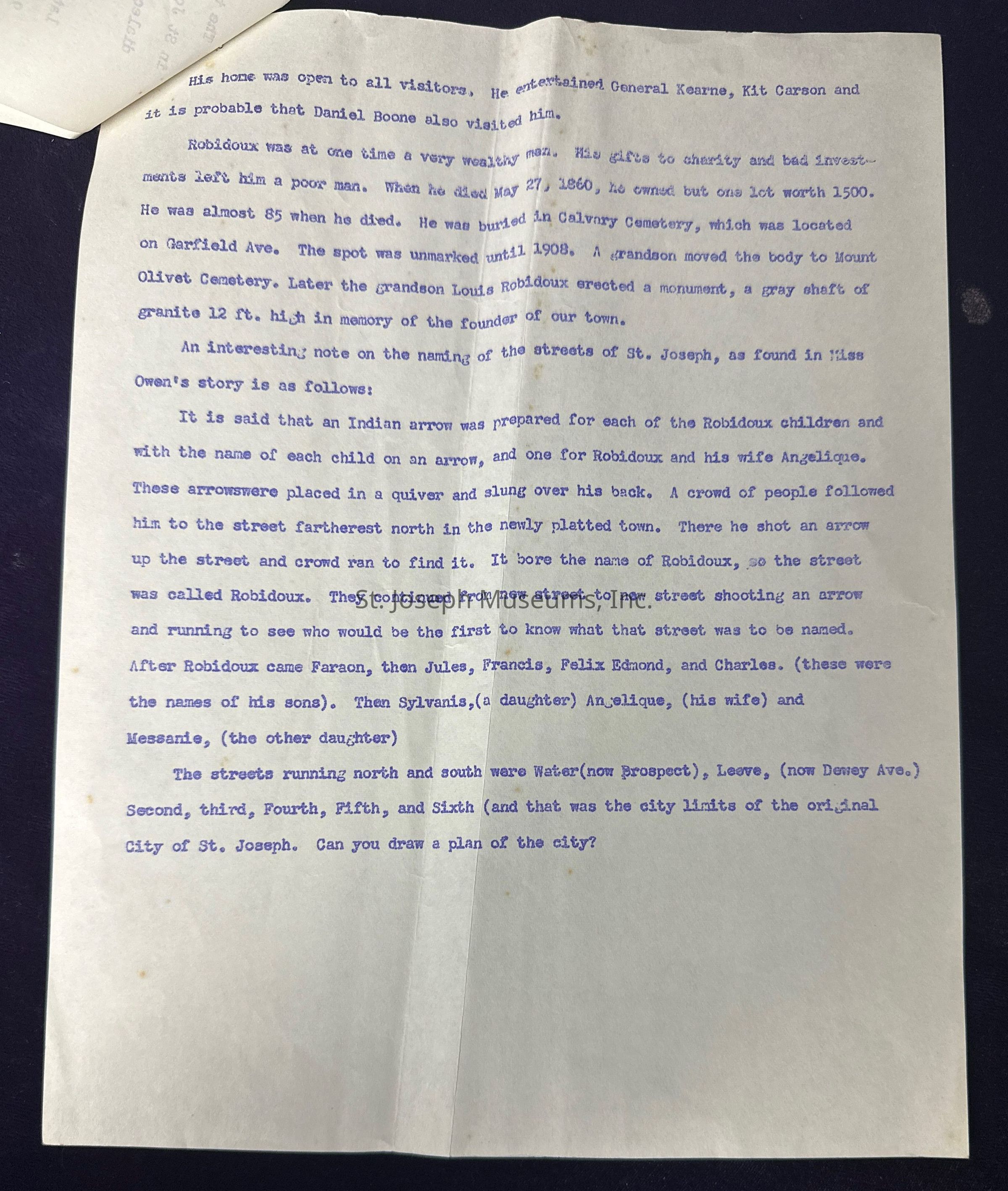
His home was open to all visitors, He entertained General Kearne, Kit Carson and it is probable that Daniel Boone also visited him.
Robidoux was at one time a very wealthy man. His gifts to charity and bad investments left him a poor man. When he died May 27, 1860, he owned but one lot worth 1500. He was almost 85 when he died. He was buried in Calvory Cemetery, which was located on Garfield Ave. The spot was unmarked until 1908. A grandson moved the body to Mount Olivet Cemetery. Later the grandson Louis Robidoux erected a monument, a gray shaft of granite 12 foot high in memory of the founder of our town.
An interesting note on the naming of the streets of St. Joseph, as found in Miss Owen's story is as follows:
It is said that an Indian arrow was prepared for each of the Robidoux children and with the name of each child on an arrow, and one for Robidoux and his wife Angelique. These arrows were placed in a quiver and slung over his back. A crowd of people followed him to the street fartherest north in the newly platted town. There he shot an arrow up the street and crowd ran to find it. It bore the name of Robidoux, so the street was called Robidoux. They continued from new street to new street shooting and arrow and running to see who would be the first to know what that street was to be named. After Robidoux came Faraon, then Jules, Francis, Felix, Edmond, and Charles. (these were the names of his sons). Then Sylvania, (a daughter) Angelique, (his wife) and Messanie, (the other daughter).
The street running north and south were Water (now Prospect), Leeve, (Now Dewey Ave), Second, third, Fourth, Fifth, and Sixth (and that was the city limits of the original City of St. Joseph. Can you draw a plan of the city?Collection
Marshall White, JOSEPH ROBIDOUXArchive Items Details
Title
Alicia Owen’s Story of Joseph RobidouxCreator
Mary Alicia Owen, Mary A. Owen, Mary Alicia Owen, Mary Alicia Owens, Mary OwensRelationships
Related Person or Organization
Person or Organization
Joseph Robidoux, Mary Alicia OwenRelated Places
Place
City
St. JosephState/Province
Missouri