Name/Title
Newspaper article from the Mentor MagazineEntry/Object ID
Q1430.635.61ADescription
Vol II pg. 61A
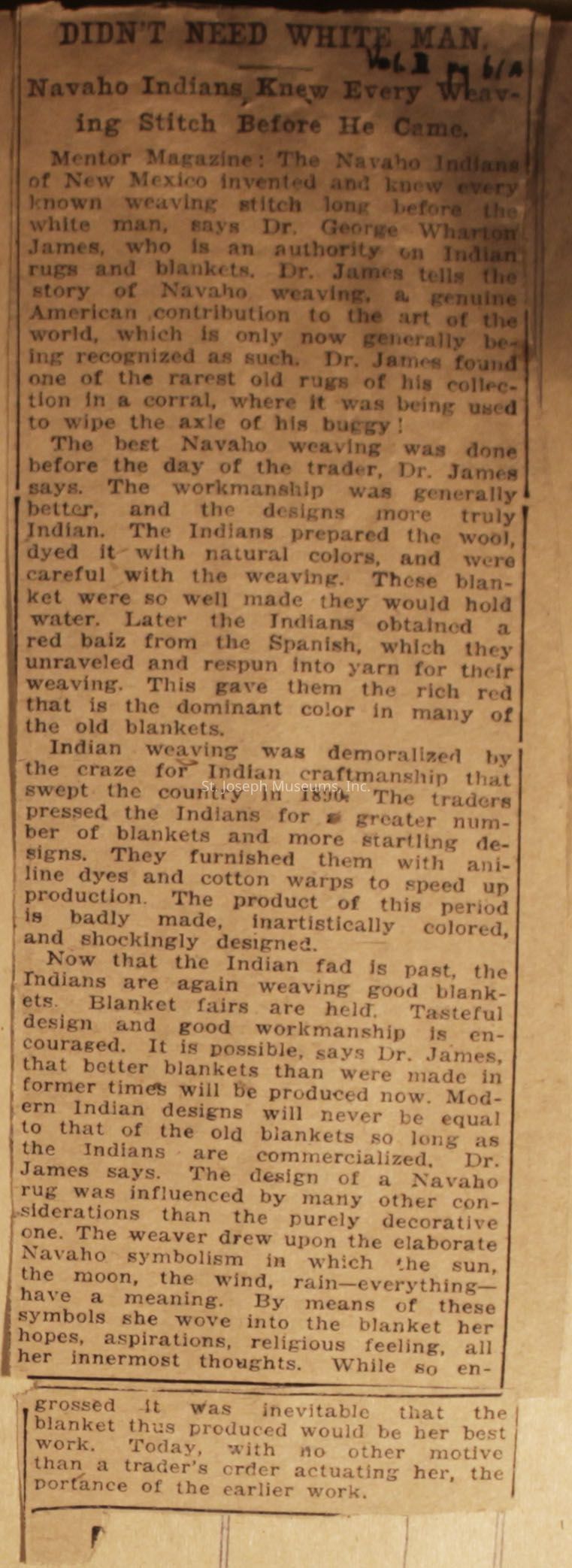
Newspaper article from the Mentor Magazine entitled, "Navaho [sic] Indians Knew Every Weaving Stitch Before He Came."
Undated.
Didn’t Need White Man
Navaho Indians Knew Every Weaving Stitch Before He Came.
Mentor Magazine: The Navaho Indians of New Mexico invented and knew every known weaving stitch long before the white man, says Dr. George Wharton James, who is an authority on Indian rugs and blankets. Dr. James tells the story of Navaho weaving, a genuine American contribution to the art of the world, which is only now generally being recognized as such. Dr. James found one of the rarest old rugs of his collection in a corral, where it was being used to wipe the axle of his buggy!
The best Navaho weaving was done before the day of the trader, Dr. James says. The workmanship was generally better, and the designs more truly Indian. The Indians prepared the wool, dyed it with natural colors, and were careful with the weaving. These blanket were so well made they would hold water. Later the Indians obtained a red baiz from the Spanish, which they unraveled and respun into yarn for their weaving. This gave them the rich red that is the dominant color in many of the old blankets.
Indian weaving was demoralized by the craze for Indian craftsmanship that swept the country in the 1890s. The traders pressed the Indians for a greater number of blankets and more startling designs. They furnished them with aniline dyes and cotton warps to speed up production. The product of this period is badly made, inartistically colored, and shockingly designed.
Now that the Indian fad is past, the Indians are again weaving good blankets. Blanket fairs are held. Tasteful design and good workmanship is encouraged. It is possible, says Dr. James, that better blankets than were made in former times will be produced now. Modern Indian designs will never be equal to that of the old blankets so long as the Indians are commercialized, Dr. James says. The design of a Navaho rug was influenced by many other considerations than the purely decorative one. The weaver drew upon the elaborate Navaho symbolism in which the sun, the moon, the wind, rain - everything - have a meaning. By means of these symbols she wove into the blanket her hopes, aspirations, religious feeling, all her innermost thoughts. While so engrossed it was inevitable that the blanket thus produced would be her best work. Today, with no other motive than a trader’s order actuating her, the portance of the earlier work.Subject
Mentor Magazine
Navajo
Weaving
Rugs
BlanketsSubject Person/Organization
Harry L. George Collection