Name/Title
Beshears: Sports IllustratedEntry/Object ID
2022.40.5Scope and Content
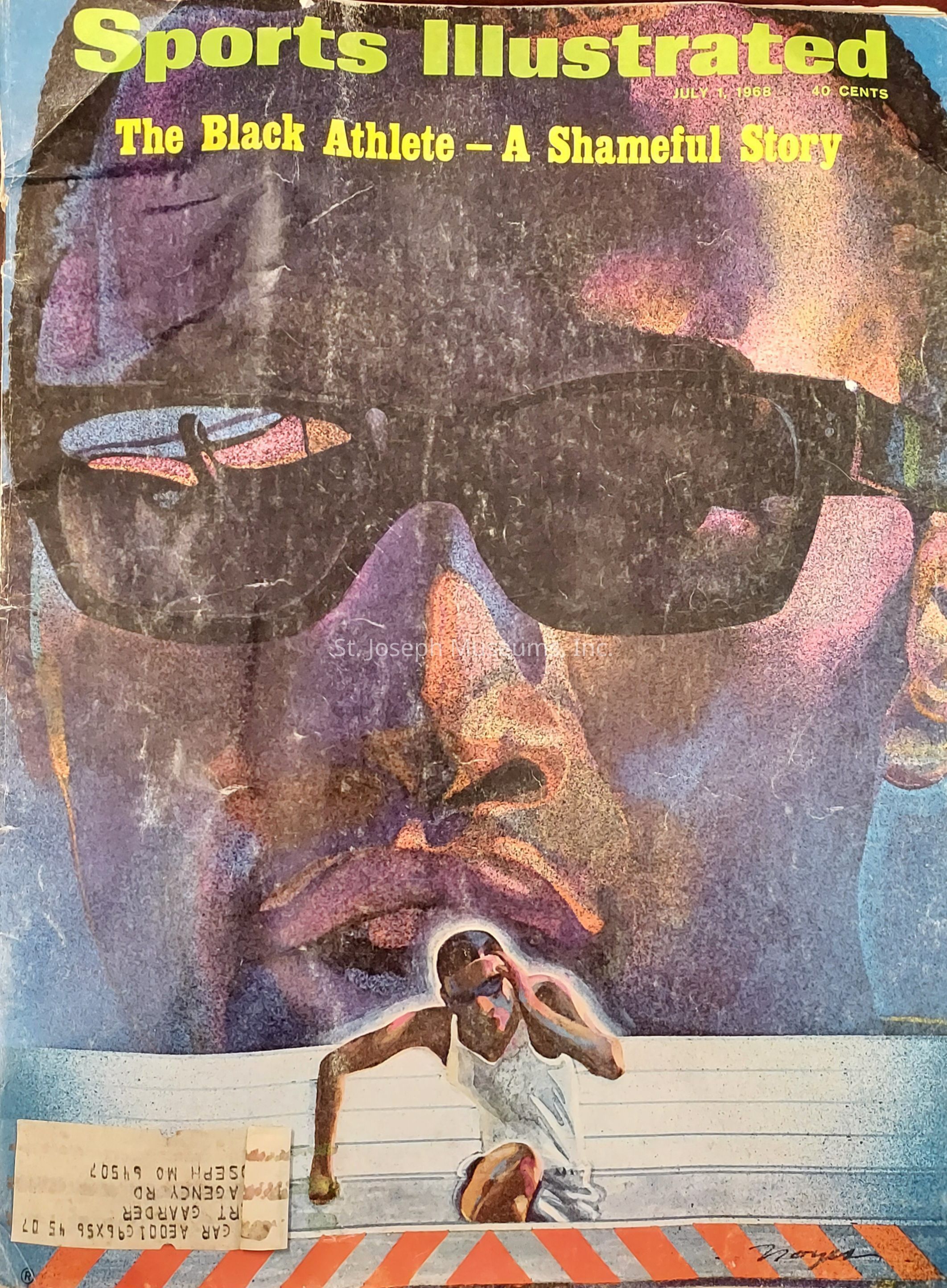
The July 1, 1968 copy of Sports Illustrated magazine featuring the article "The Black Athlete - A Shameful Story", written by Jack Olsen; drawings by David Noyes. Copyrighted © 1968 by Time Inc., Chicago, Ill. All Rights Reserved. This article is the first of a five-part series. The article ranges from page 12 to 27. The front cover is a colorful painting of the face of a black athlete in sunglasses overlooking a runner below.Context
Contents
JULY 1, 1968 Volume 29, No. 1
12 The Black Athlete --- A Shameful Story
Sport believes it has done much to advance the Negro's cause. But has it? Part 1 of a shocking series.
Sport has long been comfortable in its pride at being one of the few areas of American Society in which the Negro has found opportunity -- and equality. But has sport in America deceived itself? Is its leberality a myth, its tolerance a deceit? INcreasingly, black athletes are saying that sport is doing a disservice to their race by setting up false goals, perpetuating prejudice and establishing an insidious bondage all its own. Now when Negro athletes are shaking numerous college administrations with their demands and a boycott of the 1968 Olympics is no idle threat, Sports Illustrated explores the roots and validity of the black athlete's unrest - and finds them well founded in a five-part series Jack Olsen reports on the shockingly frustrating life of the black college athlete, the vast gulf between black and white sportsmen, how a Southwestern university treats the Negroes who are making it famous, black-white problems among the pros and what racism has done to one NFL team.
(A black and blue photo of a male African-American's upper back. Printed on it is "The Black Athlete - A Shameful Story)
(Three pictures in ascending order of size: various hues of blue of the upper face of a male African-American man with sunglasses; various hues of brown of the upper face of a male African-American man with brown and white stripes in the background; the upper body of a African-American man with alternate rose and tan stripes in a chevron pattern covering the picture. He looks to be wearing a basketball jersey and his shadow is reflected in royal blue.)
Part 1:
The Cruel Deception by Jack Olsen
Every morning the world of sports wakes up and congratulates itself on its contribution to race relations.
. . . . . . . . . . . . . . "Look what sports has done for the Negro."
To be sure there are a few well-minded men who are willing to suggest perhaps the Negro has done something for sports in return. . . . . . . . We think they've done a lot for us and we think we've done a lot for them.
The McCarthy attitude is echoed on many campuses. . . . . . . . . Everyone of them that's been here got out of the ghetto. . . . . It was profitable in both ways.
Some argue that anyone with two eyes can see what sports has done for the Negro, and offer Willie Mays as exhibit A. . . . . . Or take Bill Russell, . . . . He goes around making antiwhite remarks and collecting a six-figure check. . . . . Why, sports created Jim Brown, gave him a free education . . . catapulted him to national fame . . . . .
That's the way the argument goes and eventually reaches the classic in case histories a . . assistant professor of sociology . . . . . urges Negro athletes to boycott the Olympics, to rise up against various athlete departments . . . . . This fanatical superblack, . Harry Edwards . . . . attended various jails as a youth before it was discovered he could whirl a discus half a mile . . . . . . . . . was lifted out of the ghetto by the white sports establishment. . . . , if it were not for sports (he) probably would be alongside his brother . . . , serving 25 years . . . in the Iowa State Penitentiary . . . , or following his father . . . of Pontiac State Penitentiary. . . . . . . .
You can hear these arguments any night of the week at the saloon of your choice, . . . . . "If only we could achieve in housing, in education, in economic opportunity, all the things we have achieved is sports . . . . the race problem in the United States would disappear. "
But Negro athletes do not agree. . . . . .
Black athletes say they are dehumanized, exploited and discarded. . . . .
Black professional athletes say they are . . . . . treated like subhumans by Paleolithic coaches who regard them as watermelon-eating idiots.
. . . . . . . . . . . . . . . . . . . . . . . . . . . . . . . . . "I think I've been pretty damn good to this university. I want you to remember one thing, you came to me, I didn't come to you."
Someone asked Percy Harris. . . . , what he got out of four years of scholarship athletics at various institutions . . . "Well let's see . . . . . At the University of New Mexico, I got a sweater. At Cameron State College . . . I got a blanket. At Southwestern State I got a jacket and a blanket."
"Black students aren't given athletic scholarships for the purpose of education. . . . . . . . .
With rare exceptions, the American college coach expects the Negro athletics to concentrate on the job for which hey were hired. . . . . . . . . . . .
"There is nothing in this world so forlorn and useless as a Negro college athlete who has used up his eligibility, " . . . . . . . . . .
Certain truths about the Negro college athlete have been carefully concealed in the groves of academe, and for good reason. . . . . . . .
These shortcuts of course, seldom lead to a degree and that is the second fundamental fact about the Negro athletes in American colleges: . . . . . . .
The black professional athlete accomplishes much the same thing, although at a greater economic return to himself. . . . . . . . . . .
James Baldwin wrote: "Every Negro boy . . realizes, at once, profoundly, because he wants to live, that he stands in great peril and must find, with speed, a "thing" a gimmick, to lift him out, to start him on his way . . . . . . . . . . .
The article continues from pages 17 to 27 with examples and quotes and dialogue of events by various Negro athletes and their college and professional careers; and by college coaches. There are additional drawings by David Noyes on page 21, 22, and 26.
The remainder of the CONTENTS page displays the other articles in this issue:
28 Detroit Is Having That Dream Again
30 The Derby Drugging Mystery
32 Some Old Boys Make a Stand
34 Winning a Varsity Letter Out West
40 Ted Williams' Story: Part 4
54 The Bottle and the BabeLexicon
Nomenclature 4.0
Nomenclature Tertiary Object Term
MagazineNomenclature Secondary Object Term
PeriodicalNomenclature Primary Object Term
SerialNomenclature Sub-Class
Other DocumentsNomenclature Class
Documentary ObjectsNomenclature Category
Category 08: Communication Objects