Name/Title
Beshears: The Saturday Evening PostEntry/Object ID
2022.40.46Scope and Content
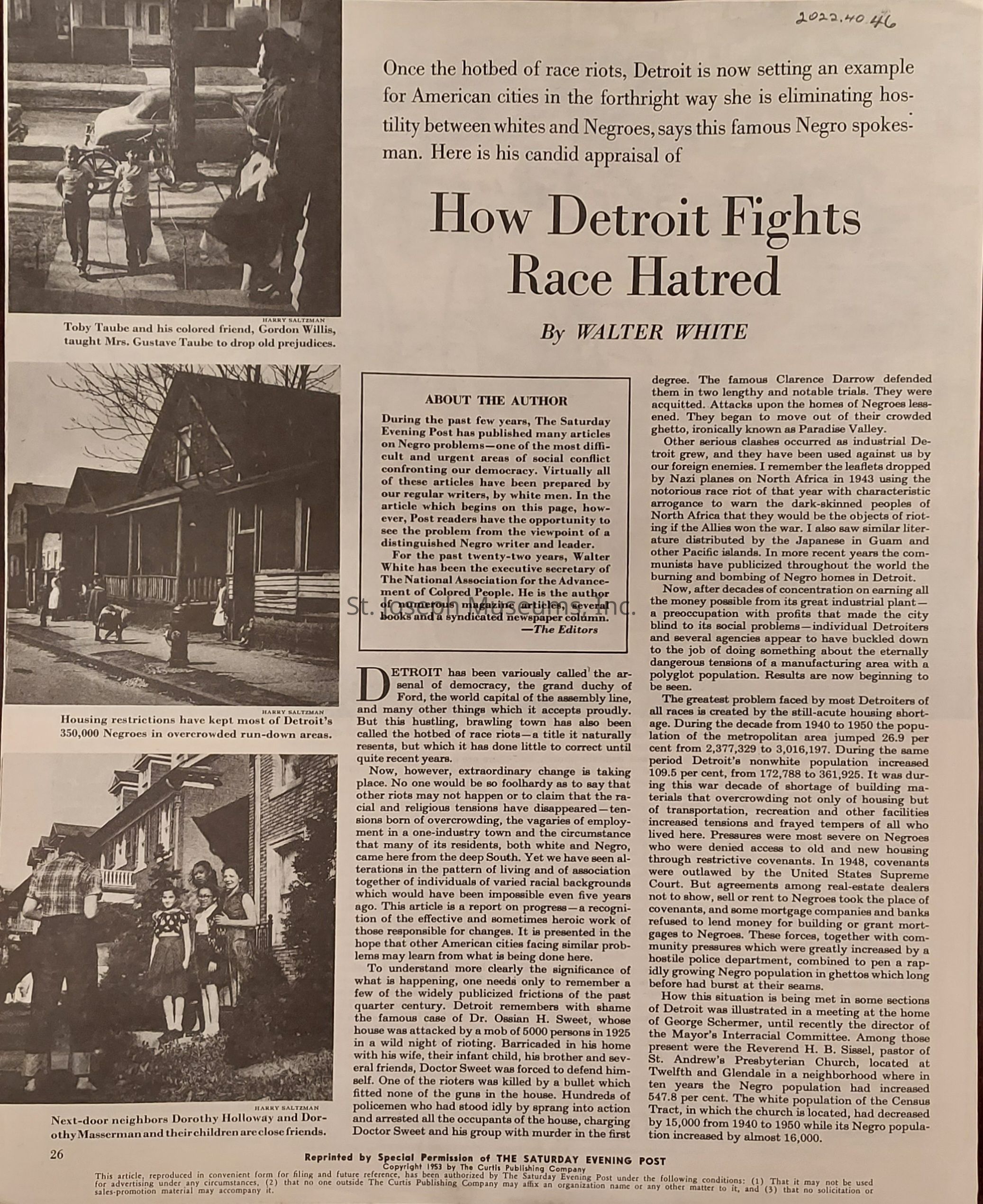
Twenty-two copies of a magazine article titled "How Detroit Fights Race Hatred" by Walter White. Reprinted by Special Permission of The Saturday Evening Post copyright © by The Curtis Publishing Company, Indianapolis, IN. The article is printed on pages 26 and 27 and continues onto pages 95 and 97 from the July 18, 1953 issue.Context
Once the hotbed of race riots, Detroit is now setting an example for American cities in the forthright way she is eliminating hostility between whites and Negroes. . . . .
Three pictures and captions along the left side of the page:
a) Toby Taube, and his colored friend, Gordon Willis, taught Mrs. Gustave Taube to drop old prejudices.
b) Housing restrictions have kept most of Detroit's 350,000 Negroes in overcrowded run-down areas.
c) Next-door neighbors Dorothy Holloway and Dorothy Masserman and their children are close friends.
Detroit has been variously called the arsenal of democracy, the grand duchy of Ford, the world capital of the assembly line, and many other things it accepts proudly. . . . .
Now, however, extraordinary change is taking place. . . . . It is presented in the hope that other American cities facing similar problems may learn from what is being done here.
To understand more clearly the significance of what is happening, one needs only to remember a few of the widely publicized frictions of the past quarter century. . . . . They began to move out of their crowded ghetto, ironically known as Paradise Valley.
Other serious clashes occurred as Industrial Detroit grew, and they have been used against us by our foreign enemies. . . . . . In more recent years the communists have publicized throughout the world the burning and bombing of Negro homes in Detroit.
Now, after decades of concentration . . . Results are now beginning to be seen.
The greatest problem faced by most Detroiters of all races is created by the still-acute housing shortage. . . . . . . These forces, together with community pressures which were greatly increased by a hostile police department, combined to pen a rapidly growing Negro population in ghettos which long before had burst at their seams.
How the situation is being met in some sections of Detroit was illustrated in a meeting at the home of . . . , until recently the director of the Mayor's Interracial Committee. . . . The white population of the Census Tract, . . . , had decreased by 15,000 from 1940 to 1950 while its Negro population increased by almost 16,000.
(A larger picture covering the top half of the second page portraying a large group of white men, a couple of police officers, and a Negro man.)
' Police protect a Negro during the 1943 race riots. Racial integration in Detroit industries is teaching Negroes and whites they can work and live together.'
Many of the . . . . parishioners (of a local church) became panic-stricken when the first Negroes moved into the neighborhood. . . . . "it was inevitable that the church must eventually die as the community changed"; or "stay and let the church change along with the neighborhood."
. . . . . The pastor) encountered the stiff resistance he had expected. . . . Some of the church members informed him . . . . of "other means" of stopping the invasion.
Meanwhile (the pastor) made pastoral calls upon the newcomers and invited them to attend the church. . . . The exodus of the white families . . . slowed down as colored and white neighbors began to know and like one another.
(Several columns of the article was the story told by Mrs. Gustav Taube who had an aversion to Negroes and was shocked when her son brought home his best friend from school only to discover he was colored. . . . . . . . . Mr. and Mrs. Taube eventually won the battle not only with their own ideas of Negroes but over the prejudices of the neighborhood itself.)
The article continues onto pages 96 and 97 made up of 4 columns of smaller print with various stories and occurrences.Collection
Beshears, KelseyLexicon
Nomenclature 4.0
Nomenclature Tertiary Object Term
MagazineNomenclature Secondary Object Term
PeriodicalNomenclature Primary Object Term
SerialNomenclature Primary Object Term
ArticleNomenclature Sub-Class
Other DocumentsNomenclature Sub-Class
Literary WorksNomenclature Class
Documentary ObjectsNomenclature Category
Category 08: Communication ObjectsDimensions
Dimension Notes
10½" x 13½"