Name/Title
Bitterroot (Lewisia rediviva)Entry/Object ID
2021.1.39 BScope and Content
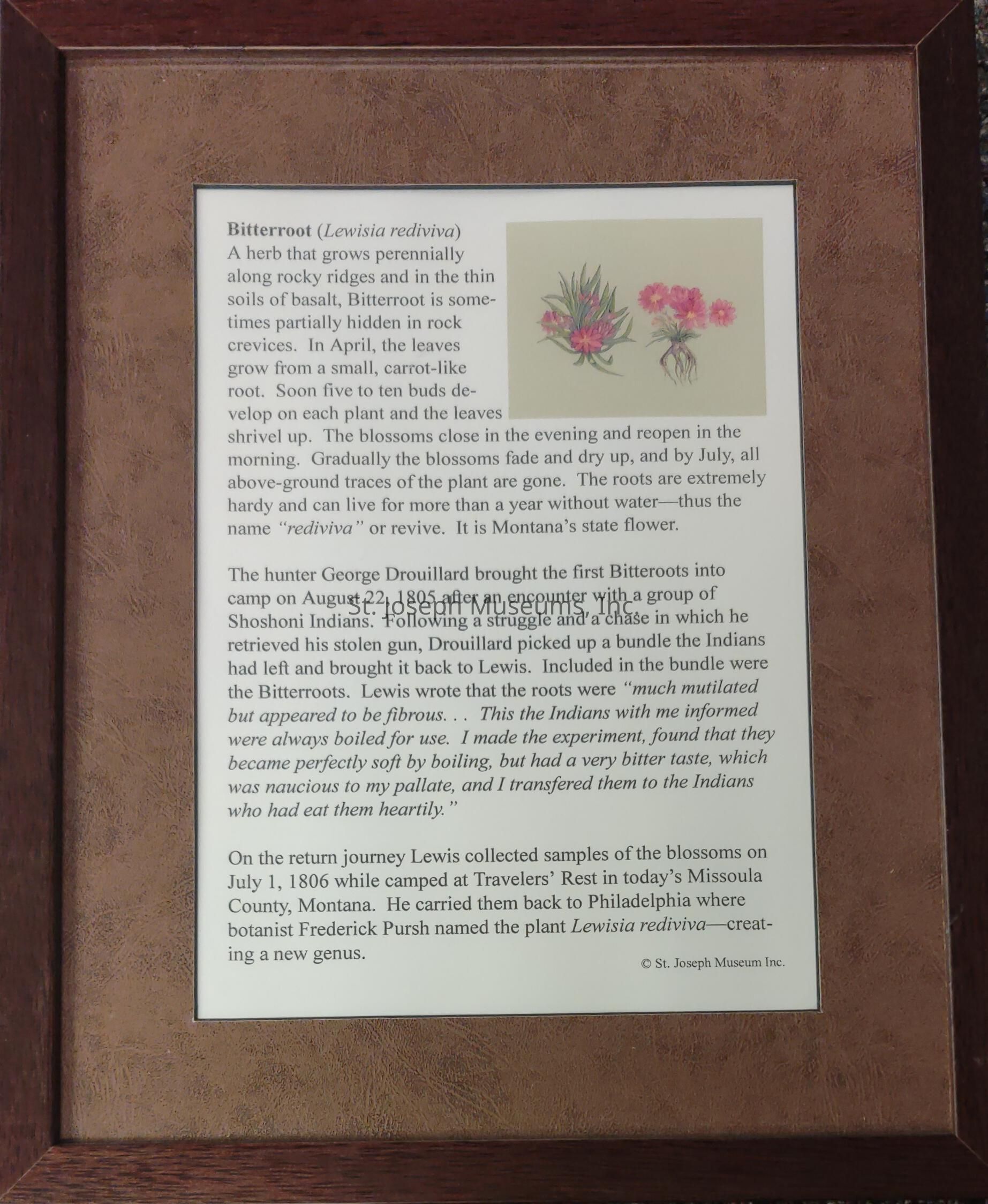
Bitterroot (Lewisia rediviva) plant description, framed.
A herb that grows perennially along rocky ridges and in the thin soils of basalt, Bitterroot is sometimes partially hidden in rock crevices. In April, the leaves grow from a small, carrot-like root. Soon five to ten buds develop on each plant and the leaves shrivel up. The blossoms close in the evening and reopen in the morning. Gradually the blossoms fade and dry up, and by July, all above-ground traces of the plant are gone. The roots are extremely hardy and can live for more than a year without water - thus the name "rediviva" or revive. It is Montana's state flower.
The hunter George Drouillard brought the first Bitterroots into camp on August 22, 1805 after an encounter with a group of Shoshone Indians. Following a struggle and a chase in which he retrieved his stolen gun, Drouillard picked up a bundle the Indians had left and brought it back to Lewis. Included in the bundle were the Bitterroots. Lewis wrote that the roots were "much mutilated but appeared to be fibrous...This the Indians with me informed were always boiled for use. I made the experiment, found that they became perfectly soft by boiling, but had a very bitter taste, which was naucious to my pallate, and I transfered them to the Indians who had eat them heartily."
On the return journey Lewis collected samples of the blossoms on July 1,1806 while camped at Travelers' Rest in today's Missoula County, Montana. He carried them back to Philadelphia where botanist Frederick Pursh named the plant Lewisia rediviva - creating a new genus.Context
Originally designed by the St. Joseph Museum in the fall of 2004. Titled "Botanical Wonders of the Uncharted West. The Recorded Flora of the Lewis & Clark Expedition."Collection
Lewis and ClarkLexicon
LOC Thesaurus for Graphic Materials
Botanical drawings, Expeditions & surveysArchive Items Details
Title
Bitterroot (Lewisia rediviva)Creator
Mary L. FletcherDate(s) of Creation
2004Subjects
Plants, Watercolor paintingsParts
Count
2Parts
Watercolor of plant and descriptive label, both framed.Condition
Overall Condition
Very GoodProvenance
Notes
"Botanical Wonders of the Uncharted West" visually depicts how well Lewis followed Jefferson's instructions. In recognition of this achievement, The S. Joseph Museums, Inc. commissioned accomplished artist Mary Fletcher to create fifty (50) selected paintings of flora documented by the Corps during their Journey. These framed watercolor originals are accompanied by similarly framed labels, generated by former Head of Research Jackie Lewin, which describe the corresponding plants with appropriate quotations from the Journals. This collection makes available for study and appreciation plants that were new to Lewis and Clark, but which Native Peoples already recognized as valuable sources of food, medicine, and tools. Some of these still remain a mystery to many, but all will enjoy their beauty, their diverse uses, and their accomplished renderings.