Name/Title
BookletEntry/Object ID
2014.2.3295a-bScope and Content
A booklet printed for The Passing of Our Holy Father Benedict; Mass of Thanksgiving; and For The Renewal of the Basilica of the Immaculate Conception in the 125th Year Since the Founding of Conception Abbey. It is dated March 22, 1999 and printed by "The Printery House, Conception, Missouri"
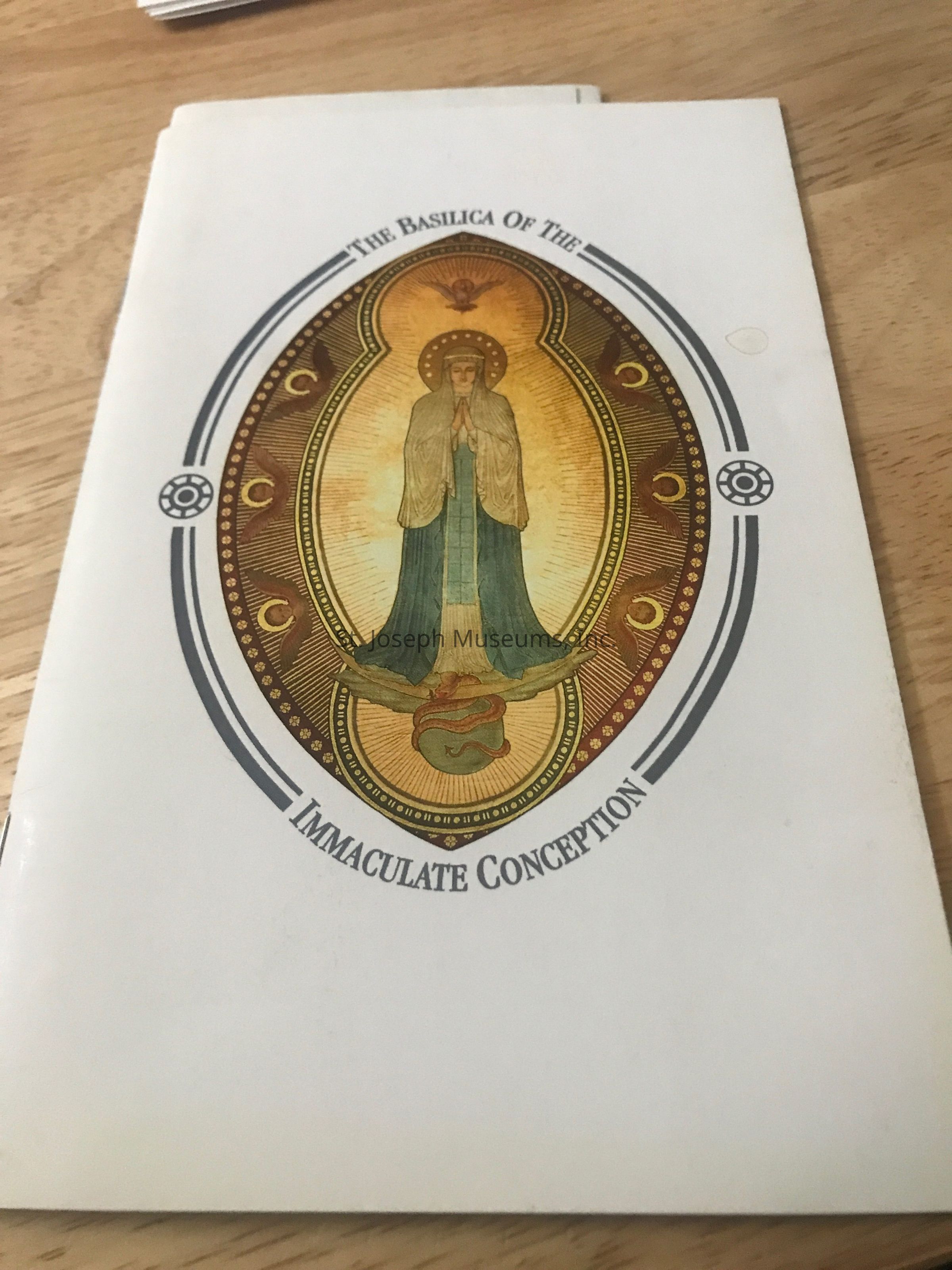
On the front cover is the picture of the Basilica of the Immaculate Conception. On the back cover is a colored replica of 'The Coat of Arms of the Basilica of the Immaculate Conception', on the inside is a black and white replica of the coat of arms.
An unattached paper inserted into the booklet explains "The Beuronese Murals at Conception Abbey." It is double sided. At the bottom of the backside has a small drawing of the main building at Conception Abbey and "For more information please contact:" with the additional information.Context
ORGAN PRELUDE
ENTRANCE SONG
The Promised Land
GLORY TO GOD IN THE HIGHEST
LITURGY OF THE WORD
FIRST READING
Proverbs 2:1-9
RESPONSORIAL PSALM
Psalm 1: 1, 1-2; 4, 6 [Refrain Ps 40:5]
SECOND READING
Ephesians 6: 10-13, 18
SEQUENCE
GOSPEL ACCLAMATION
GOSPEL
HOMILY
PROFESSION OF FAITH
LITURGY OF THE EUCHARIST
PREPARATION OF THE GIFTS
HOLY, HOLY, HOLY
MEMORIAL ACCLAMATION
GREAT AMEN
LAMB OF GOD
COMMUNION
RECESSIONAL HYMN
INTO LAND OF CANAAN BRIGHT
ORGAN POSTLUDE
CONCEPTION ABBEY BASILICA RENEWAL
Community Liaisons Doors, Millwork & Finish Hardware
Architect Sheet Metal, Roof, Cupola
General Contractor
Principal Aluminum Door Frames & Windows
Project Manager
Project Superintendent Drywall & Plaster
Excavation Brick Flooring
Metal Work Decorative Painting
Concrete Flatwork
Masonry Mural Restoration
Stone Base & Window Sills Heating & Air Conditioning
Structural Steel Electrical
Reinforcing Steel Sound System
Organ Contractor, Phase I
Ambo, Choir Stalls, Pews Art Conservation, Phase I
Icons Painting
Altar, Stained Glass & Lighting Icon Stands, Candle Holders,
Handrails, Organ Pit
Plumbing Sacristy, Statio Hallway
Tabernacle and
Restoration of Cross & Sanctuary Lamp
PLANNING COMMITTEES
Church Planning Committee Basilica Renewal Committee (I)
Basilica Renewal Committee (II)
Design Team and Consultants
ACKNOWLEDGEMENTS
MUSIC
Entrance Song:
Mass Ordinary:
Responsorial Psalm:
Sequence:
Gospel Acclamation:
Communion Song:
Recessional Hymn:
PRINTING
The Printing House, Conception, Missouri
__________________________________________________________________
The Basilica's murals are the most striking of its interior decoration. They are fine examples of a style of art called Beuronese. More important, however, is the fact that the murals - as well as the entire interior decoration - were executed by the monks of Conception Abbey. As much as the buildings itself, the murals testify to the aspirations of the monastery's forefathers. In 1892, three candidates arrived at Conception from the monastery at Beuron in southwest Germany, two of them whom had studied art there. This opened the way for the Basilica's redecoration after the damage of the 1893 tornado was repaired. Abbot Frowin wrote: "On the advice of Fr. Lukas, I am ready to paint our church with the help of our fathers and brothers [...] To my regret I found out that the archabbot of Beuron could not accommodate us by lending a painter from his school." (Diary, August 17, 1893)
Beuron was founded in 1863 by the brothers Maurus and Placidus Wolter through the beneficence of Princess Catherine of Hohenzollern. It was an active proponent and the German counterpart of the revival of monastic life, liturgy and music by Dom Prosper Guerenger of the Abbey of Solesmes in France. . . . . . . . . . . . . A small sign of the degree of Beuron's influence on Conception is the act that Abbot Frowin adopted the style of Beuron's monastic habit instead of Engelberg's.
The three main characters in the development of Beuronese art were Maurus Wolter (d. 1890), Desiderius Lenz (d. 1928) and Gabriel Wüger (d. 1892). . . . . , Lukas Steiner (d. 1906), Lenz and Wüger joined a group of artists in Rome called the Nazarenes. . . . . They studied the old masters, trying to relearn the technical skills needed to undertake large frescoes. . . . . , Lenz became fascinated with Egyptian art . . . He believed that the highly stylized form of art . . . lent itself better than any subsequent form of expressing a religious ideal. . . . . .
Lenz and Wüger dreamed of forming a monastic community of artists and even drew up plans for a monastery building. . . . . For them, Christian art flowed from the experience of Christian community. . . . they met Maurus Wolter, who had similar artistic aspirations for his young community at Beuron. . . . . Upon the invitation of Princess Catherine, Lenz and Wüger designed and constructed a chapel, . . . . This chapel epitomizes their theories in a harmonious blend of both art and architecture. . . . . .
Lenz and Wüger, with Wolter . . . . developed a distinctive style and philosophy of religious art and architecture and soon attracted many followers. . . . . . The high point of their reputation came in 1905, when they were the centerpiece of an exhibition of avant garde art in Vienna. In recent years, art historians
continued on back
have begun to reevaluate the style. Some see it . . . with the insight that art and community are connected; some consider it as one of the first expressions of the abstract movement which dominated the 20th century art; and some maintain that it was the forerunner of the German Bauhaus movement. . . . .
It is difficult to speak of Beuronese art as a coherent style when, in fact, there were at least two or three styles which competed for "canonization" as various elements came in and out of favor. . . . . They chose as their guiding principles the use of plain backgrounds and basic colors, a limited use of perspective and a repetition of decoration.
The most significant principle or canon of the Beuronese school is the role which geometry played in determining proportions. . . . Geometrical proportions determine ideal forms, and the result is an innate harmony comparable to the mathematical relationships in musical compositions. . . . .
Other canons of the school include:
* The orientation of the art is hieratic, speaking to the spirit of the viewer. . . . . .
* Works are anonymous, done by a group effort, and not for the glory of the artist, but of God.
* Imitation is favored over originality, with freehand copying revealing an artist's genius.
* There is full integration of art and architecture. Painting and sculpture are not "additions" to an architectural given but an integral part of it. . . . . . . .
Beuronese art was revolutionary for its time, and also characteristic of its time. It offered a stylized, simplified and hieratic approach to art which went against the grain of contemporary romantic forms. . . . . . Abbot Frowin, . . . . . . .saw the "pure" simplicity of Beuronese art as fitting decoration for his church.
Between 1893 and 1897, several monks of Conception, . . . . . . . .redecorated the walls and ceilings of the Abbey church primarily in the Beuronese manner, retaining elements of the original Victorian stenciling. . . Conception's was the first church in the United States so decorated. The apse painting of the Immaculate Conception is an original work by Lukas Etlin. . . . . .Lexicon
Nomenclature 4.0
Nomenclature Sub-Class
Other DocumentsNomenclature Class
Documentary ObjectsNomenclature Category
Category 08: Communication Objects