Name/Title
Buffaloberry (Shepherdia argentia)Entry/Object ID
2021.1.32 BScope and Content
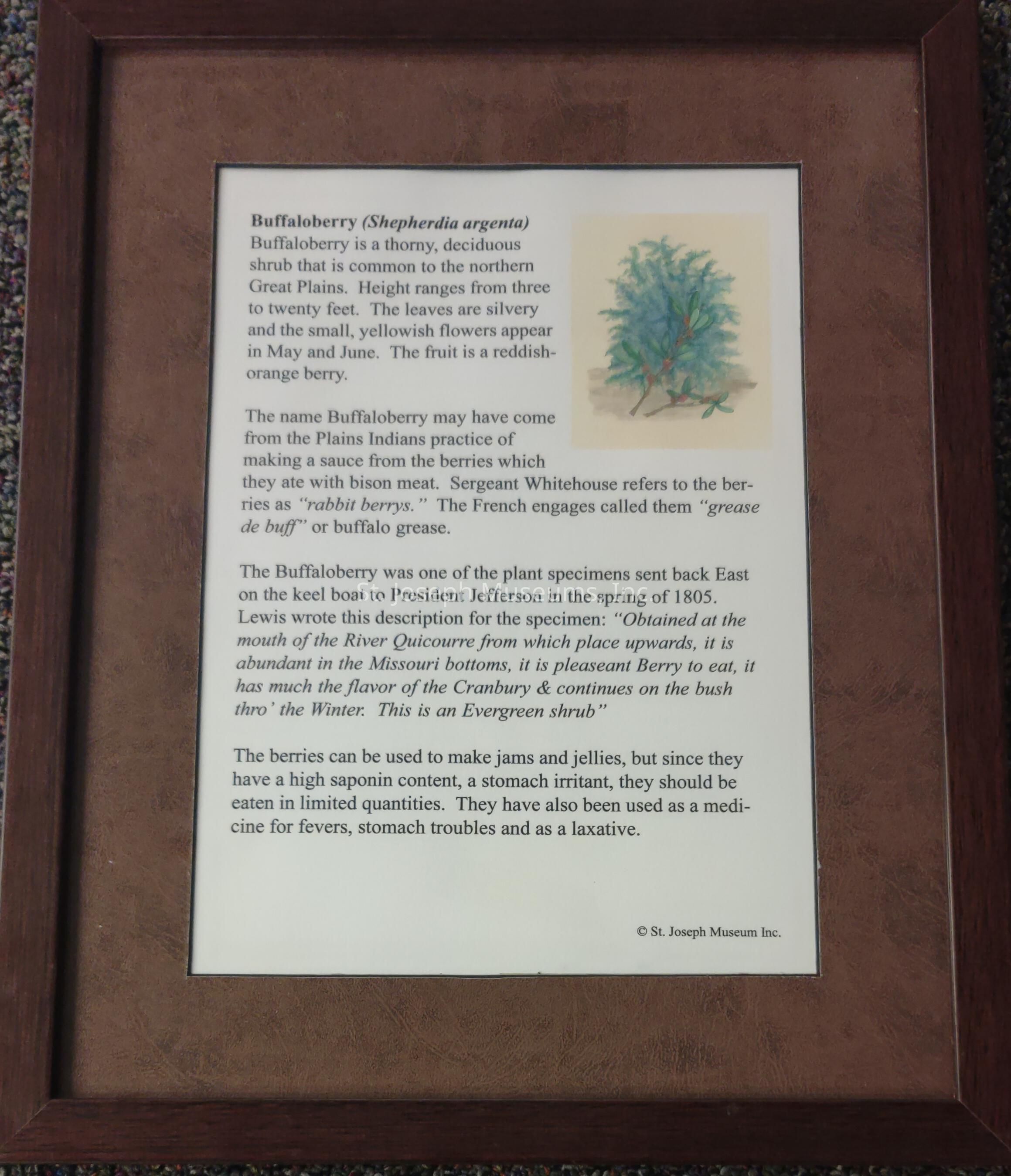
Buffaloberry (Shepherdia argentia) plant description, framed.
Buffaloberry is a thorny, deciduous shrub that is common to the northern Great Plains. Height ranges from three to twenty feet. The leaves are silvery and small, yellowish flowers appear in May and June. The fruit is a reddish-orange berry.
The name Buffaloberry may have come from the Plains Indians practice of making a sauce from the berries which they ate with bison meat. Sergeant Whitehouse refers to the berries as "rabbit berrys." The French engages called them "grease de buff" or buffalo grease.
The Buffaloberry was one of the plant specimens sent back East on the keel boat to President Jefferson in the spring of 1805. Lewis wrote this description for the specimen: "Obtained at the mouth of the River Quicourre from which place upwards, it is abundant in the Missouri bottoms, it is pleaseant Berry to eat, it has much the flavor of the Cranbury & continues on the bush thro' the Winter. This is an Evergreen shrub"
The berries can be used to make jams and jellies, but since they have a high saponin content, a stomach irritant, they should be eaten in limited quantities. They have also been used as a medicine for fevers, stomach troubles and as a laxative.Context
Originally designed by the St. Joseph Museum in the fall of 2004. Titled "Botanical Wonders of the Uncharted West. The Recorded Flora of the Lewis & Clark Expedition."Collection
Lewis and ClarkLexicon
LOC Thesaurus for Graphic Materials
Botanical drawings, Expeditions & surveysArchive Items Details
Title
Buffaloberry (Shepherdia argentia)Creator
Mary L. FletcherDate(s) of Creation
2004Subjects
Plants, Watercolor paintingsParts
Count
2Parts
Watercolor of plant and descriptive label, both framed.Condition
Overall Condition
Very GoodProvenance
Notes
"Botanical Wonders of the Uncharted West" visually depicts how well Lewis followed Jefferson's instructions. In recognition of this achievement, The S. Joseph Museums, Inc. commissioned accomplished artist Mary Fletcher to create fifty (50) selected paintings of flora documented by the Corps during their Journey. These framed watercolor originals are accompanied by similarly framed labels, generated by former Head of Research Jackie Lewin, which describe the corresponding plants with appropriate quotations from the Journals. This collection makes available for study and appreciation plants that were new to Lewis and Clark, but which Native Peoples already recognized as valuable sources of food, medicine, and tools. Some of these still remain a mystery to many, but all will enjoy their beauty, their diverse uses, and their accomplished renderings.