Research Type
ResearcherPerson
Tori ZiegerNotes
Answers for the osteology program:
Sex:
Male. See the pronounced supraorbital ridges, the very round supraorbital margin.. Mastoid process is moderately large. External occipital protuberance/nuchal crest is clearly defined
Age:
Adult. Sagittal suture is fused, which indicates mid to upper 20s. Squamous suture is not completely fused, meaning they are likely under the age of 40. The coronal suture is completely fused, starting to disappear. This means they are on the upper end of the coronal suture range (upper 20s, possibly into the 30s)
All cranial sutures are still visible, meaning they are not very old.
No dentition. With this limited source of information, it is estimated that this person is between the ages of 26-39 (upper 20s to upper 30s). If you were somewhere in this range or close to it, consider your answer correct
Trauma:
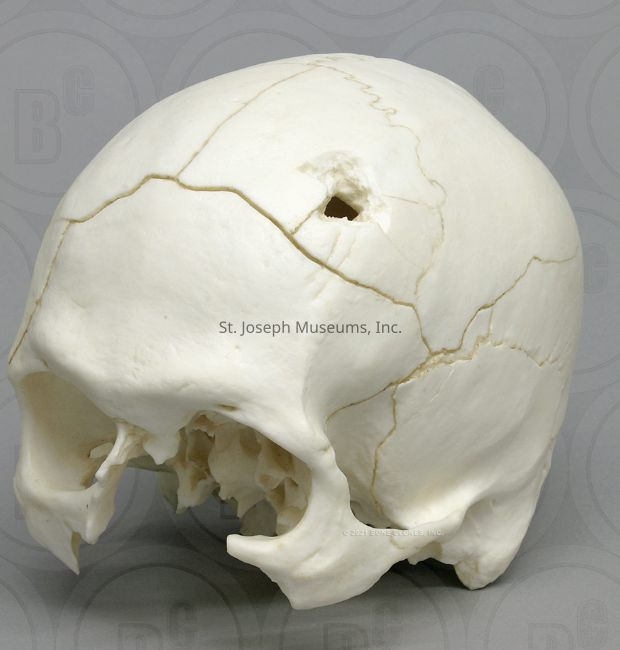
Perimortem projectile trauma. Small caliber gunshot, entrance is on the right parietal bone near the squamosal and coronal sutures.
The entrance itself is the rounded area. The jagged breaks are damage caused by the bullet entering the skull - those bone fragments are missing.
Exit is on the left, on the upper left frontal bone near the coronal suture. You can see the beveling on the outside of the bone.
Trajectory is from the right to the left in a slight upward trajectory. This is consistent with a self-inflicted gunshot wound from a right handed individual. (A second person could have inflicted the wound if they were shooting from below the person).
Associated fractures radiate out from both the entrance and exit wounds. There is one large associated fracture that begins at the entrance would and travels across the entire forehead (frontal bone)
Pressure from the gunshot caused significant damage to the right eye orbit. There is no evidence of a second injury. When the bullet entered the side of the head, the pressure fractured the ethmoid and orbital bones on the right side. That pressure then continued through the nasal cavity and resulted in the separation of the bones of the lower face. Originally, the facial tissue would have held these bones in place but once the soft tissue was lost (decomposition or removal by investigators), those bones would have been separated completely.
The right zygomatic bone is broken at the zygomatic arch (the thin bone between the temporal bone and the zygomatic bone). There isn’t enough information to 100% determine how this injury happened, but it is likely a secondary injury because of the gunshot, possibly because of the separation of the facial bones or due to the individual falling down after the gunshot wound.