Research Type
ResearcherPerson
Tori ZiegerNotes
Answers for osteology program:
Sex:
Female. The forehead is smooth with no supraorbital ridge. The supraorbital margins are sharp. The mastoid process is relatively smooth and there is no protuberance on the occipital bone
Age:
Adult. All cranial sutures have started to close, but still show gaps in all of them. The third molar on the right side is present but not fully erupted. No signs of wear on the first molar on the right side. Age is likely late teens-early 20s
Trauma:
Perimortem blunt force trauma.
All teeth were present at the time of death, but several were lost after death (leaving behind empty tooth sockets). Present are:
RIGHT - third molar, first molar, first and second premolar, canine, lateral incisor
LEFT - canine, first and second premolar
The broken teeth likely happened postmortem. The jaggedness to the breaks indicate that the teeth had been “dead” a while before breaking.
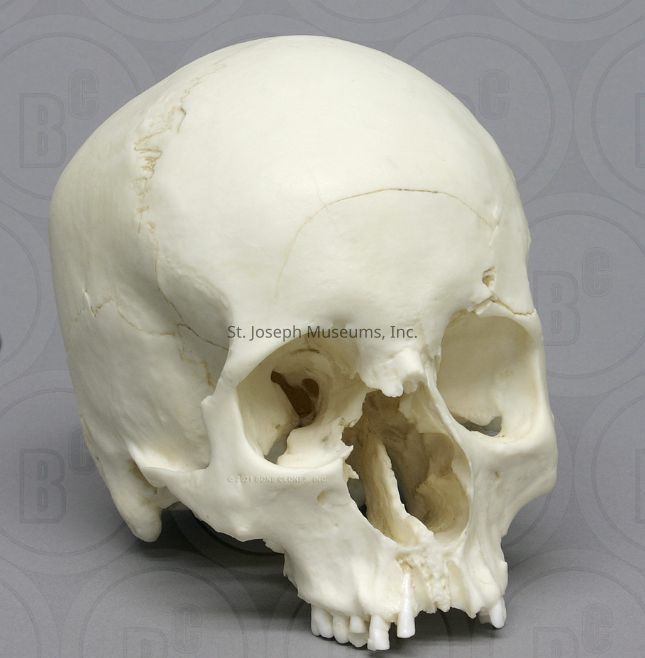
Trauma A was on the left supraorbital margin (right above the eye). There are radiating fractures coming from that point, including a concentric fracture that arcs over the lower forehead and ends right above the right eye socket. One fracture that extends posteriorly from the impact site into the orbital roof (top of eye socket) severely disrupts the suture between the frontal bone and the ethmoid.
There are portions of facial bones missing on the right side - the maxilla, ethmoid, and nasal bones are all affected and missing parts. There is no point of impact evidence, this damage is a possible side effect of the impact above the left eye.
However, the roots of the maxillary incisors are exposed by missing bone, which likely happened at the time of death. If it was caused by the same trauma that damaged the eye socket and the nose, it is likely that the nose itself suffered trauma and the impact site itself is not visible on the bone.
Trauma B is above the left ear. Right above the zygomatic process of the temporal bone (the thin arch that connects to the face) is the site of impact. The left temporal bone is pulled away from the sphenoid (look at the bottom of the skull and compare the two sides), which was caused by this blunt force trauma.
There is damage to the bone above the right molars, exposing roots at this location. This damage was likely secondary to the other impacts.