Research Type
ResearcherPerson
Tori ZiegerNotes
Answers for osteology program:
Sex:
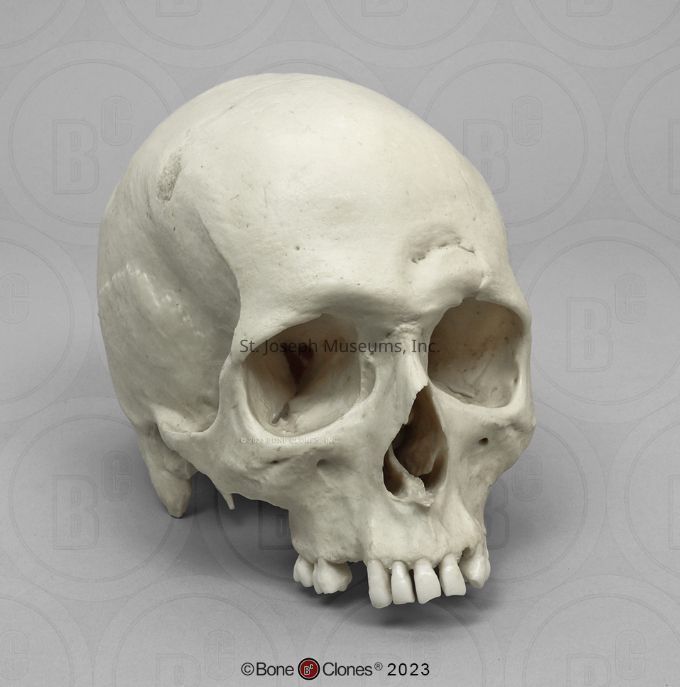
Male. The supraorbital ridge and external occipital protuberance/nuchal crest are very pronounced. The supraorbital margin is rounded and the mastoid process is large
Age:
Adult. The teeth show some signs of wear, though occlusal surfaces are still well defined. Cranial sutures indicate someone over the age of 40. The degree of suture disappearance indicates someone much older, as this is past the peak closure age for all sutures. Age range estimate is 40-60 years old.
Trauma:
Antemortem blunt force trauma.
There are 10 maxillary teeth remaining. They are:
LEFT: medial incisor, canine, first premolar, first molar, second molar
RIGHT: medial and lateral incisor, canine, first molar, second molar
The left second premolar and the right first and second premolars were lost during life. The tooth socket has completely healed over, indicating that the tooth were lost well before they died. Both third molars were also removed/lost during life. The left lateral incisor was lost after death. On the left second molar, there is a deep groove on the lingual side that indicates a filling might have once existed there but was lost. Some periodontal disease is evident (tooth disease). Look closely at the gum line around the molars in particular and you can see that the gums have receded and tooth roots are visible.
Trauma A is on the left side of the frontal bone, above the left eye. This depression is circular and shows signs of healing (the edges are smoothed, as is the surface. There is one remaining radiating fracture that is also well into the healing process.
Trauma B is on the right parietal and is also slightly circular. This depression has parallel lines in it, an impression from the weapon is likely. The smooth edges and surface also indicate healing.
The circular nature of these two blows is consistent with a hammer strike.
Cause and manner of death cannot be determined for this individual; the two hammer blows did not kill him during the time of the attack.