Research Type
ResearcherPerson
Tori ZiegerNotes
Answers for the osteology program:
Sex:
Female. The supraorbital ridge is very small and the supraorbital margins are sharp. Mastoid processes are small. There is a slight prominence to the external occipital protuberance/nuchal crest but that is attributed to normal variation.
Age:
Adult. The third molars are fully erupted and in their finished position. This puts the age estimate at least into the mid 20s. Suture closure estimates are compromised by the traumatic injuries and it is not possible to determine age using that method. The most that can be said is an adult that is likely over the age of 21.
Trauma:
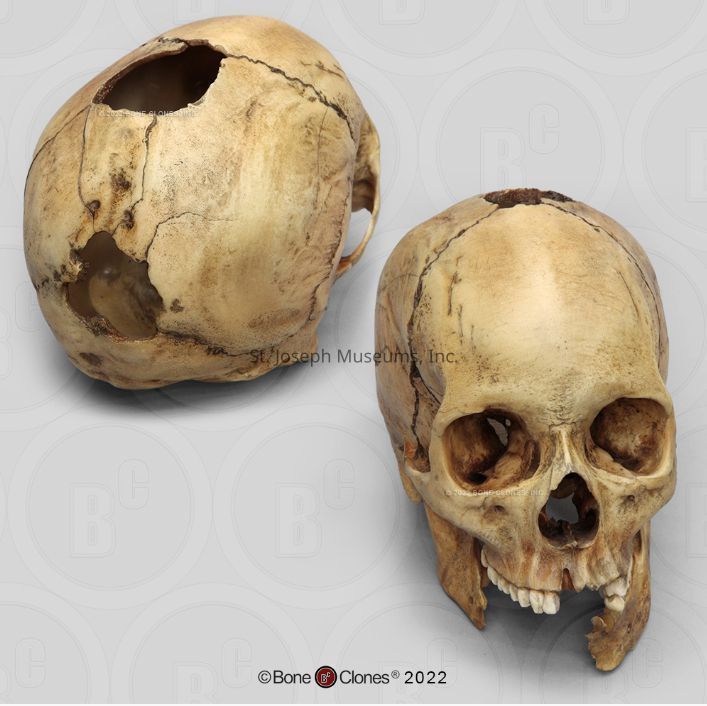
Perimortem projectile trauma and possible blunt force trauma
There are 17 teeth. RIGHT MAXILLA: second incisor, canine, first and second premolar, first, second and third molar. LEFT MAXILLA: first and second premolar, first, second, and third molar. The roots are still present of the medial and lateral incisor. RIGHT MANDIBLE: None. LEFT MANDIBLE: first and second premolar, first, second and third molar.
Trauma A is to the top of the parietals along the sagittal suture. There is internal beveling that can be felt with your finger, which means this is an entry wound. This injury involves both parietal bones, though it is more to the left than the right. There is one radiating fracture that travels inferiorly and ends in the lambdoid suture and the coronal suture is disrupted by the force of the gunshot wound in both directions.
Trauma B is to the occipital and the bottom of both parietals. This wound happened second, as the two superiorly traveling radiating fractures terminate in the already existing wound on the superior portion of the head. The lambdoid suture, already weakened from the radiating fracture from Trauma A, was drastically disrupted by this injury. A third fracture also travels superiorly from the trauma injury. There is internal beveling which can be felt inside the wound, however there is slight beveling on the exterior surface. This MIGHT be an exit wound, however it is possible that these are both entry wounds and the bullets were not traveling at a high enough velocity to exit.
Because of the large amount of damage done to the entry sites, these injuries are consistent with shotgun wounds.
The mandible and left zygomatic bone show evidence of fracture as well, though neither injury is likely linked to the shotgun shots. These are likely blunt force injuries, though the site of impact is not able to be seen so that is just a hypothesis. The mandible is fragmented into at least three pieces with one piece missing. The left zygomatic bone is also missing.