Name/Title
Chestnut, Judge J. T.: Last Man of Confederate Veterans' Camp Think's Lincoln Right, 1932Entry/Object ID
9999.581.13566Scope and Content
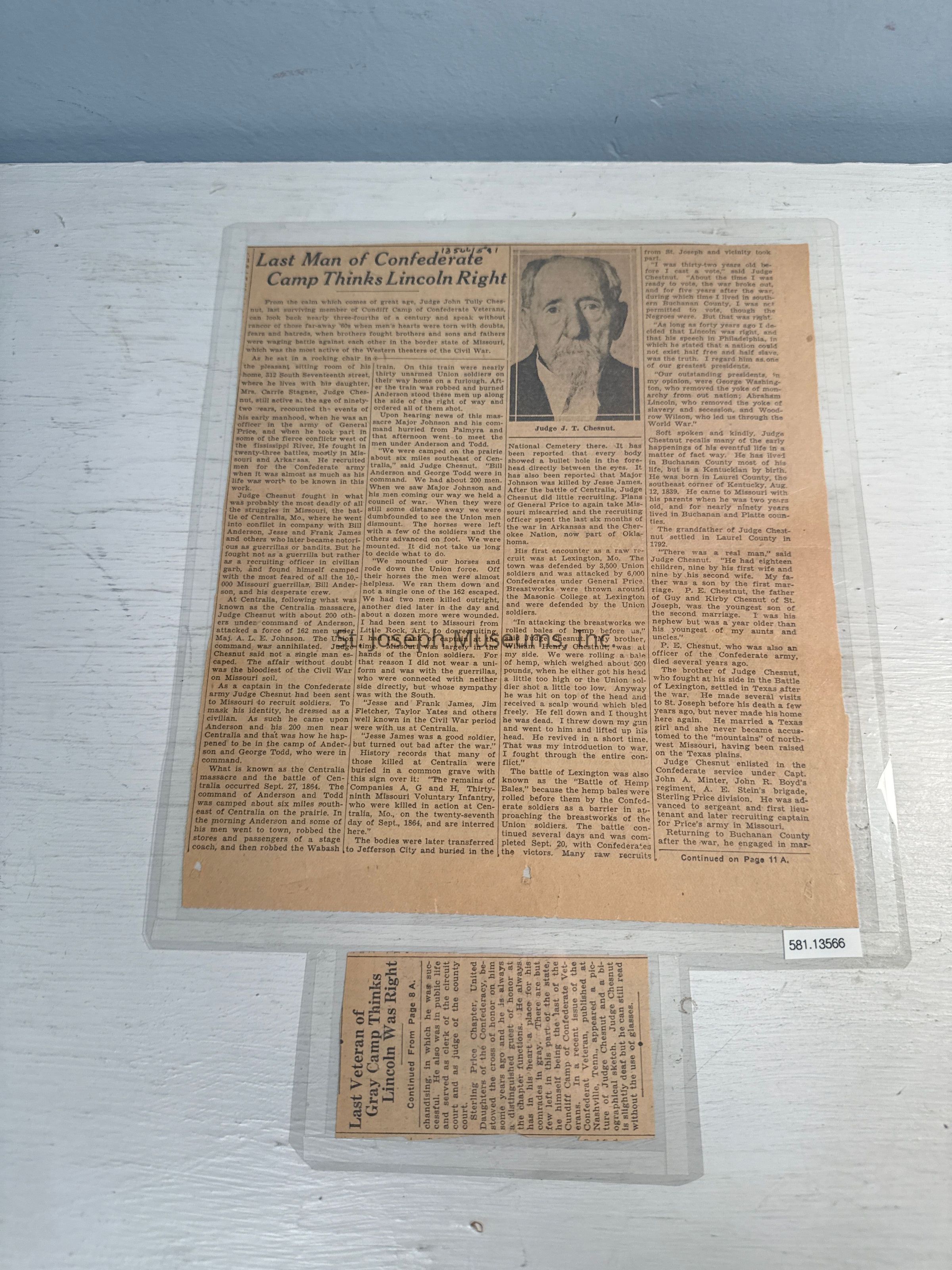
Chestnut, Judge J. T. Last Man of Confederate Camp Think's Lincoln Right, 1932. Judge John Tully Chesnut, last surviving member of Cundiff Camp of Confederate Veterans, can look back nearly three-fourths of a century and speak without rancor of those far-away '60 when men's hearts were torn with doubts, fear, and hatreds, when brothers fought, brothers and sons and fathers were waging battle against each other in the border state of Missouri, which was the most active of the Western theaters of the Civil War.
The Judge lives with his daughter, Mrs. Carrie Stagner.at 312 South seventeenth street in St. Joseph, MO. He is still active at the age of 92.
He recounted the events of his early manhood, when he was an officer in the army of General Price, and when he took part in some of fierce conflicts west of the Mississippi River. He fought in 23 battles, mostly in Missouri and Arkansas. he recruited men for the Confederate army when it was almost as much as his life was worth to be known in this work .
He fought in what was probably the most deadly of all the struggles in Missouri, the battle of Centralia, MO, where he went into conflict in company with Bill Anderson, Jesse and Frank James and others who later became notorious as guerrillas or bandits, But he fought not as a guerrilla but rather as a recruiting officer in civilian guard, and found himself camped with the most feared of all the 10,000 Missouri guerrillas, Bill Anderson and his desperate crew.
At Centralia, following what was known as the Centralia massacre, he with about 200 others under command of Anderson, attacked a force of 162 men under Maj. A. L. E. Johnson. The Union command was annihilated. Judge Chesnut said not a single man escaped. The affair without doubt was the bloodiest of the Civil War on Missouri soil..
As captain in the Confederate, he had been sent to Missouri to recruit soldiers. To mask his identity, he dressed as a civilian. As such he came upon Anderson and his 200 men near Centralia and that was how he happened to be in the camp of Anderson and George Todd, who were in command.
The battle known as the Centralia massacre and the battle of Centralia occurred September 27, 1864. The command of Anderson and Todd was camped about six miles southeast of Centralia on the prairie. In the morning Anderson and some of his men went to town, robbed the stores and passengers of a stage coach, and then robbed the Wabash train. On this train were 30 armed unarmed Union soldiers on their way home on a furlough. After the train was robbed and burned Anderson stood these men up along the side of the right of way and ordered all of them shot.
Upon hearing the news of this massacre Major Johnson and his command hurried from Palmyra and that afternoon went to meet the men under Anderson and Todd. They were camped on the prairie about six miles southeast of Centralia. Bill Anderson and George Todd were in command. They had about 200 men. When they saw Major Johnson and his men coming, they held a council of war. When they were still some distance away, they were dumfounded to see the Union men dismount. The horses were left with a few of the soldiers and the others advanced on foot. The Confederates mounted their horses and rode down the Union force. Off their horses, the men were almost helpless. The Confederates ran them down and not a single one of the 162 escaped. Two of the confederates were killed outright, another died later in the day and about a dozen more were wounded.
Judge J. T. Chesnut had been sent to Missouri from Little Rock, AK to do recruiting. He had the rank of captain at that time. Missouri was largely in the hands of the Union soldiers. For that reason he did not wear a uniform and was with the guerrilla, who were connected with neither side, but whose sympathy was with the South.
Jesse and Frank James, Jim Fletcher, Taylor Yates and others well known in the Civil War period were with him at Centralia.
History reports that many of those killed at Centralia were buried in a common grave with a sign over it that read "The remains of Companies A, G, and H, Thirtyninth Missouri Voluntary Infantry, who were killed in action at Centralia, MO., on the twenty-seventh day of Sept., 1864, and are interred here." The bodies were later transferred to Jefferson City and buried in the National Cemetery there.
It was reported that every body showed a bullet hole in the forehead directly between the eyes. It has also been reported that Major Johnson was killed by Jesse James. After the battle of Centralia, Judge Chesnut did little recruiting. Plans of General Price to again take Missouri miscarried and the recruiting officer spent the last six months of the war in Arkansas and the Cherokee Nation, now part of Oklahoma.
His first encounter as a raw recruit was at Lexington, MO. The town was defended by 3,500 Union soldiers and was attacked by 6,000 Confederates under General Price. Breastworks were thrown around the Masonic College at Lexington and were defended by the Union soldiers.
In attacking the breastworks, rolled bales of hemp were rolled before them. Judge Chesnut's brother, William Henry Chesnut was at his side. They were rolling a bale of hemp, which weighed about 500 pounds, when he either got his head a little too high or the Union soldier shot a little too low. He was hit on top of the head and received a scalp wound which bled freely. He fell down and I thought he was dead. He threw down his gun and went to him and lifted up his head. He revived in a short time. That was Judge Chesnut's introduction to war,. He fought through the entire conflict. The battle of Lexington was also known as the "Battle of Hemp Bales." The battle continued several days and was completed September 20, with Confederates the victor.
Judge Chesnut was thirty-two years old before he could cast a vote. About the time he was ready to vote, the war broke out, and for five years after the war during which time he lived in southern Buchanan County, He was not permitted vote, though the Negroes were.
As long as forty years ago he decided that Lincoln was right, and that his speech in Philadelphia, in which he stated that a nation could not exist half free and half slave. was the truth. He regarded him as one of our greatest presidents.
Judge Chesnut 's outstanding presidents were George Washington, who removed the yoke of monarchy from out nation; Abraham Lincoln, who removed the yoke of slavery and secession, and Woodrow Wilson, who led us through the World War."
Judge Chesnut was soft spoken and kind. He lived in Buchanan County most of his life, but is a Kentuckian by birth. He was born in Laurel County August 12, 1839. He came to Missouri with his parents when he was two years old, and for nearly ninety years lived in Buchanan and Platte counties. The grandfather settled in Laurel County in 1792. He had eighteen children, nine by his first wife and nine by his second wife. He father was the son by the first marriage. P. E. Chestnut, the father of Guy and Kirby Chesnut of St. Joseph,was the youngest son of the second marriage. Judge Chesnut was the nephew but was a year older than his youngest, of aunts and uncles. P. E. Chestnut, who was also an officer of the Confederate army, died several years ago.
The brother of Judge Chesnut, who fought at his side in the Battle of Lexington, settled in Texas after the war. He made several visits to St. Joseph before his death a few years ago, but never made his home here again. He married a Texas girl and she never became accustomed to the "mountains of northwest" Missouri, having been raised on the Texas plains.
Judge Chesnut enlisted in the Confederate service under Capt. John A. Minter, John R. Boyd's's regiment, S. E. Stein's brigade, Sterling Price division. He was advanced to sergeant and first lieutenant and later recruiting captain for Price's army in Missouri.
He returned to Buchanan County after the war, he engaged in merchandising, in which he was successful. He also was in public life and served as clerk of the circuit court and as judge of the county court.
Sterling Price Chapter, United Daughters of the Confederacy, bestowed the cross of honor on him some years ago and he is always a distinguished guest of honor at the chapter functions. He always has in his heart a place for his comrades in gray. There are but few left in this part of the state, he himself being the last of the Cundiff Camp of Confederate Veterans. In a recent issue of the Confederate Veteran, published at Nashville, TN. appeared a picture of Judge Chesnut and a biographical sketch. Judge Chesnut is slightly deaf but he can still read without the use of glassesLexicon
LOC Thesaurus for Graphic Materials
Civil wars, OutlawsSearch Terms
Anderson, Bloody Bill, Civil War Guerilla Battles, Civil War Battles in Missouri, Centralia Massacre, Battle of Lexington, Battle of Hemp Bales, Confederate Army, James, JesseRelationships
Related Person or Organization
Person or Organization
Bill AndersonPerson or Organization
John R. BoydPerson or Organization
Guy ChestnutPerson or Organization
Kirby ChesnutPerson or Organization
William Henry ChesnutPerson or Organization
Judge John Tully ChestnutPerson or Organization
Chestnut, P. E.Person or Organization
Jim FletcherPerson or Organization
Frank JamesPerson or Organization
Jesse JamesPerson or Organization
Johnson,Person or Organization
Maj. A. L. E. JohnsonPerson or Organization
Abraham LincolnPerson or Organization
Capt. John MinterPerson or Organization
Daughters of the Confederacy/Sterling Price Chapter #401Person or Organization
Carrie StagnerPerson or Organization
A. E. SteinPerson or Organization
George ToddPerson or Organization
Washington.,GeorgePerson or Organization
Wilson, WoodrowPerson or Organization
Taylor Yates