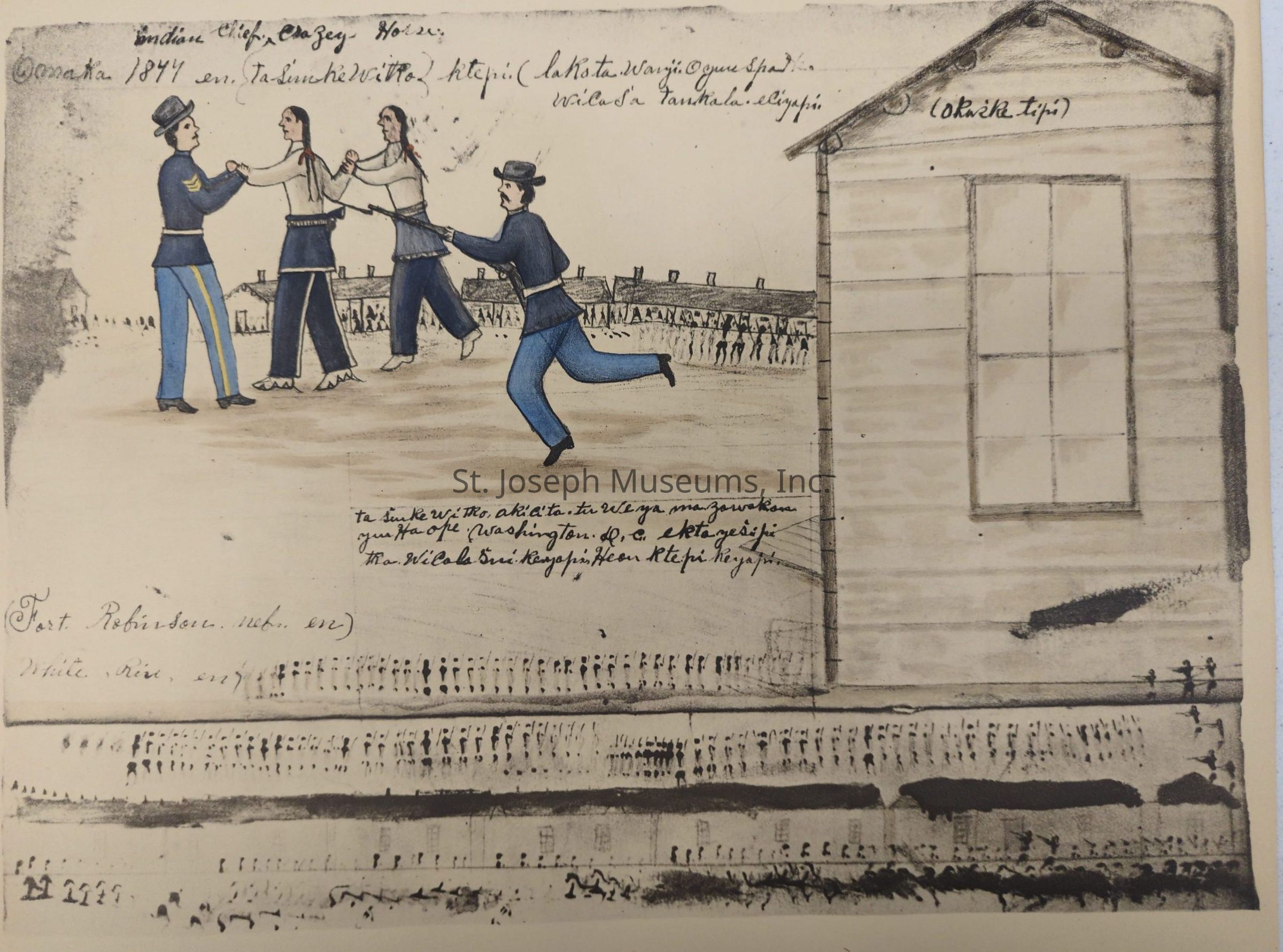
Crazy Horse's Death, Amos Bad Heart Buffalo, Sioux Indian Painting, Part II, Plate XVIII
Name/Title
Crazy Horse's Death, Amos Bad Heart Buffalo, Sioux Indian Painting, Part II, Plate XVIIIEntry/Object ID
575/13136B-18Scope and Content
Crazy Horse's Death, Amos Bad Heart Buffalo, Sioux Indian Painting, Part II, Plate XVIII. Drawing. The death of Crazy Horse. The scene is Fort Robison, Nebraska, in 1877. The fort is indicated by the buildings, crudely in perspective, and by the file of soldiers shown in miniature, schematic figures before the buildings in the distance and in two ranks above the foreground barracks which also are drawn in miniature. Horses and troopers are indicated at the bottom of the composition. The principle figures represent a sargeat and an Indian policeman holding Crazy Horse by the arms while a soldier (as the Indian tradition maintans) runs forward to bayonet him. Portfolio of Sioux Indian Painting, Part 2, The Art of Amos Bad Heart Buffalo, published by C. Szwedzicki, Nice, France, 1938. Limited Edition (400). No. 339. Introduction and notes by Hartley Burr Alexander. Signed by C. Szwedzicki & V. Grespin. Amos Bad Heart Buffalo is considered the most notable northern Indian artist whose work is known. He is the son of an Oglala warrior who fought in the Battle of Little Big Horn, along with his brother, He Dog. They are often subjects of Amos's work, Amos was born in 1869 and died in 1913. The prints are enlargements of Amos's orginial drawings. Cover: "Going to the Warriors's Dance" Part. 1 contains Plates I-XXV. Painters of Part 1 are Sioux, Mandan, Shoshone, and Kiowa. On cover of Portfolio--Sioux Warriors on horseback, by Kills Two (Nupa Kie), Oglala Sioux.Collection
W. Webb WheelerLexicon
LOC Thesaurus for Graphic Materials
ArtSearch Terms
Sioux Art, Oglala Sioux Art, Battle of Little Big Horn, Death of Crazy Horse, Native American, Native American Art, Sioux, Oglala Sioux, Custer, George, Crazy HorseLegacy Lexicon
Object Name
Print, ArtEthnography
Culture/Tribe
Oceti Sakowin
Native American